

Rain Wu's new work begins with salt from the sabkhas, the land the sea left behind. Ahead of The Territory Dreams Back at NIKA Project Space, the artist talks to Author about Taoist cycles, alchemy, her grandfather's illegal salt, and the much older sea we all carry in our blood.
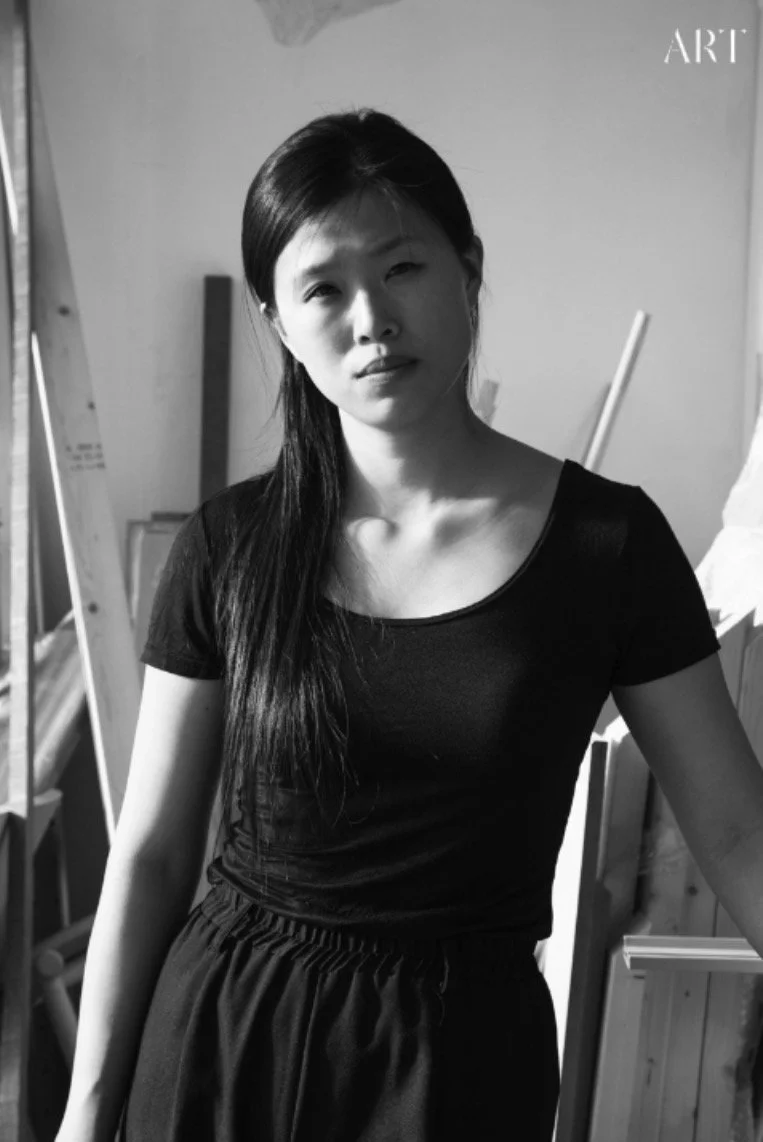
picture by Rain Wun
Rain Wu is an artist from Tainan, Taiwan, who trained as an architect and moved to London. Her concept-driven practice works with salt, mycelium, scoby cellulose, oyster shells and food to explore time and transformation. The Territory Dreams Back is at NIKA Project Space, Al Quoz, Dubai, until 15 January.
Rain Wu's grandfather used to carry seawater up from the coast near Tainan and boil it in secret, with dried twigs hidden under his bed to feed the fire. Salt was a monopoly, and making your own was against the law. Wu learnt this from her father only after she had started making seawater paintings of her own. She had, without knowing it, picked up a family habit, and an older human one: the same quiet act of defiance that took Gandhi to the beach at Dandi.
Trained as an architect, Wu left buildings for materials that refuse to stay still: salt, mycelium, scoby cellulose, oyster shells and, increasingly, food. Architecture, as she points out, seeks permanence, but in geological time every building material is perishable. For The Territory Dreams Back, a group show at NIKA Project Space in Dubai's Al Quoz, she has made a new series of seawater paintings with one change. The salt comes not from the ocean but from the sabkhas, the coastal salt flats of the Emirates. Beside them sits Agloe, named after a town that existed only as a copyright trap on a map until a shop made it real, and cast from the surfaces of the streets around the gallery. At the opening she gives a new lecture-performance, Salt as Cosmogram, served with dishes she describes as narrative capsules.
Our questions circled a single material. Her answers move between Taoism, Paracelsus, Genesis and the six-million-year-old salt mountain at Petralia in Sicily, and keep returning to one idea. Salt, for Wu, is both a structure and a solution: strong enough to hold up the ceilings of mines, and gone the moment it meets water.
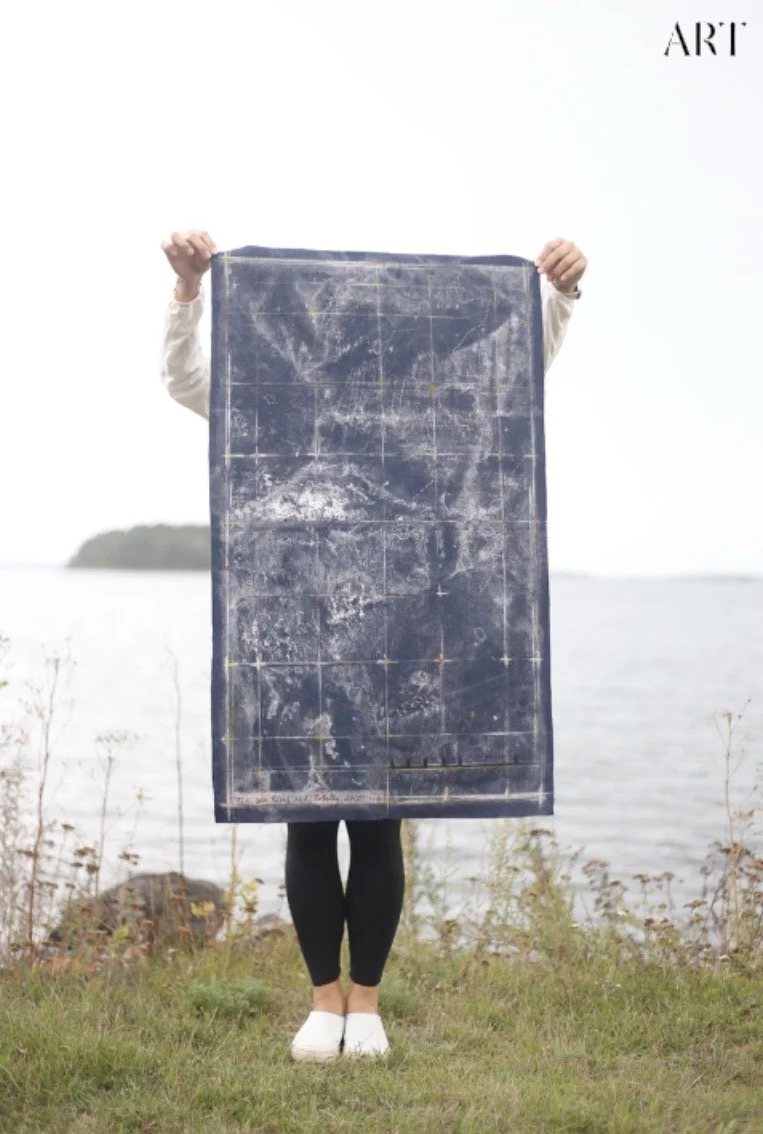
The Sea Rises and Totally Still III. Menorca Residency. 2020. Salt on cotton. 66x55cm.
Oona Chanel: This work doesn't exist yet. We'll be in print before it's finished, so we're writing about something that isn't there. Tell me what it is today, and what it's trying to become.
Rain Wu: The show The Territory Dreams Back at NIKA Project Space in Dubai invited artists to contribute different perspectives on land use and its authority. My works come in through my long-term interest in questioning what a map does, in a set of seawater paintings and a site-specific sculptural installation.
The Sea Rises and Totally Still investigates cartography as a cultural construct, moulded by human longing and vision as much as by physical topography. By charting speculative lands, the work treats cartography as a generative act, one that constructs realities instead of merely recording them. Usually my "seawater paintings" use seawater taken directly from the ocean. But here the salt comes from the local sabkhas, from the land the sea left behind.
Beside the paintings sits Agloe, made from casts of the surfaces around NIKA. The two works sit in juxtaposition to each other: one appears visually as maps and places but is entirely fictional, even accidental; the other takes an evidential approach to map-making, bringing in the area of Al Quoz as a sensorial but non-scalar map.
And at the opening, I will give a new lecture-performance, Salt as Cosmogram, looking at salt as another form of mapping. If cartography maps the surface of the world, cosmograms create the mental axis of the universe. The performance looks at salt's symbolic and cultural history, coupled with dishes made specifically as narrative capsules for looking at salt as a rock, a body, a talisman and an expression.
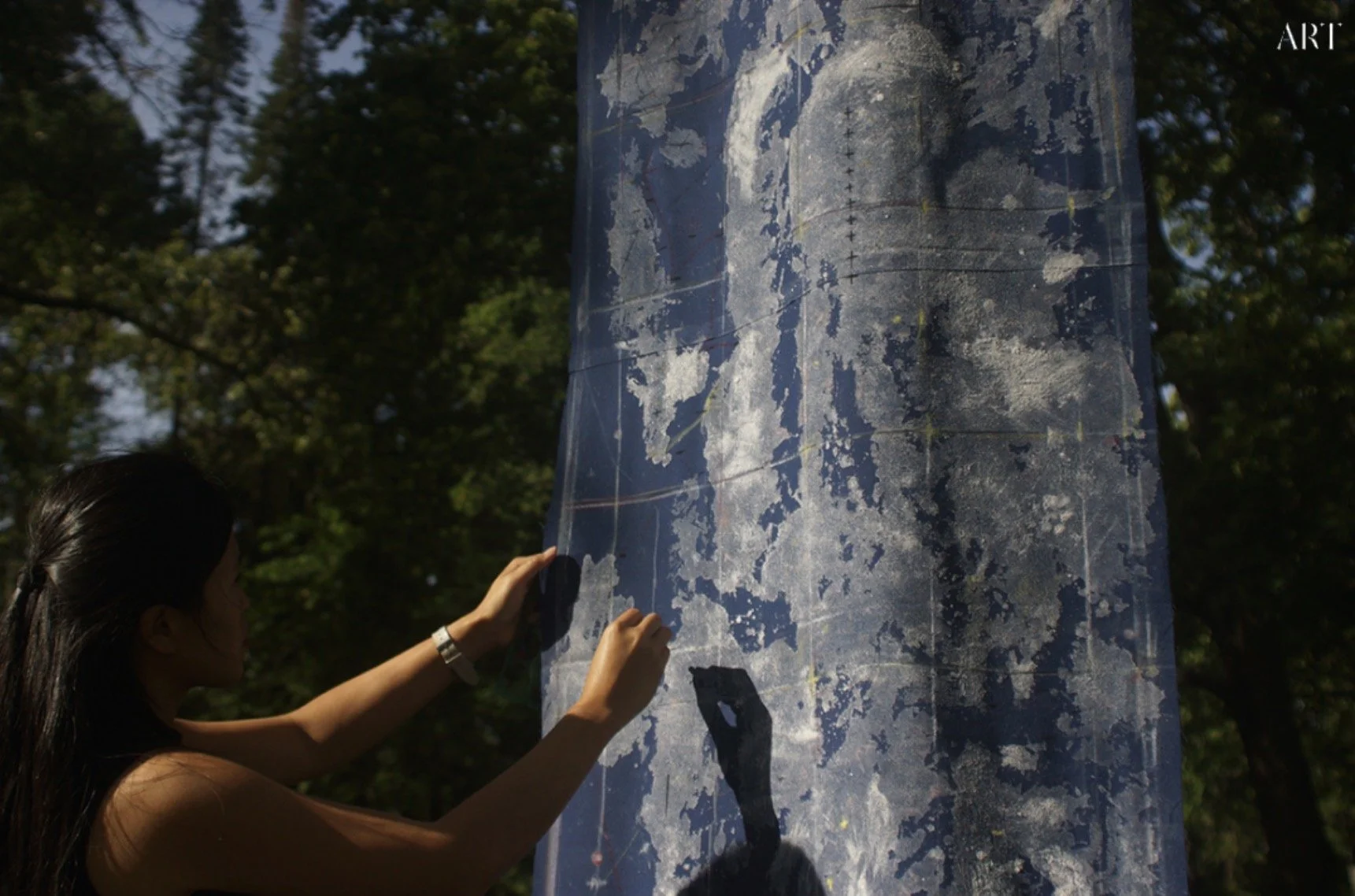
The Sea Rises and Totally Still III. Menorca Residency. 2020. Salt on cotton. 66x55cm.
O.C. Rain is the one water that holds no salt. When the sun lifts the sea into the sky, the salt stays behind. You carry the name of what's left when salt is taken away. Is your work a way back to what your name leaves out?
R.W. In the Taoist philosophy I grew up with, the cloud was the river and will be the rain tomorrow. The sea, the cloud and the salt are one cycle, so my name is only another point on the same loop.
O.C. Salt is what's left when the sea goes. Is this work about something present, or about the evidence that something has gone?
R.W. Neither. It's about a way of experiencing different geological times at once. In the Palaeozoic era, when vertebrates first came out of the water and formed life on land, the sea was about a third as salty as it is now. That lighter salinity is still what we carry in our blood, our amniotic fluid, our sweat, our tears. Through the lens of salt, we are living in the present while carrying a much older sea inside us.
O.C. When salt dissolves it doesn't disappear. It becomes invisible and stays. Is there something in your own life that behaves like that?
R.W. I had a syncretic Buddhist-Taoist upbringing, in which the ideas of karma, reincarnation and the transformation of things were built into my understanding of the world. Practices of offering, with food placed for ancestors, gods and spirits, shaped my early sense of a world that is relational and animated beyond rational explanation. Scientifically, the law of conservation of mass also tells us that materials are only rearranged and do not escape a closed system. My practice is concept-driven. It combines these thoughts, looks for the potential of what an everyday, profane material could be, and searches for the interconnection of microcosm and macrocosm meeting in my work.
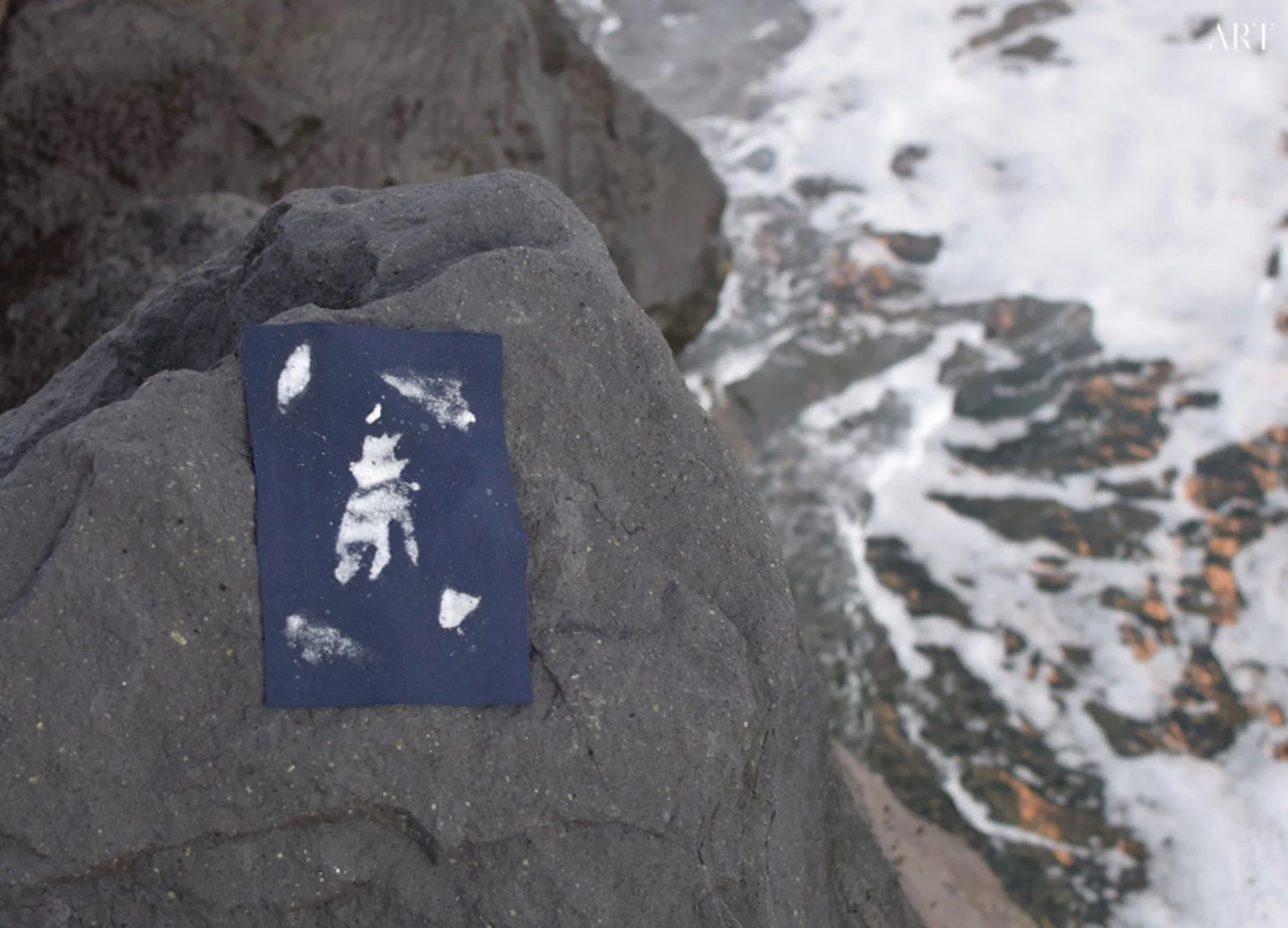
The Sea Rises and Totally Still III. Menorca Residency. 2020. Salt on cotton. 66x55cm.
O.C. In Genesis, Lot's wife looks back at the city she's leaving and turns into a pillar of salt. You moved from Tainan to London, and from buildings to food. Is salt, for you, the material of looking back?
R.W. Having lived more than half of my life away from home, I'm glad my home city, Tainan, has not been condemned by God like Sodom was for Lot. I often look back for inspiration and connection. When I first made the seawater paintings, I learnt from my father that my grandfather used to do the same. He would carry seawater up from the coast and hide dried twigs under the bed so he could boil it. Interestingly, it was illegal, as there was a salt monopoly. I later read that Gandhi led the anti-colonial movement in India on a march to Dandi beach to collect salt, also illegally under the British colonial government, which sent him to jail, where he famously spun cotton. I like that I'm retracing not only my grandfather's steps but an ancient action shared by many cultures and common to all humans.
O.C. Paracelsus divided all matter into three principles: sulphur for the soul, mercury for the spirit, and salt for the body, the part that stays fixed. Your practice is built on change. Why work with the one element alchemy kept for permanence?
R.W. For alchemists, material changes served as metaphors for spiritual purification and the improvement of the soul. What might be read literally as turning base metal into gold is fundamentally an aspiration towards spiritual transformation. In this view, sulphur, mercury and salt are deeply interconnected and inseparable. I like to begin with salt, the most physical and abundant element, and trace its path towards the immaterial and ineffable.
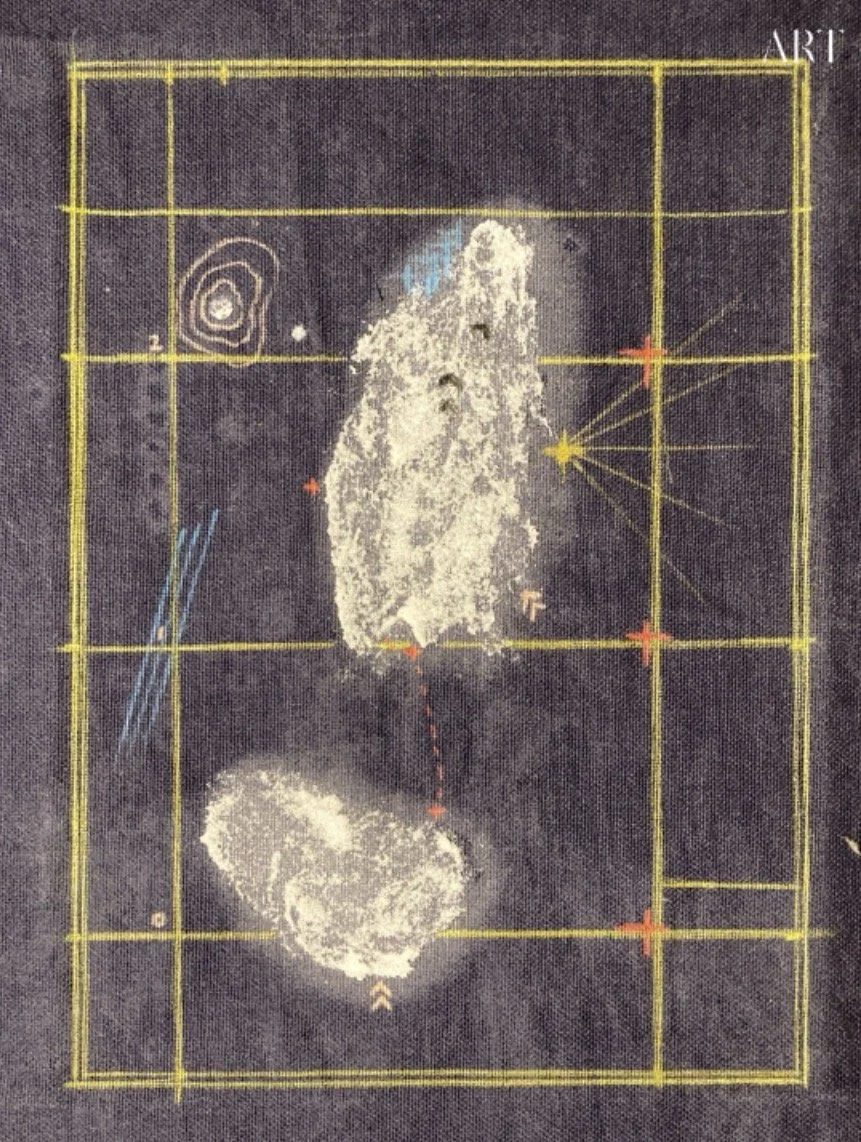
The Sea Rises and Totally Still III.2020. Salt on cotton. 66x55cm.
O.C. Salt grows as cubes. It's one of the few places nature arrives at a right angle on its own. You were trained as an architect to draw right angles. When you look at a salt crystal, do you feel recognised or corrected?
R.W. In its dry, concentrated form, salt is so strong that pillars of it hold up the ceilings of mines thousands of feet underground. Add water and it dissolves into a clear, colourless liquid, the main solute of every ocean. What interests me most is that salt is both a structure and a solution!
O.C. Salt is how people first stopped time. It halts decay. Yet you insist that your works decay. Which are you really working with: preservation, or permission to rot?
R.W. It's all about perspective on time. The foundation of my creative practice lies in a long-standing curiosity about time and its material scales. Architecture seeks permanence, yet in geological or cosmological time every building material is perishable: stone becomes sediment, soil turns fertile, matter continuously transforms. This tension has led me to work with materials that foreground transformation, such as salt, mycelium, scoby cellulose and oyster shells. Increasingly, food has become both my primary material and my conceptual lens.
A piece of architecture might last 2,000 years, which is very long against a human life of about 80. But in a salt mountain like the one in Petralia, Sicily, which I visited in the summer, the salt was formed six million years ago.
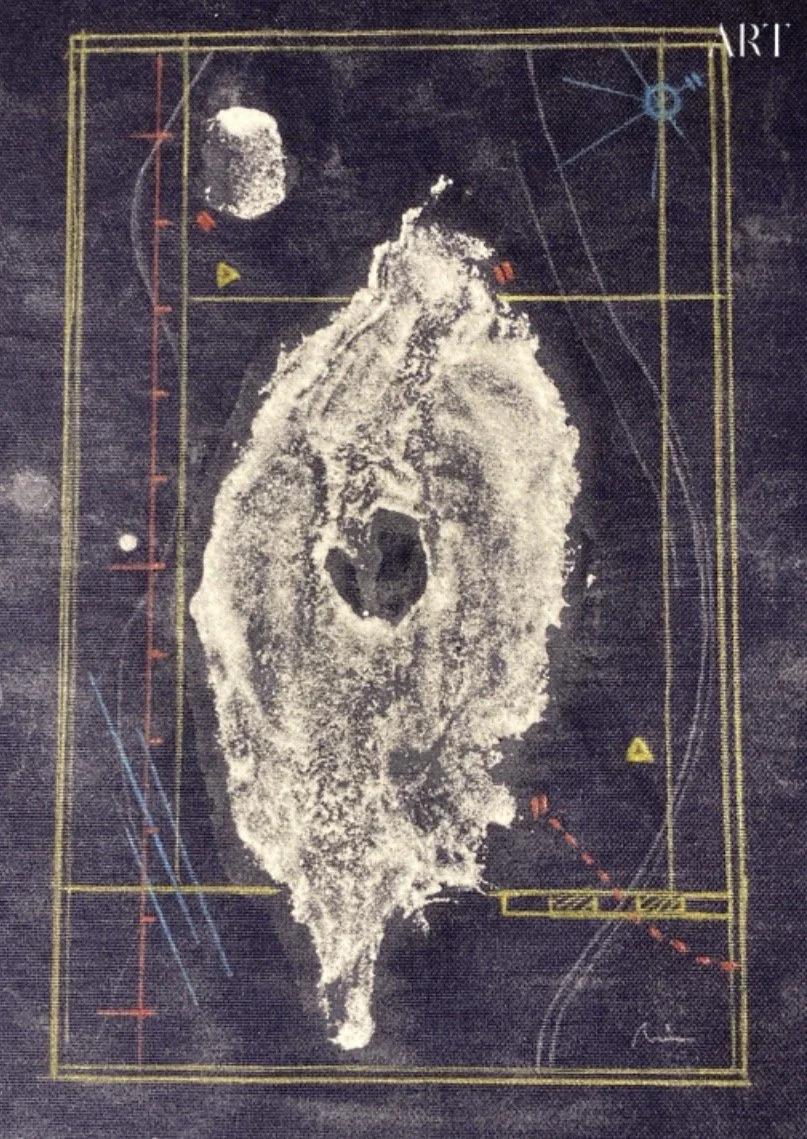
The Sea Rises and Totally Still III.2020. Salt on cotton. 66x55cm.
O.C. A painting can be owned. A dish can only be eaten. Once someone has eaten the work, where is it, and is it still yours?
R.W. It is, as it should be, on the road of transformation from one thing to another.
Annemarie Mol wrote that "the world moves through us when we eat". I approach food as a medium through which bodies, environments and belief systems intersect.
O.C. You've written that the cloud was the river and will be the rain tomorrow. If everything is passing through, is a gallery, or a fair booth for a few days, a container for your work, or only the place where it stands still for a moment?
R.W. The show holds a conversation between the dreamings of different artists who are also looking at the land, its origins, politics and myths. A precious ichi-go ichi-e moment.
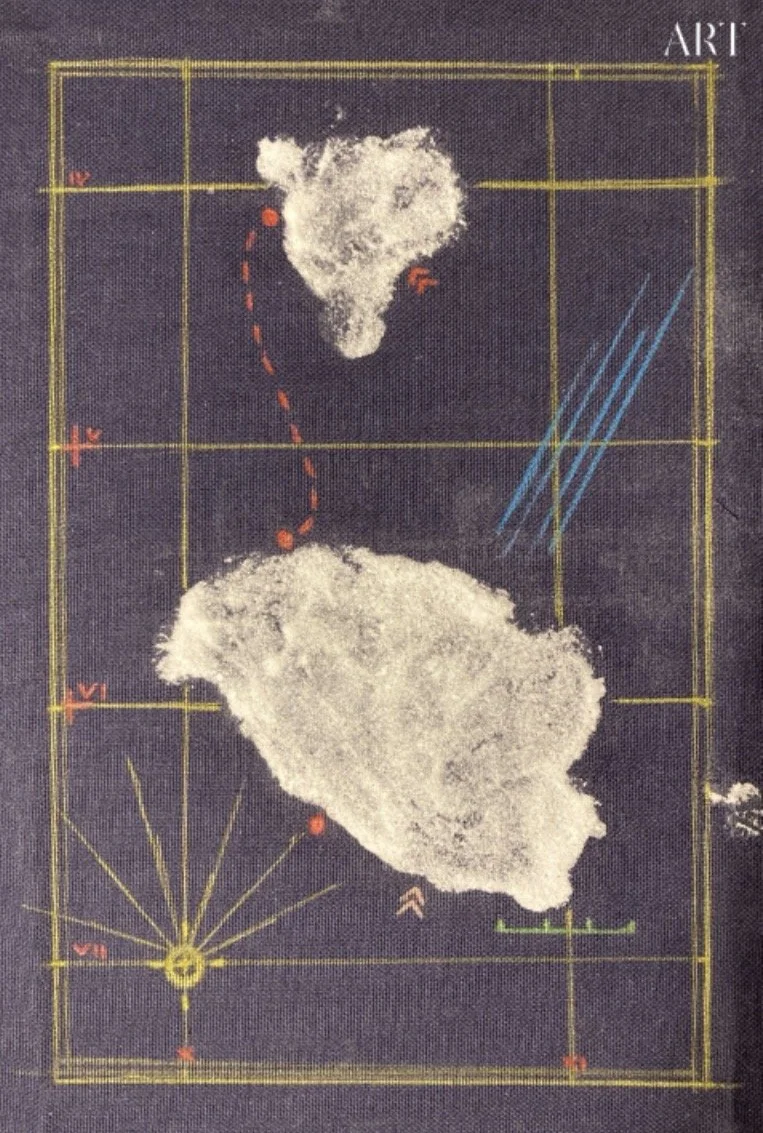
The Sea Rises and Totally Still III.2020. Salt on cotton. 66x55cm.
O.C. In Japan, small cones of salt are set at the doors of houses and restaurants to keep out what can't be seen. What is this installation guarding against?
R.W. This series, The Sea Rises and Totally Still, was made here in Dubai with salt from the sabkhas. Sabkhas cover around 5% of the UAE, and they are carbon sinks that work their ecological magic. The work should hold that thought!
O.C. The show closes on 15 January. Say you could leave one grain of this work somewhere in Dubai where no one would ever find it. Where would you put it?
R.W. Back in the desert, on the sabkha, where the salt came from, to start the cycle again.
BY OONA CHANEL
