

The founder of Iris Projects talks to Author about the true cost of a fair, the collectors buying Emirati art, the place of a private gallery in a state-built scene, and what it will take to build lasting careers for artists in the UAE.
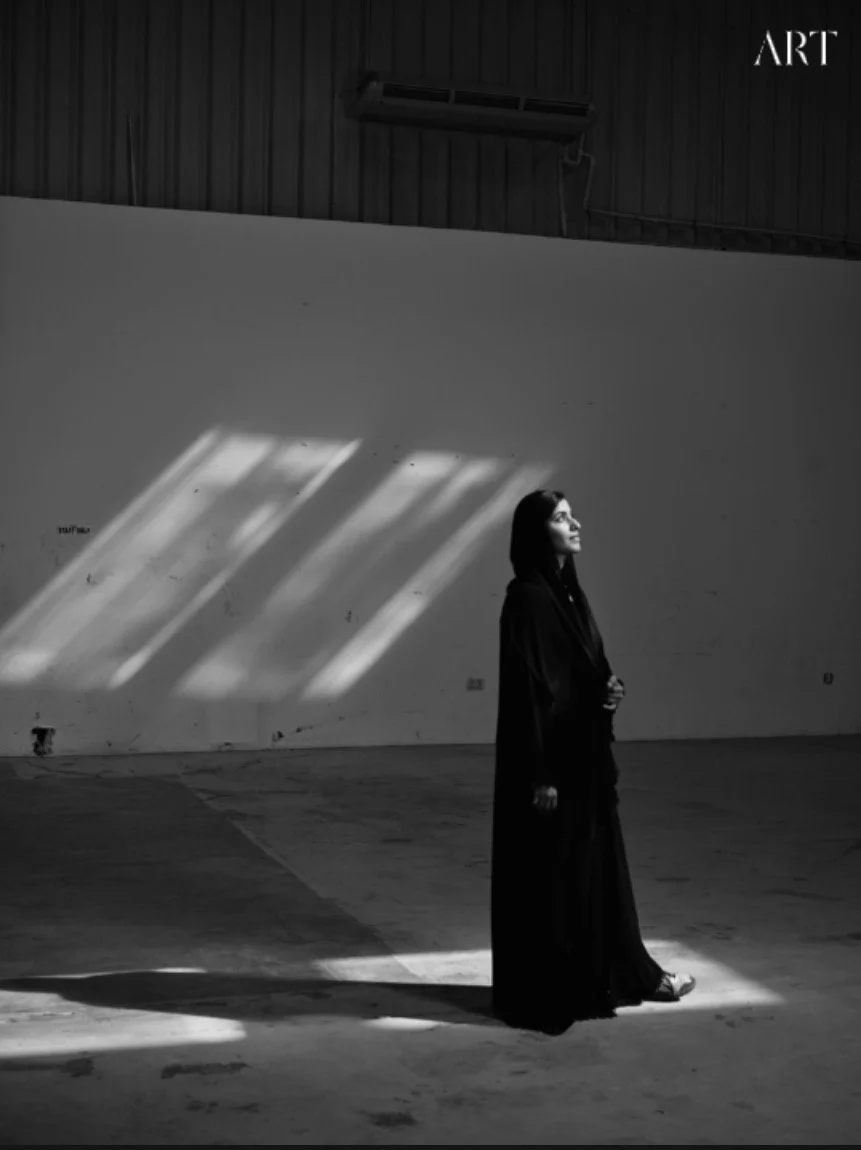
Picture by Maryam Al Falasi
In Abu Dhabi, culture has largely been built by the state: the museums, the public commissions, the national collections. Private galleries work in the narrow space between that patronage and the international market, carrying their own risk, and very few of them have been founded by Emiratis. Iris Projects is one. Maryam Al Falasi started it in 2020, at first as a digital platform, and this week it takes its place in the main section of Frieze Abu Dhabi.
Ask most gallerists about money and the conversation drifts, politely, towards vision. Al Falasi answers the question line by line, then explains why a fair is never judged only by what sells that week.
She is precise about where a gallery like hers belongs. Not a supplier to the institutions, and not a counterweight to them: "We should be collaborators, but we are independent in our judgement." She thinks of representation as stewardship, a responsibility for the conditions in which an artist's work can grow, and she counts it as a success, not a loss, when one of her artists outgrows the city. Juma Al Haj, whose work fronts this edition, has just moved to Paris for his MFA.
What follows is a conversation about how the scene here actually works: who pays for it, who buys from it, what artists and galleries owe one another, and who is allowed to say a show has failed. She answers every question in full, and without hedging.
Oona Chanel: Iris is one of five UAE galleries in the main section at Frieze Abu Dhabi. It is the youngest of them, and one of very few founded by an Emirati. Is that a distinction, or a responsibility you didn't ask for? And what did Iris have to prove to get in that an older gallery would not have had to?
Maryam Al Falasi: I think it is both. Being one of the youngest galleries, and also one of very few founded by an Emirati, or even a Khaleeji, comes with a responsibility that I take seriously.
I see that responsibility as supporting artists to develop and present their work on their own terms, while broadening how art from the UAE and wider Gulf is understood here and internationally.
I started Iris Projects in 2020, initially as a digital platform, because I felt there was an opportunity to contribute something meaningful to the cultural landscape of Abu Dhabi. The ambition was never simply to open a gallery; it was to build something that would support artists and play an active role in the city's developing art scene.
What Iris Projects had to prove was that being young did not mean being inexperienced in our thinking or limited in our ambition. We had to demonstrate a clear vision, and a serious and considered programme.
I don't think an older gallery necessarily has to prove less, but an emerging gallery has less institutional history. You have to build credibility through every decision you make, every artist you represent, and every relationship you establish.
O.C. Walk me through the real arithmetic of the booth: what it costs, who carries that cost, and what has to sell for the week to make sense. Is Frieze a sales event for Iris, or an investment in being seen?
M.A.F. There is a romantic perception of art fairs, but the reality is that they are substantial financial commitments.
There is the participation fee, production, shipping, insurance, travel, accommodation, installation, staffing, hospitality and all the preparation that happens months before the fair opens. And then there is the opportunity cost of taking your team away from the gallery.
For an independent gallery, you are carrying that risk yourself. There isn't necessarily a large institutional structure behind you absorbing the costs.
The maths has to make sense. We look at the total investment, the value of the works presented, the commission structure, and the level of sales required to recover the expenditure. That said, we don't judge every fair solely on what sells that week.
Frieze Abu Dhabi, for example, is both a commercial opportunity and a long-term investment in visibility. You are meeting collectors who may acquire from you six months later, and curators who may bring your artists into institutional conversations over many years.
Of course, I want to sell. A gallery has salaries, rent, and an entire operation to sustain. But I also want the right people to discover our artists.
O.C. In this country the state is the biggest patron. It builds the museums, commissions the public art and buys the work. Where does a private gallery fit into that? Are you a partner to the institutions, a supplier to them, or a counterweight?
M.A.F. I don't see the private gallery and the state as competing forces. I see them as different parts of a cultural ecosystem that need one another.
The UAE has been fortunate to have a government that understands culture as a long-term investment. Its institutions, museums, cultural foundations, public commissions and universities teaching art history and fine art have created opportunities that many other markets are still trying to establish.
But institutions and private galleries have different responsibilities. A museum has a particular institutional mandate. A private gallery can often work more closely and more continuously with artists, take risks on emerging practices, introduce new voices, and develop relationships with collectors before an artist's work enters an institutional collection.
We can identify artists early, invest in their development, build a market around their practice and create the conditions for their work to be acquired.
I don't want Iris Projects to be seen simply as a supplier to institutions. Nor do I see us as a counterweight. We should be collaborators, but we are independent in our judgement.
A healthy cultural ecosystem cannot rely on one patron or one institution. It needs private collectors, galleries, foundations, museums, critics and writers and, of course, an audience.
O.C. Who actually buys Emirati contemporary art today? Give me an honest portrait of your collectors: where they're from, how old they are, and what share are Emirati. And why don't more Emiratis collect the artists of their own generation?
M.A.F. I think the collector landscape is much more diverse than people sometimes assume.
Of course, we have Emirati collectors who are actively supporting our programme and the artists we represent. But we also have a very international collector base: Europeans, Asians, Middle Easterners, Americans, and, importantly, international collectors who have now made Abu Dhabi their home.
We also have a real mix of ages: we have collectors from my own generation, including Gen Z, to people in their mid-40s and 50s, all the way to collectors in their 80s. Emirati collectors in their thirties are buying artists of their own generation rather than waiting for those artists to become established internationally.
We are also seeing institutions, both local and international, beginning to acquire Emirati art. This is an important development, and one we hope will continue to grow. Institutional acquisitions give artists another level of visibility and recognition and, importantly, a place within the historical record.
I think we are witnessing the development of a more mature collecting culture in the UAE. There is still room for it to grow, particularly in terms of encouraging more people to see collecting as an active way of participating in and contributing to our cultural landscape.
O.C. You pair every artist with a mentor. Here, artists move between government commissions, private patrons and galleries, often all at once. In practice, what does representation mean in the UAE? What does an artist owe a gallery, and what does a gallery owe the artist?
M.A.F. At Iris Projects, representation is not simply about selling an artist's work. It is about building a long-term relationship with them, and investing in the development of their practice.
We pair our artists with mentors because I believe artistic development should extend beyond the immediate production of work. Artists need critical dialogue, exposure to different perspectives, professional guidance, and opportunities to understand how their practices can evolve.
What does an artist owe a gallery? I don't think it should be framed as an obligation of loyalty at the expense of their independence. There has to be mutual trust, transparency and a clear understanding of what each side expects from the relationship.
And what does a gallery owe an artist? A great deal. We owe them advocacy, commitment, professional representation, thoughtful pricing, strategic opportunities, and consistency. We have to think beyond the next exhibition or the next sale.
I often think of representation as stewardship. You are taking responsibility for helping build the conditions in which an artist's practice can grow, without attempting to control what that practice becomes.
O.C. Juma Al Haj is moving to Paris. When an artist you represent leaves to grow abroad, is that the gallery's success or its loss? Can Emirati art fully mature without its artists leaving?
M.A.F. I think it is a success when an artist reaches a point where their practice needs to expand beyond the environment in which it began.
I have always believed that our responsibility is to create opportunities for artists, not to limit them geographically. If an artist needs to move to Paris, London or Tokyo to challenge themselves or develop their thinking, then that should be encouraged.
There is an important distinction between leaving to access opportunities and leaving because those opportunities do not exist at home. For Juma, he has moved to Paris for his MFA studies, and I'm very much looking forward to seeing how this will benefit his practice.
O.C. The Gulf has more fairs than critics. Who in this region is allowed to say a show is bad? Has anyone ever told you Iris Projects got something wrong, and were they right?
M.A.F. I think this is an important conversation to be having.
A cultural ecosystem needs criticism, disagreement and intellectual rigour. If every exhibition is celebrated, every artist is described as exceptional, and every initiative is considered successful, we eventually lose the ability to distinguish between what is genuinely significant and what is simply being promoted.
We need independent critics, researchers, curators, writers, and collectors who feel comfortable forming opinions without worrying about whether those opinions are convenient. And that applies to Iris Projects too. We should not be exempt from criticism because we are an independent gallery or because we are contributing to a developing cultural scene.
I would rather someone challenge an exhibition with a well-founded argument than offer praise without substance.
O.C. You are building an archive of your grandfather and his support for culture. What did that generation understand about culture in this country that today, with all its money and all its museums, risks forgetting?
M.A.F. This is a very personal project for me. I have always believed that archiving is important, particularly when it comes to preserving our own histories and the contributions of the generations who came before us. For me, this is also a way of giving back and contributing to my grandfather's legacy, ensuring that his role and the initiatives he supported are documented and preserved for future generations.
My grandfather was among those who supported the early social and cultural movements in the country by supporting theatre shows and local bands, as well as founding a social club. I believe that he helped create spaces for people to come together and exchange ideas.
I actually think the essence of what that generation understood about culture remains very much the same today. Culture, particularly our own, is so deeply embedded in our everyday lives that it is difficult to separate it from who we are. It lives in our traditions, our social practices, our language, our gatherings and the way we relate to one another.
O.C. Fast-forward ten years to the tenth edition of Frieze Abu Dhabi. What has to be true by then for you to call this decade a success for Emirati art? And what are you afraid will happen instead?
M.A.F. In ten years, I would like Emirati artists to have lasting international careers and be represented in significant museum collections, without international recognition becoming the only measure of success.
Success would also mean a stronger market at home: more Emiratis collecting and independent galleries able to grow, so artists can build sustainable careers here.
My concern is that we mistake expansion for development. More museums and fairs are positive, but numbers alone do not create a lasting art scene. We also need critical writing and research, as well as collectors who support artists over time.
I believe that success should be measured by whether the artists and institutions based here are stronger in ten years than they are today. I want us to be able to say that we helped shape the UAE's cultural scene, rather than simply growing alongside it. Maryam Al Falasi is the founder of Iris Projects, a contemporary art gallery in Abu Dhabi that she launched in 2020, first as a digital platform. Iris Projects represents artists including Juma Al Haj, and shows in the main section of Frieze Abu Dhabi at Manarat Al Saadiyat, 19–22 November.
BY OONA CHANEL
