

Baghdad-born and Helsinki-based, Adel Abidin brings two new ink drawings of a world after oil to NIKA Project Space at Frieze Abu Dhabi. He talks to Author about two kinds of darkness, the Standard of Ur, the Zanj Rebellion, and the secret shape he hides in every work.
Adel Abidin (b. 1973, Baghdad) is an Iraqi-Finnish artist based in Helsinki. He holds a BA in painting from the Academy of Fine Arts in Baghdad and an MFA from the Academy of Fine Arts in Helsinki. He represented Finland at the 52nd Venice Biennale in 2007, received the Finland Prize for Visual Arts in 2015 and won the Ithra Art Prize in 2023. His new drawings from Petroleum Afterlife are shown by NIKA Project Space at Frieze Abu Dhabi.
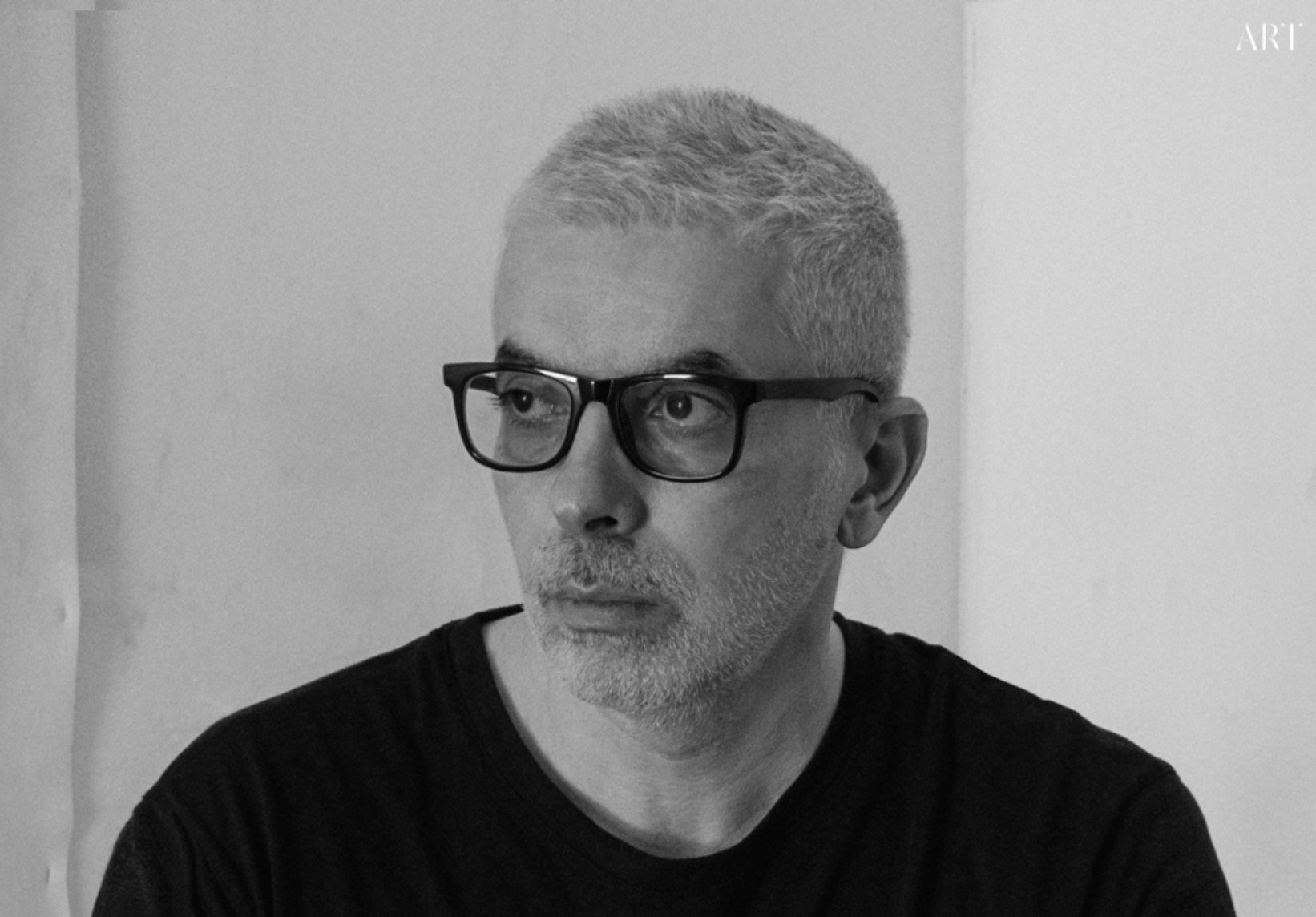
Picture by Adel abidin
Adel Abidin has a habit of hiding a shape somewhere in his work, so faint it is almost impossible to find. He likes to imagine someone spotting it years from now, long after he has gone, and wondering whether it was ever really there. It is a fitting secret for an artist whose subject is what remains: of empires, of rebellions, of the oil age, of us.
Born in Baghdad in 1973, Abidin trained as a painter at the city's Academy of Fine Arts and moved to Helsinki in 2000 for his MFA. He has stayed ever since, long enough to have spent almost as many years in Finland as in Iraq. He represented Finland at the Venice Biennale in 2007, won the Finland Prize for Visual Arts in 2015 and, in 2023, the Ithra Art Prize for ON, a wall built from thousands of stamped impressions of a single Arabic word. His work has always been funny in the way the best political art is funny: deadpan, exact, and slightly unbearable.
For NIKA Project Space's booth at Frieze Abu Dhabi he brings Document 5 and Document 6, two ink drawings from Petroleum Afterlife, a series that imagines the planet once people have left the stage and only the consequences of oil remain. He builds them line by line until the lines disappear, painting, as he puts it, with a pen. Showing them at a fair, where everything ends with a price tag, does not escape him. "Perhaps the entire work is a receipt," he says. The trouble is that it "might arrive long after the customer has disappeared."
Our questions wandered from the Standard of Ur to the Kalevala, from the marshes of southern Iraq to the Finnish sauna. His answers kept turning them around to look at the other side. Here is the conversation in full.
Oona Chanel: You are making a new work for NIKA's booth at Frieze Abu Dhabi. Describe it to me as if I will never see it. Then tell me the one thing in it that no buyer will ever notice.
Adel Abidin: The two ink drawings I am presenting at Frieze Abu Dhabi belong to an ongoing series of drawings and paintings titled Petroleum Afterlife. The project takes some of the ideas I explored in What Remains further, imagining a world where humans are no longer present, or at least no longer the main characters, yet the consequences of their existence remain everywhere.
Petroleum existed millions of years before us, but in a relatively short period of human history, it has transformed almost everything: our cities, economies, politics, wars, and even our understanding of progress. I find it fascinating that something buried beneath the earth for so long could become so central to human civilisation. And what happens when that relationship ends? What will remain of everything we built around it?
The drawings, Document 5 and Document 6, imagine that possible afterlife. They depict unfamiliar landscapes, fragmented structures, and objects that seem to have once served a purpose, although that purpose is no longer clear. I think of them as documents of my research into a world that doesn't exist, at least not yet. I enjoy the contradiction of presenting something entirely imagined as evidence of something that has already happened.
There is also something important about how I approach drawing. When I work with an ink pen, I am not simply trying to make something that looks like a drawing. In many ways, I am trying to create a painting using the pen. I build depth, atmosphere, and tonal richness through the density of lines and the spaces between them. It is a slow process, but I enjoy that intimacy with the surface. Eventually, the individual lines begin to disappear, and something else emerges.
As for what might go unnoticed, I have a habit of hiding a shape somewhere in my works. Sometimes it is extremely difficult to recognise, almost impossible. I like imagining someone discovering it years from now, perhaps long after I am gone, and wondering whether it was intentional or simply their imagination. It's a little secret I leave for someone I will probably never meet.
I don't necessarily see these drawings as images of destruction. I am interested in the possibility of a world continuing without us. We humans have this extraordinary confidence that everything revolves around our existence. But what if we are simply one chapter in a much longer story? And perhaps not even the most interesting one.
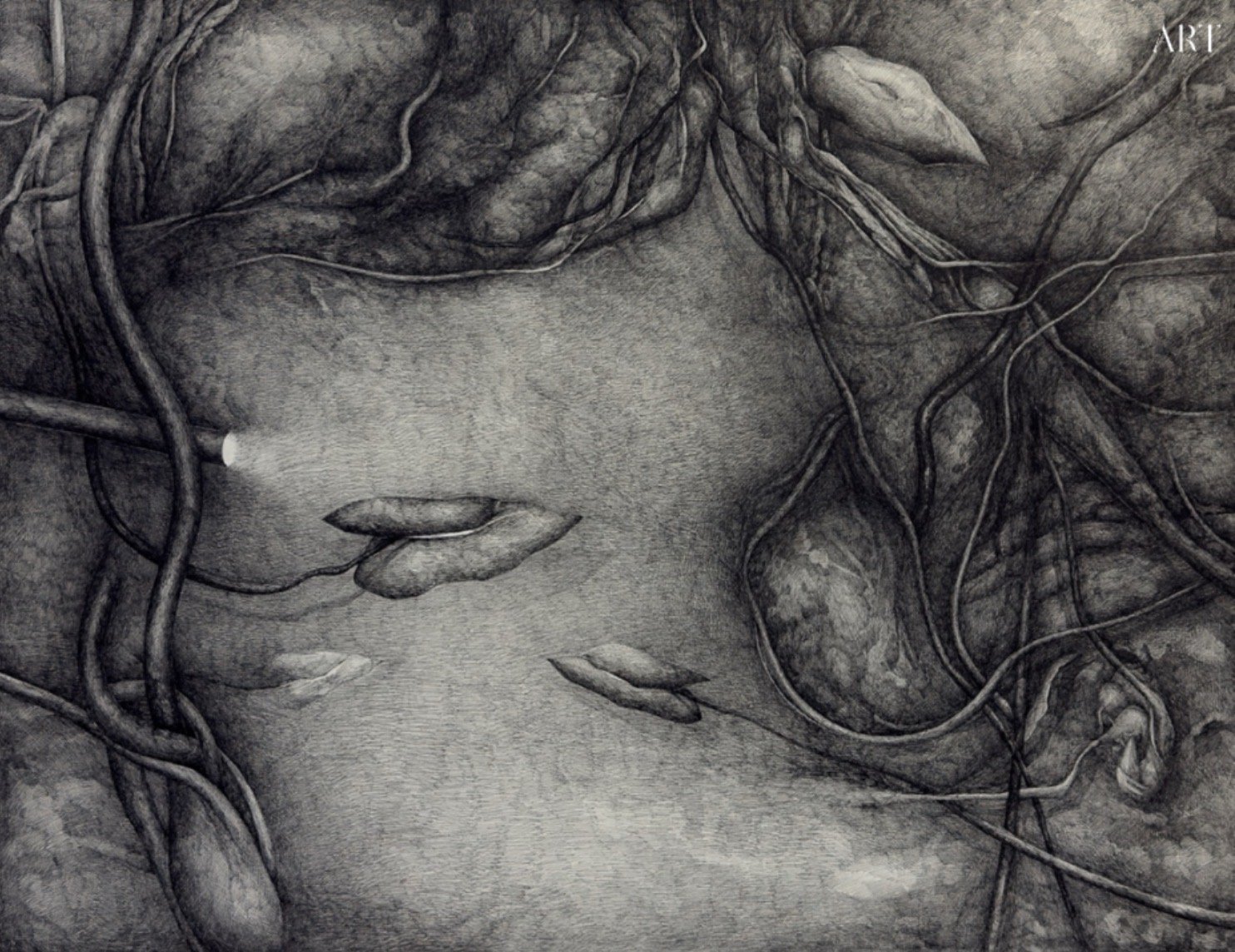
petroleum afterlife untitled works on paper.
O.C. You left a city with too much sun for one where the December light lasts about six hours. Which darkness taught you more?
A.A. The darkness in Baghdad was never about the absence of sunlight, and the darkness in Helsinki is not necessarily something negative.
Growing up in Baghdad, I experienced darkness even in the brightest hours of the day. It had nothing to do with nature, but with the reality we were living in.
Helsinki is a different story. Those long, dark winters can be quite depressing, not only for me but also for the people around me. But artistically, I have to admit that Finnish darkness has been rather generous to me. The freezing temperatures and lack of daylight mean I end up spending most of my time locked inside my studio, working. So something that can be emotionally exhausting becomes surprisingly productive.
Perhaps Baghdad taught me that darkness doesn't need the night to exist, while Helsinki taught me that even darkness can be put to work.
And in Finland, you have plenty of it.
O.C. Arabic has ghurba, the estrangement of living far from where you belong. Finnish has kaiho, a longing with no clear object. After twenty-six years in Helsinki, which of the two words describes you now?
A.A. Perhaps neither. Or perhaps both.
To be frank, I was already experiencing ghurba during the 27 years I lived in Baghdad. Because of my appearance, being a white-looking man, I often felt that I didn't quite belong to the society I was born into.
Strangely enough, I found this interesting. Being perceived as different allowed me to observe things from another angle, to notice certain codes, behaviours, and contradictions that might otherwise have escaped my attention.
Then I moved to Finland to pursue my master's degree, and after all these years I have realised that the feeling I had in Baghdad had somehow become official. In Iraq, I felt like an outsider; in Finland, I actually was one. At least on paper. I have now lived in Finland for almost as long as I lived in Iraq, and the longer I stay, the stranger the idea of belonging becomes. Even after all these years, I am occasionally reminded that I come from somewhere else.
But I don't necessarily see that as a problem anymore. I have become quite comfortable with not fully belonging anywhere.
Perhaps belonging is not something we should constantly search for, as if there is a particular place waiting for us to fit perfectly into it.
These days, I am less interested in discovering where I belong and more curious about why we are so obsessed with belonging in the first place.
O.C. In Unfitted, a tailor measures figures who are running away. When you arrived in Finland in 2000, who took your measurements, and what did they get wrong?
A.A. I suppose the measurements started almost immediately, although nobody was actually holding a measuring tape.
The question of how we shape, reshape, or sometimes erase our identities has interested me for a long time.
In Politically Correct (2018), I explored how the pressure to conform can gradually distort language until it becomes unreadable. In Cleansing (2018), I approached something much more disturbing: the violence behind the idea of purifying people, as if their identities, beliefs, or even skin colour were something that needed to be washed away.
But in Unfitted, which is part of They Were Here, I approached identity with a certain absurdity.
The figures are not running away from the tailor. Quite the opposite. They have come to him willingly, hoping to change their identities.
I find that fascinating. We usually think of identity as something deeply rooted in who we are, but what if it could be changed as easily as a piece of clothing? Would we still be the same people underneath?
The tailor is performing an almost impossible task, trying to give someone a new identity by taking their measurements. But who decides what the correct fit is? The tailor, the person wearing it, or the society they are trying to fit into?
So I don't think the problem was necessarily that someone took my measurements incorrectly. The problem is that we tend to believe there is a correct size for everyone.
And I have never been particularly interested in wearing a suit that fits perfectly.
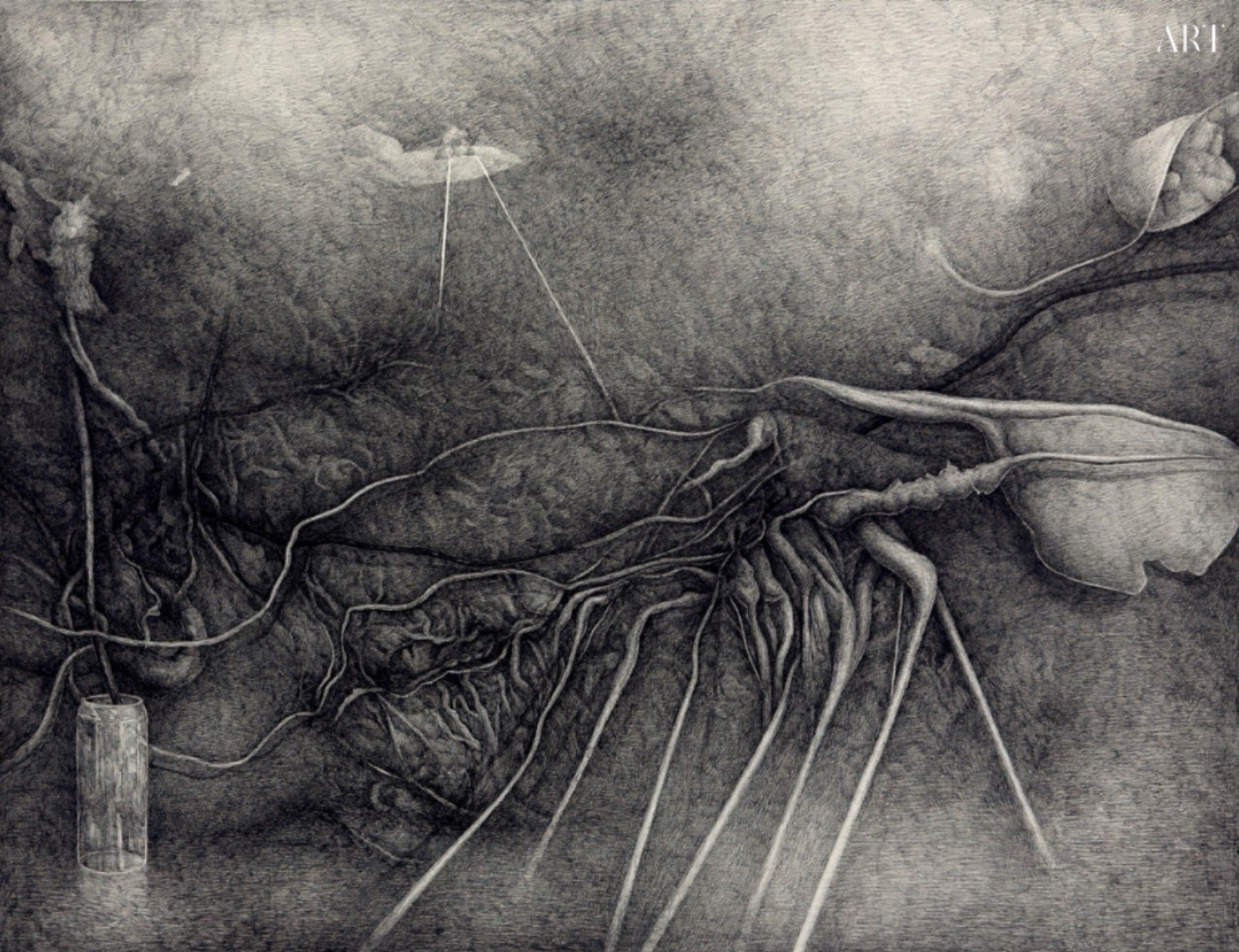
petroleum afterlife untitled works on paper.
O.C. The Standard of Ur has a war face and a peace face, and whoever held it could only show one side at a time. Which side of Iraq do you hold outward in Helsinki, and which do you hold outward here in the Gulf?
A.A. I find it rather amusing that an object created around 4,500 years ago is still being discussed through two categories: war and peace.
What makes it even more interesting is that these are modern names for its two main panels. We don't actually know how the Sumerians themselves understood them. Perhaps the way we interpret history tells us as much about ourselves as it does about the people who created it.
I don't think Iraq has only two sides, and I certainly don't feel responsible for presenting a particular image of it, whether in Helsinki or here in the Gulf. I am an artist, not an ambassador.
Iraq is not simply a place of war, nor is it merely the birthplace of civilisation. It is both, and so much more. Yet we constantly reduce entire societies, with all their contradictions and complexities, to a few familiar images.
In They Were Here, I wasn't interested in reproducing the Standard of Ur simply to celebrate an ancient civilisation. I wanted to question what civilisation actually means, especially when we look at what has happened to the same geographical region thousands of years later.
So I suppose I don't hold either side outward. I would rather turn the object around, examine it from every possible angle, and question why we insist on seeing only two sides in the first place.
O.C. Your hypothesis is that if the Sumerians were alive today, they too would abandon their civilisation and flee. But someone always stays. Who stays behind in your version, and what are they guarding?
A.A. My original thought was rather absurd, but also disturbing.
Imagine the Sumerians, who helped establish one of humanity's earliest civilisations, returning to the very land where they built it, only to discover that they might have to pack their belongings and leave.
What an extraordinary achievement for humanity, isn't it? Thousands of years of progress, and we have somehow managed to make the birthplace of civilisation a place people may feel forced to escape.
But you are right. Someone always stays.
I think we should be careful not to romanticise that. We often speak about those who remain as if they are courageously protecting their homeland, history, or identity. Sometimes that is true. But sometimes people stay simply because they have no choice, no means to leave, or nowhere else to go.
And what are they guarding? Perhaps nothing particularly heroic. Perhaps just their homes, their families, or the ordinary life they are desperately trying to hold on to. For me, that is one of the cruelest contradictions of displacement.
Leaving is not always a choice, and staying is not always an act of resistance. Sometimes both are simply different ways of trying to survive.
O.C. The Zanj were brought to southern Iraq to drain the marshes. Eleven centuries later the same marshes were drained again, this time by the state. What does it do to a landscape to be emptied by force twice, and what does it do to the people who come from it?
A.A. First, I think we need to make an important historical distinction.
The Zanj were not brought to southern Iraq simply to drain the marshes. They were enslaved people, many brought from Africa, who were forced to work under extremely harsh conditions, particularly removing salt-affected soil to reclaim land for agriculture.
The deliberate draining of the Iraqi marshes under Saddam Hussein in the 1990s was a different operation. We should not confuse the two, although both reveal something disturbing about the relationship between power, people, and landscape.
What strikes me is the reversal.
In one period, human beings were enslaved and forced to transform the land.
Centuries later, the land itself was deliberately transformed, forcing human beings to abandon their homes.
First, people were forced to change the landscape. Later, changing the landscape became a way of forcing people out.
We often think of landscapes as passive witnesses to history. But they can also be manipulated, exploited, and turned into instruments of power.
And the consequences do not disappear when the political system responsible for them disappears. People carry those consequences for generations, while the landscape carries its own physical traces.
Perhaps the land has a longer memory than those who keep trying to control it.
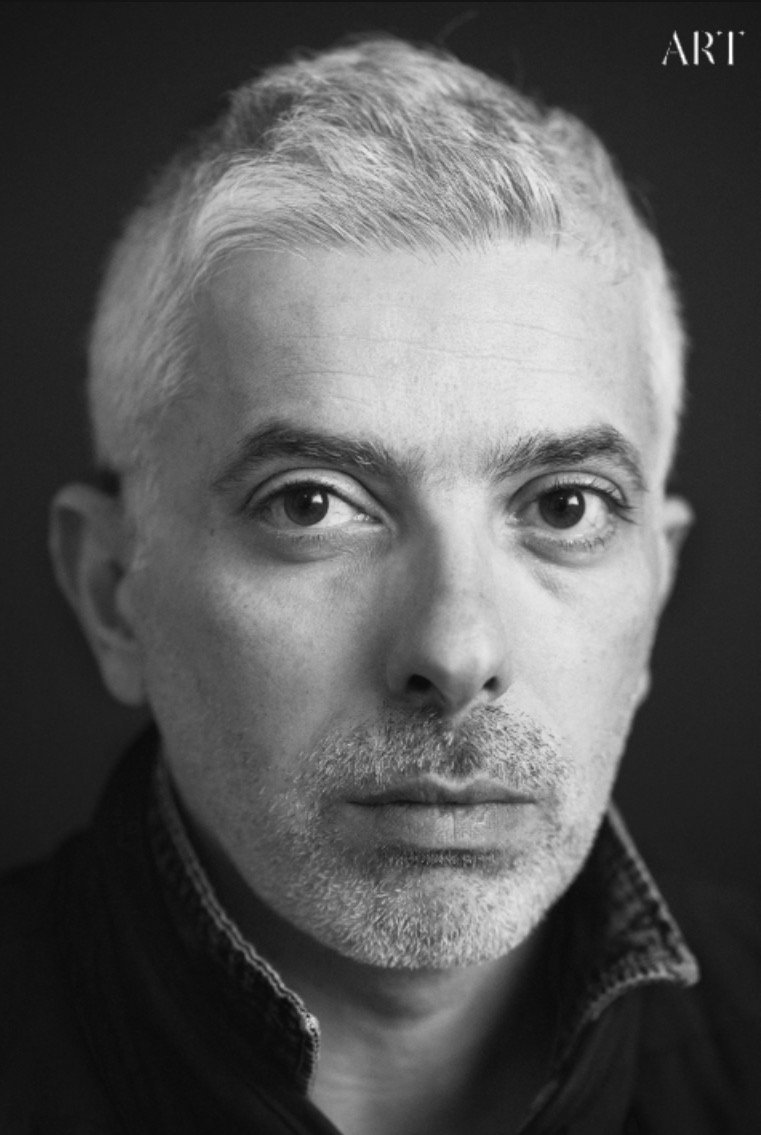
Picture by Adel abidin
O.C. If the Zanj had won, what would their monuments look like? And would you have been allowed to make fun of them?
A.A. That's an interesting question, but I think we need to distinguish between making fun of history and questioning how history is written.
In The Revolt, I wasn't making fun of the Zanj. Quite the opposite. I was trying to create space for voices that are largely absent from the historical accounts that survived.
Much of what we know about the Zanj Rebellion comes from sources written by people who opposed them or belonged to the society that defeated them. We are therefore looking at the rebellion largely through the eyes of the victors.
Now, if the Zanj had won, perhaps we would have inherited an entirely different history. They might have built magnificent monuments celebrating their victory, telling stories about freedom, justice, and heroism.
But would those stories have been any more truthful? I don't know.
Winning a war doesn't necessarily make someone a reliable historian.
And would I have been allowed to make fun of them? Perhaps. Perhaps not. But that wasn't my intention in making The Revolt.
The more interesting question for me is what happens to the stories, memories, and experiences of those who don't win.
After all, history is not only about what happened. It is also about who was allowed to tell us what happened.
O.C. Your surname shares its Arabic root with ʿabd: servant, worshipper and, in the old chronicles, slave. You spent years in the archive with the Zanj. Did the word follow you in there?
A.A. Well, that's quite an unexpected connection to make!
Yes, my surname, Abidin, comes from the Arabic root ʿ-b-d, but the word from which it derives refers to worshippers or devotees. Arabic words sharing the same root can have very different meanings, so I would be careful about drawing conclusions from that connection.
When I researched the Zanj Rebellion, I wasn't searching for a personal connection to the people involved, and my surname certainly wasn't what brought me to their history.
I was interested in understanding how a major historical event could reach us with so little of the defeated people's own perspective.
I don't believe I need a linguistic or personal connection to a historical injustice in order to question it.
Not every story I investigate needs to be about me.
O.C. The Kalevala was stitched together in the 1830s from songs Elias Lönnrot collected from singers in the forests. Gilgamesh survived on clay and was dug up long after its people had gone. One epic was written down to make a nation, the other outlived one. Which kind of memory do you trust?
A.A. Well, I don't think I would trust either of them completely.
Both stories survived through very different processes, but neither reached us untouched.
The Kalevala was assembled from oral traditions, selected and rearranged into something that eventually became central to Finnish national identity. Gilgamesh survived through clay tablets that were copied, rewritten, broken, buried, and rediscovered thousands of years later.
Your question actually reminds me of my work ON (2023), which won the Ithra Art Prize.
The work grew out of my research into the Zanj Rebellion. I became fascinated by how historical accounts were transmitted from one person to another, often using the Arabic word ʿan (عن), meaning “from” or “on the authority of” someone.
In ON, I used this single word as a stamp, repeating it thousands of times with different pressures and creating layers of information that gradually form an image. Some impressions are strong, while others almost disappear.
For me, it became a way of visualising how history reaches us: fragmented, modified, sometimes exaggerated, and sometimes missing altogether.
And this is why your comparison is interesting. In both The Kalevala and Gilgamesh, we are dealing not only with what people remembered, but also with what others decided to preserve.
I am less concerned with choosing which memory to trust than with understanding how it travels, who carries it, and what happens to it along the way.
After all, something surviving for thousands of years doesn't necessarily mean it survived accurately.
O.C. Finnish myth has Tuonela, the land of the dead across a black river where a swan keeps watch. Islam has the barzakh, the threshold where the dead wait. Your figures are always in transit. Are they crossing a river, or are they waiting?
A.A. That's an interesting comparison, although I have never necessarily thought of my figures as travelling towards the land of the dead.
Your question reminds me of an earlier work, Plan B (2008).
In that work, I covered the floor of an industrial workshop with mattresses, carefully fitting them around the machinery and obstacles without removing anything.
It was an attempt to create a sense of comfort in a place that was clearly not designed for it.
What interested me was the absurdity of trying to make an uncomfortable situation comfortable without actually changing the conditions that made it uncomfortable in the first place.
Something similar happens in many of my works. The figures are not necessarily moving towards a destination, nor are they simply waiting for something to happen. Sometimes they are trying to adapt to circumstances they cannot control.
So perhaps the question isn't whether they are crossing the river or waiting beside it.
What if the river cannot be crossed? What if there is no other side?
Maybe they are simply trying to find a way to live where they are, even if that means placing a mattress on an industrial floor and pretending, just for a moment, that everything is perfectly comfortable.
O.C. Video can be cut, but a painting can only be covered. When you came back to painting for What Remains, what did you paint over?
A.A. Well, I wouldn't necessarily agree that a painting can only be covered. You can scrape it, erase parts of it, or even destroy it. Painting has its own ways of editing. When I returned to painting for What Remains, I realised that the process made me feel more human than working with other mediums.
I wanted a more intimate relationship with my subject matter. I wanted to engage with it directly through my hands, the colours, and the lines.
I was also becoming increasingly interested in the process itself, rather than simply the final image.
For me, painting and drawing are almost like conducting a long research project without using words.
You spend hours, days, sometimes weeks trying to understand something. But instead of explaining it, you feel your way through colours, lines, gestures, and all the decisions you make along the way.
And I enjoy not necessarily knowing where the work is going. Sometimes a colour or a line takes me somewhere I hadn't intended, and I find myself following it. It's a different kind of thinking, one that doesn't always need to be translated into language.
So perhaps I wasn't painting over anything in particular. I was allowing myself to experience my subject matter differently, and to discover things I might never have found through other mediums.
O.C. The first writing in Mesopotamia was not poetry but bookkeeping: grain, sheep, debts. An art fair is also a ledger. Is there a receipt hidden somewhere in the work you're bringing to the booth?
A.A. Perhaps the entire work is a receipt.
We have become extremely good at calculating the economic value of petroleum: how much we can extract, how much we can sell, and how much wealth it can generate.
But when it comes to calculating the environmental, political, and human consequences, our accounting becomes rather selective.
In Petroleum Afterlife, I imagine a world where humans are no longer around, but the consequences of their existence remain. The landscapes and strange structures in these drawings could be seen as the remains of a transaction that took place long before.
And of course, there is something rather amusing about presenting these works at an art fair, where everything, including my drawings, eventually comes with a price tag.
We have managed to turn almost everything into something that can be bought and sold, even our concerns about what we are doing to the planet.
So yes, perhaps there is a receipt hidden somewhere in the work.
The only problem is that it might arrive long after the customer has disappeared.
O.C. If you were forbidden to be funny for one year, what would your work have to become? And would you survive it?
A.A. I would probably become even funnier, unintentionally.
Humour has always been an important part of my artistic practice, although I have never been particularly interested in making people laugh for the sake of laughter. For me, humour is a way of exposing the absurdity of situations we have somehow come to accept as perfectly normal. And quite often, the more disturbing the situation is, the more absurd it becomes.
The funny thing is that I don't really need to invent absurdity. Reality has been extremely generous in providing it.
Sometimes I feel that my role as an artist is simply to point at something that already exists and ask, “Are we seriously accepting this?”
So if I were forbidden to be funny for a year, I would probably end up making something terribly serious, which, knowing myself, would become completely ridiculous.
Would I survive? Probably.
But I am not sure the work would obey the rules.
O.C. In old Finland the sauna was where children were born and where the dead were washed. In Baghdad the hammam held the same heat and water. If you were given your last wash, what would you want scrubbed away, and what would you want left on the skin?
A.A. Well, I have to confess that even after 26 years of living in the land of saunas, I have never really been a big fan of them. Which, I suppose, is rather suspicious behaviour in Finland.
But if we are talking about my very last wash, I think I would want all my certainties washed away. Especially the ones I spent my life believing were absolutely true. The certainty that we understand history, that we know where we belong, that our civilisation will last forever, or that we are somehow more important than everything else around us.
I think we humans have been rather generous in granting ourselves that importance. And what would I want left on my skin?
Everything that life has left there. The marks, the scars, the memories, the mistakes, and perhaps even the things I never managed to understand.
I wouldn't want to leave this world looking as if I had never lived in it.
After all, I have spent much of my artistic life questioning what remains after we are gone.
It would be rather ironic if, at the very end, I asked someone to wash away all the evidence.
BY OONA CHANEL
