

Najat Makki trained as a relief sculptor, in an art where a form rises from its ground but never fully leaves it. Nearly five decades on, the pioneering Emirati artist talks to Author about light, henna and saffron, a glowing fishing net, and why her work should be read by rhythm, not by date.
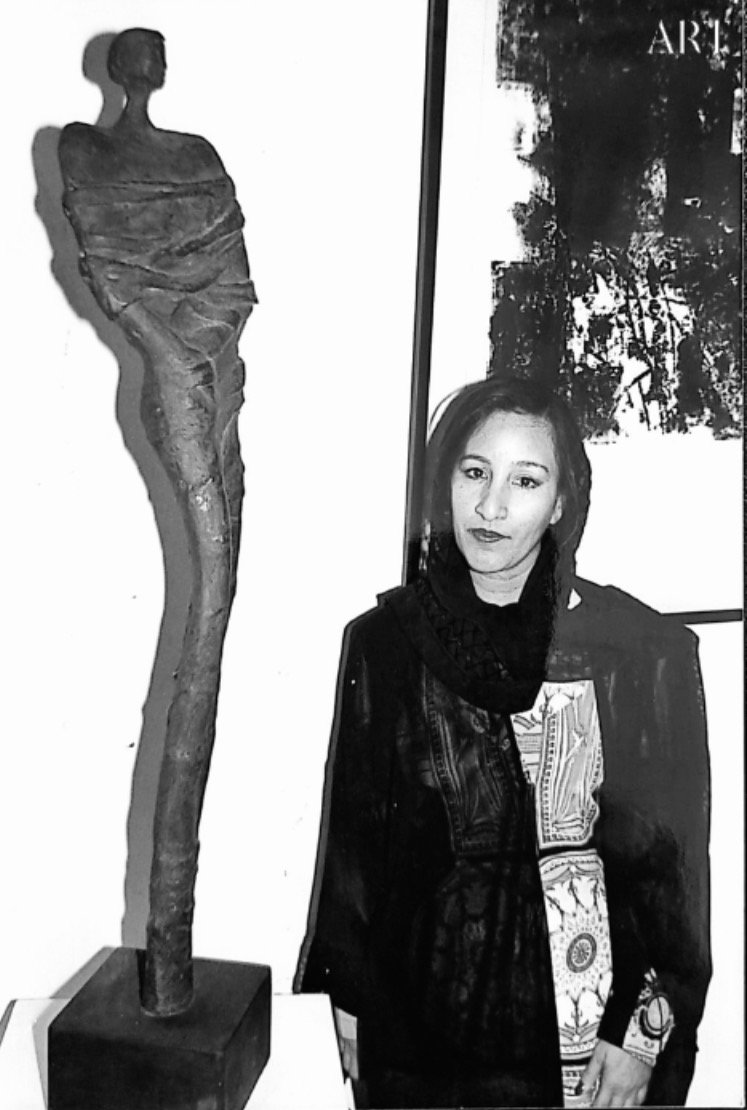
Picture by Najat Makki
Najat Makki (b. 1956, Bur Dubai) is a painter and sculptor and one of the pioneers of contemporary art in the UAE. In 1977 she became the first Emirati woman awarded a government scholarship to study art abroad, and she holds bachelor's and master's degrees in relief sculpture and metal and a doctorate in the philosophy of art from Cairo. She was the only woman among fifteen artists in the UAE Pavilion at the 56th Venice Biennale in 2015.
Najat Makki learned to think in relief. In 1977 she became the first Emirati woman awarded a government scholarship to study art abroad, and in Cairo she trained in relief sculpture and metal: an art in which a figure pushes up out of its background while staying bound to it. That double movement, out and back, still runs through everything she makes. Her paintings are built more than brushed, layered with paste and thick paint until the light catches their ridges. Her women are drawn long and upright. Her sea has a surface you want to put your hand on. Even at her most abstract, she keeps one foot in the ground the work came from.
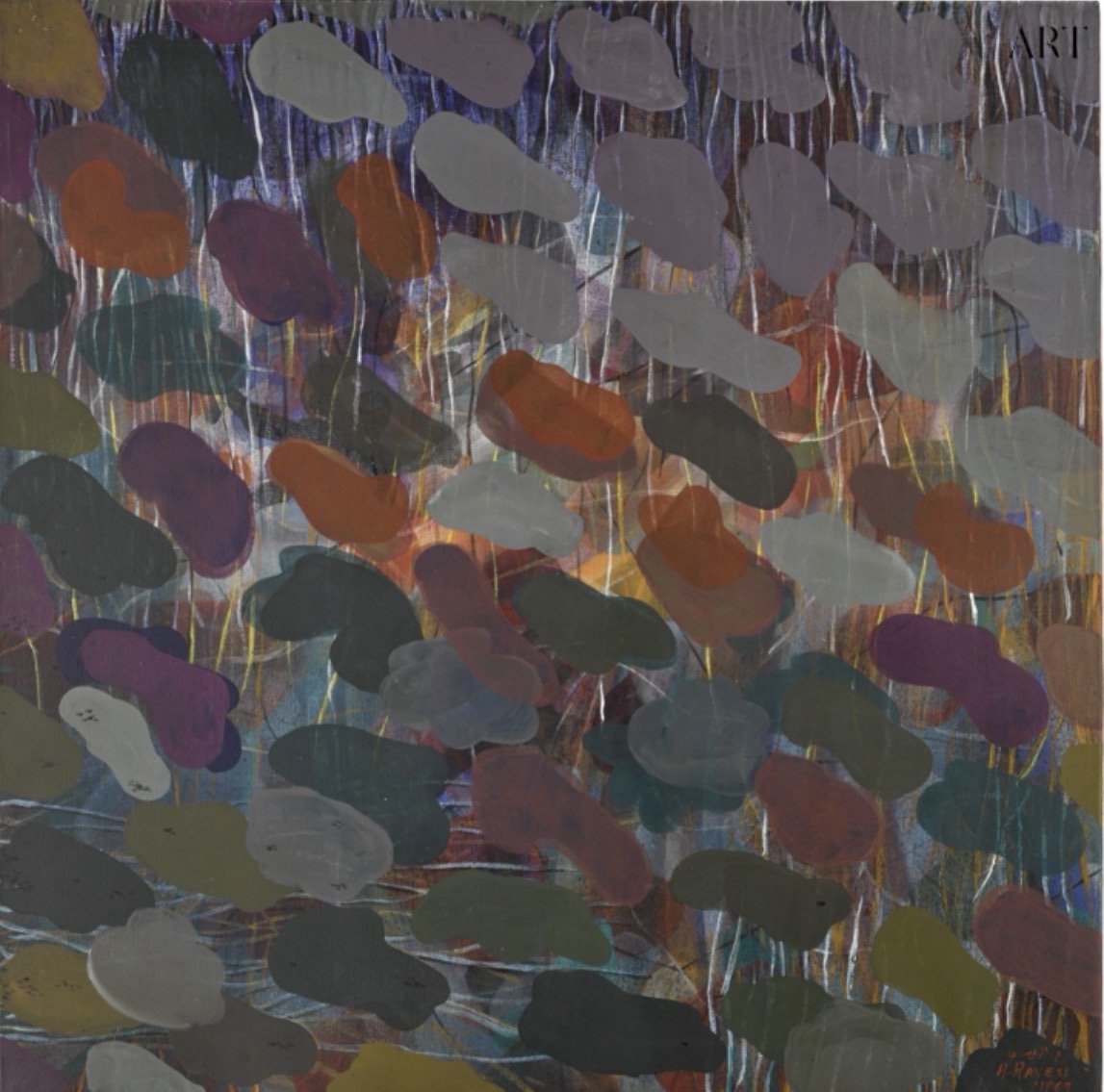
Aref El Rayess, Warak el Kharif (Autumn Leaves), 1969, estimate $80,000 - 120,000
Her name will be in the saleroom next month, when Sotheby's offers her 1988 canvas A Woman's State of Being in Abu Dhabi. But in conversation, translated here from Arabic, she has little interest in milestones. She wants to talk about how a surface is built, and how light moves across it.
It starts, she says, with looking, and with the material.
"A work begins with seeing and observing, then with expression through a first structure of lines, areas and shapes, always in harmony with the material, so that it carries its aesthetic idea and the material's visible and tangible qualities: light and shadow, line, texture, surface.
"Some of my reliefs were in low relief, and it is natural there for the shapes and elements to emerge from the ground of the panel, which was laid on a prepared surface pressed with clay. What draws us to relief is the building of masses and elements. It creates visual gradations that deceive the eye and give the work dimensions beyond the surface, so the viewer moves with them into a wider space. Through practice, the artist learns how to handle the material, keeping the raised and sunken levels until the whole composition is complete. Lines that cross and interlace bring out the aesthetic values, and sometimes the artist places them to create a visual rhythm that carries the viewer's eye from the surface into depth.
"Light and shadow are the language the artist speaks through the rise and fall of the elements and the voids between the lines. In relief and in installation, light is not just one element of the work. It is the main element through which we perceive beauty and through which meaning and content are revealed.
"Installations are different, because they are surrounded by space. They are a visual and a philosophical embodiment at once, and the space itself becomes part of the composition. The viewer feels the mass and the void in a dialogue of push and pull, and the background becomes part of the meaning the artist intends. A painting, in turn, is a surface for dialogue with colour, mass, line and void. The elements form through lines and layers of colour, and texture and depth are suggested by playing the tones between light and dark."
That push and pull is not only physical. Makki moves between abstraction and figuration without treating them as rivals, and she is precise about what each can carry.
"What draws a viewer into the idea of a work is what it carries of aesthetic and philosophical dimensions, because it acts directly on the senses and on human feeling. Abstraction has that quality. It reaches the soul through mass, void, rhythm and texture, and sometimes through dispersion and chaos. It speaks to the senses through lines and their directions, and through the beauty of mass. It is not bound to any one time.
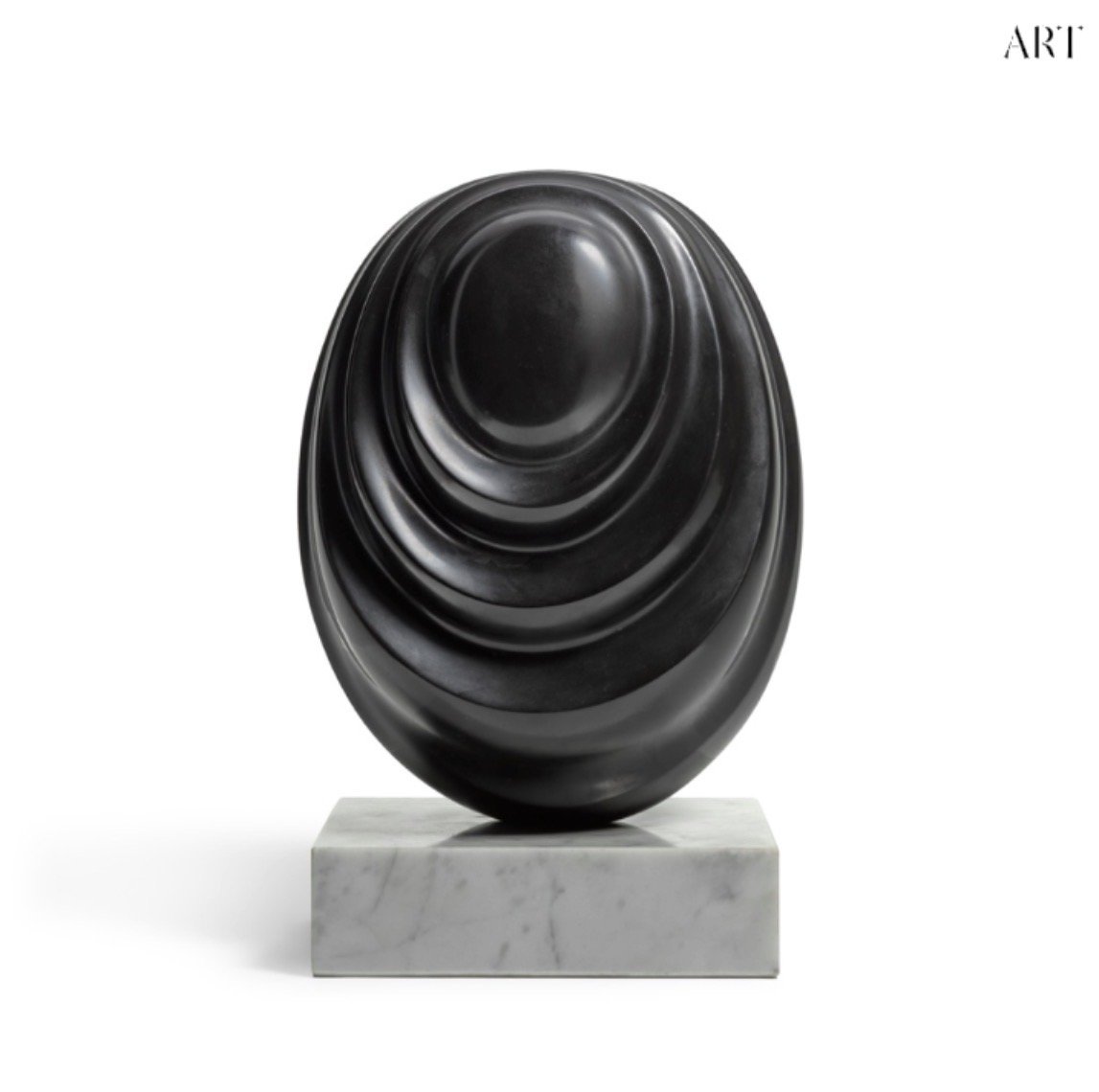
Mona Saudi, The Seed, 1983, estimate $40,000 - 60,000
"The figurative image is a story told in front of your eyes. I don't deny that I have made such images, but I have always tried to give some elements a departure from the familiar. The elongation of figures in my work, especially women, is a symbol of a woman's strength and dignity, and of her leading role in society and the family. When I painted the sea, I wanted to give it a symbolic, tactile rhythm, so that the viewer could almost feel it under their hand, through the movement of the lines and the contrasting gradations of colour.
"An artist can work with materials through the environment and the society they live in. That is why I found heritage materials such a fertile ground for what I wanted to say about women. I used henna, saffron, wars and others. Another artist turned to the tent to express society and heritage, and I respect that, but my vision is different. My idea was to use materials that are close to women.
"In one work I took on the subject of intellectual dispersion. It was made of geometric shapes spread across a wall in a particular way, their surfaces carrying colours that overlap one another. That is where you see abstraction's power to speak about social life. When a work is freed from the need to narrate a personal story, it opens the field for the viewer to take part in making the meaning. Abstraction creates an interactive space that mirrors collective complexity. Coloured masses, clashing or in harmony, can express solidarity or social fracture with an emotional honesty deeper and wider than a painting that literally records a demonstration or a crowd."
One of her most personal works is an installation about the stories told to children before sleep, built around a fishing net that glows with fluorescent colour. Asked where the life of a work like that sits, in its form, its pattern, its material or its setting, she does not pick one.
"When those things come together in one visual field, we are not looking at separate elements side by side, but at a living system, like an interwoven fabric. Agency does not lie in any one of them alone. It lies entirely in the living relationship that grows between them.
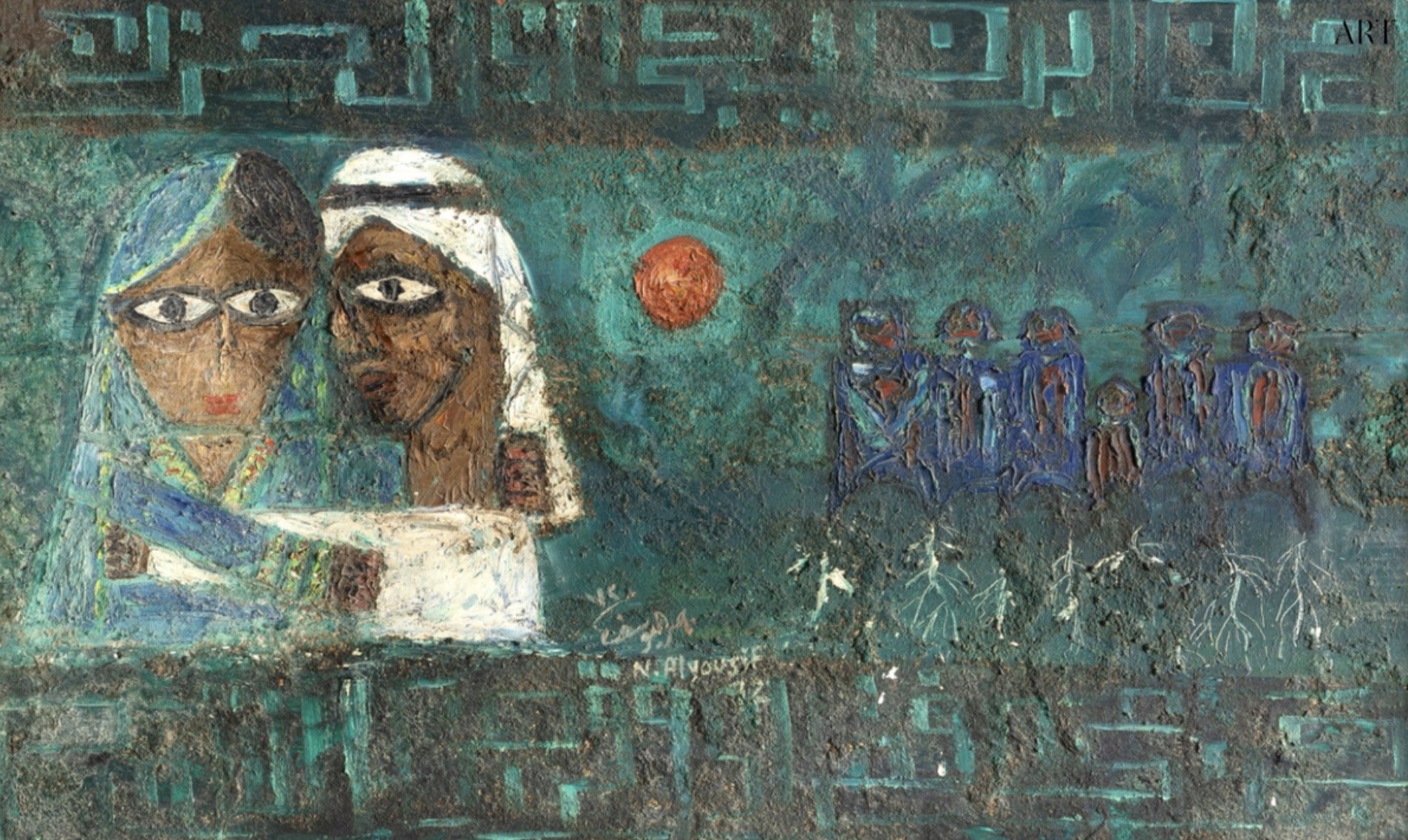
Nasser Al-Yousif, Roots, 1972, estimate $50,000 - 70,000
"I show this in my installation about the folk tales told to children before sleep, which exist among every people in the world. I imagined it as a fishing net, carrying an aesthetic and a philosophical vision at the same time. That custom never ends. It matters in a person's consciousness as they grow up, and sometimes the stories we heard as children are what help us see things later in life.
"How the answer changes from work to work depends on the composition, or more broadly on the approach, the idea and the nature of the piece. Here we have a tale that every people on earth tells its children, each according to its own nature and heritage, yet all the tales resemble each other in the way they are told. So the work takes on a spiritual, or as people say, a heritage dimension, and ornament leads: the units of the net and the material trace within them. The net is known everywhere and has the same function everywhere, but here it was used to carry meaning. It is a continuous, generative structure that expresses the infinite, and it connects the viewer to the memory of place, so that environment and form become inseparable in the repeated rhythm of the pattern. The net reaches out towards the environment and towards social relationships, and the material becomes the language that speaks for the environment, along with the fluorescent colours and the light they give off, which stir the feelings."
The same thinking shapes how she sees heritage, and what it means to inherit an image that once belonged to someone else.
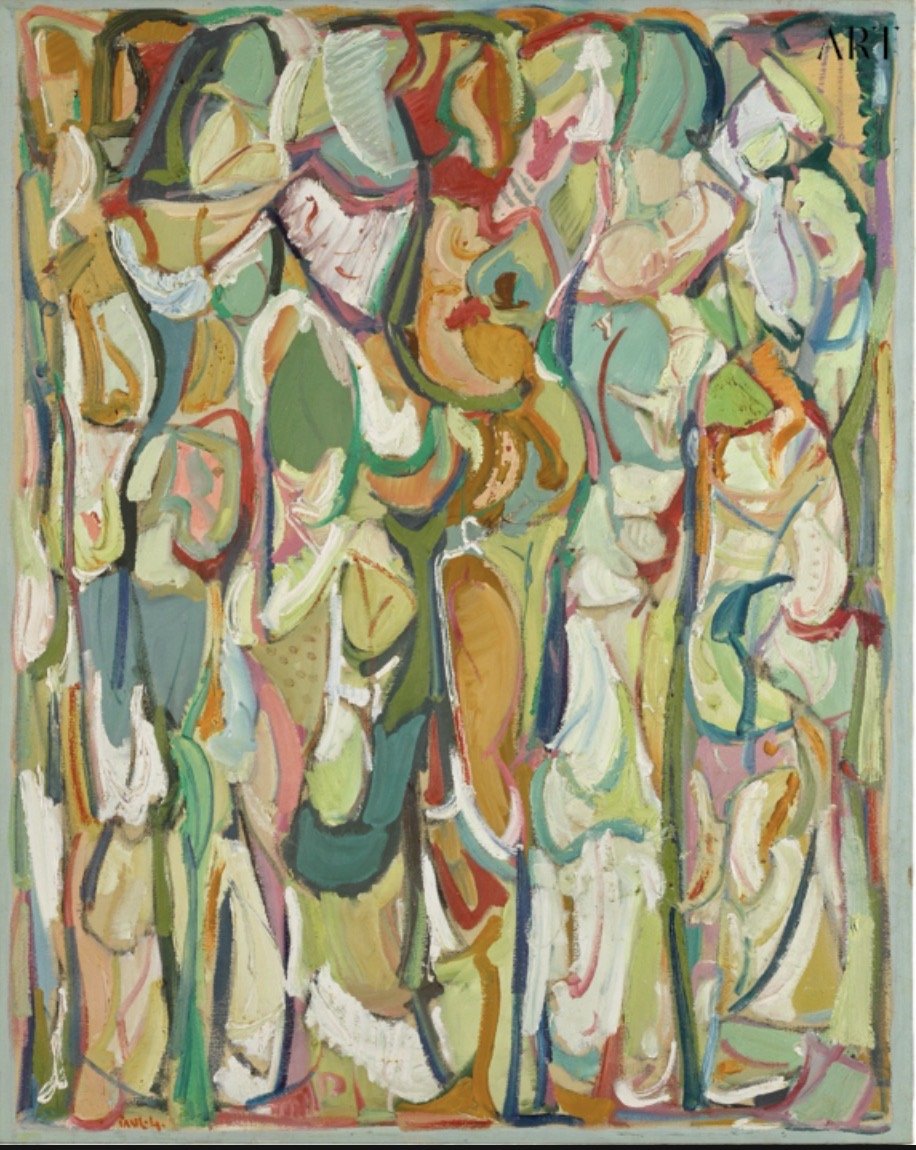
Paul Guiragossian, Varte (Rose), 1986, estimate $120,000-180,000
"When we inherit an image or an artwork without inheriting the authority that once protected it, we do not inherit something meaningless. We take on the authority attached to the work, and the freedom to act on it.
"As for cultural histories, I believe the artworks discovered across human civilisations carry the identity of their era, their time and their place. No historical work is born an orphan. Cultural histories are not solid rock but moving currents. What discoveries have shown is that every work carries a symbol of where it came from, of its identity, even if it is only an abstract line. The symbols and geometric shapes that appear on ancient seals and coins prove it."
For an artist who has worked across sculpture, painting and installation, she is surprisingly firm on one point. The material is not something she swaps when a problem gets hard.
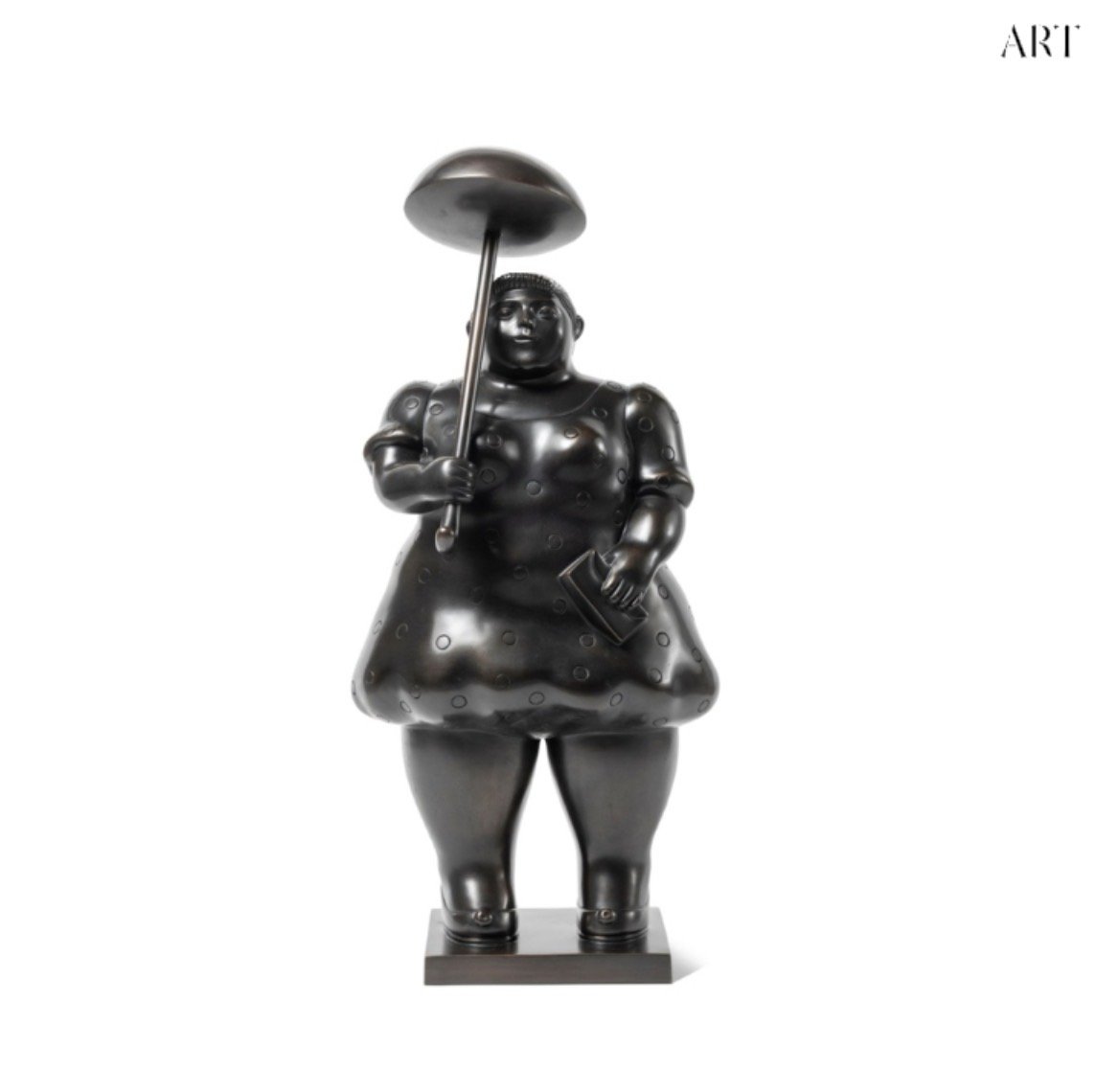
Fernando Botero, Donna con Ombrello, bronze, 2008, estimate $350,000 - 550,000
"Every work has an idea or subject that is clear to the artist, or sometimes an intuition, and that idea is one of the pillars of planning the work. The artist is the one who understands that the material and the medium are the true home of the work, while the idea takes shape according to their command of their tools and the depth of their knowledge of materials. The artist's responsibility is to shape the material, not the subject. In my own experience, I don't remember ever changing a material or a medium. It is the material that sets its own rhythm."
She is just as clear about where a viewer, or a critic, should look first.
"The structure, the composition of the work, is the first thing that registers with the viewer. By that I mean the structural relationships, the distribution of density, the elements within it and the values of colour and line they carry: rhythm, balance, proportion and space. Content, too, is what distinguishes one work from another, its artistic and expressive language, which is what stays with you and brings aesthetic and intellectual pleasure. The richer the content, the greater the weight of the experience the work holds.
"A critic may well identify a work's subjects by observing how it is built: the distribution of masses and voids, the directions of the lines and what they carry, the contrasts of colour and texture. All of that reveals the artist's skill in organising the work."
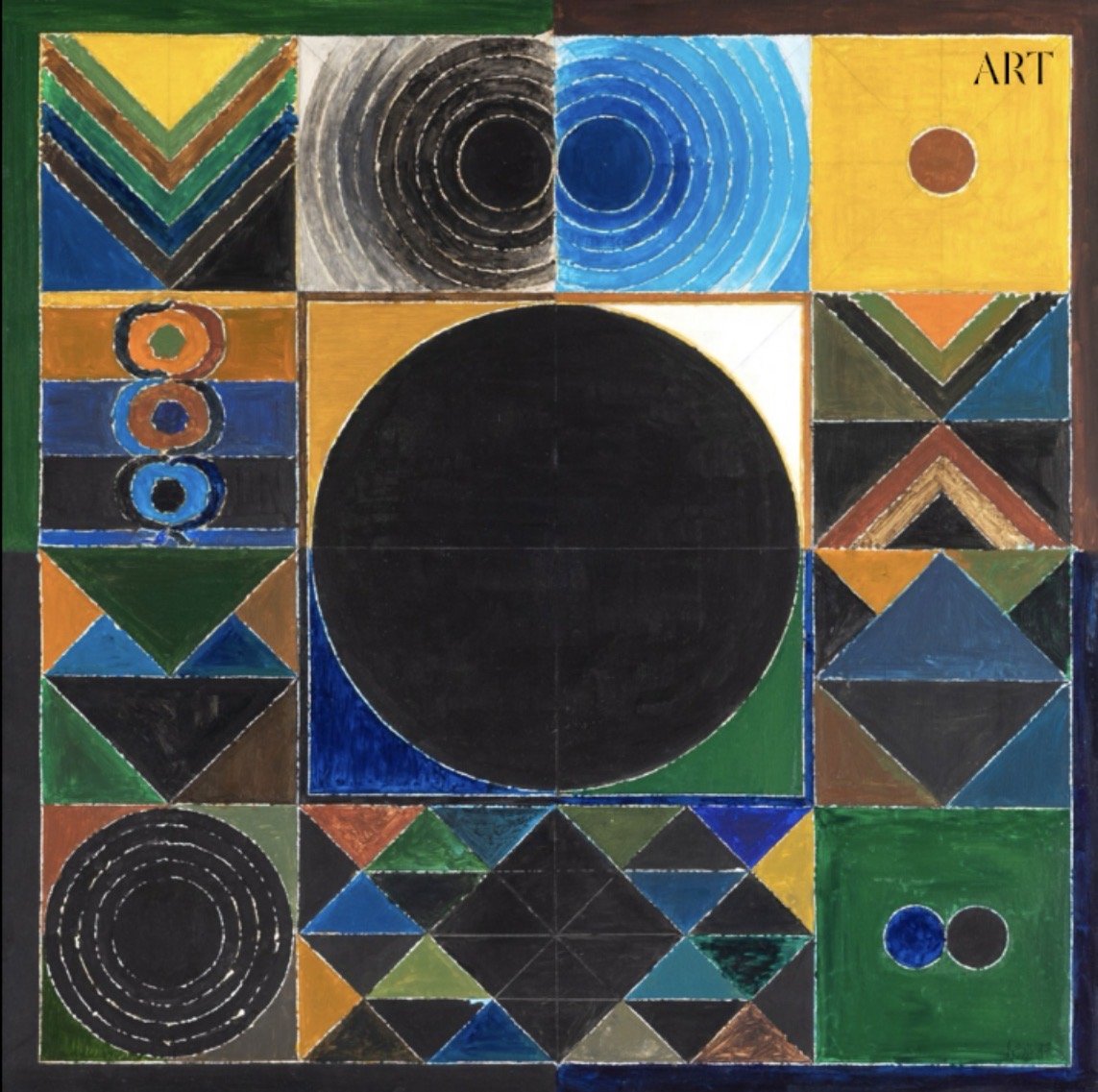
S.H. Raza, Bindu (estimate $150,000-250,000)
Makki is usually introduced through her firsts: the scholarship, a doctorate in the philosophy of art from Cairo in 2001, the only woman among fifteen artists in the UAE Pavilion at the 2015 Venice Biennale. She knows the shape of that story, and she is wary of it.
"Many people look at an artist's biography as the passport to everything they have made, without looking at the works themselves as more important than the dates they were shown. The biography does hold important milestones, but people rarely stop at them unless they know the artist well. Even more rarely does a critic or viewer turn to the works and what they carry in values, meanings and ideas, as if a painting were only a footnote to the artist's life, a souvenir of an occasion or an exhibition, rather than a visual and intellectual being in its own right.
"An institution could look instead at the relationship between line and space, at the artist's relationship with rhythm and its recurrence: the rhythm of mass or line, the frequent return of texture, a focus on a particular colour. That means gathering works that share a visual treatment, whatever year they were made. It places the viewer before the development of plastic thought, not the passing of years or the number of exhibitions. It means analysing the structure of the work and asking questions about the artist's choices: why this element, and why the focus on it?"
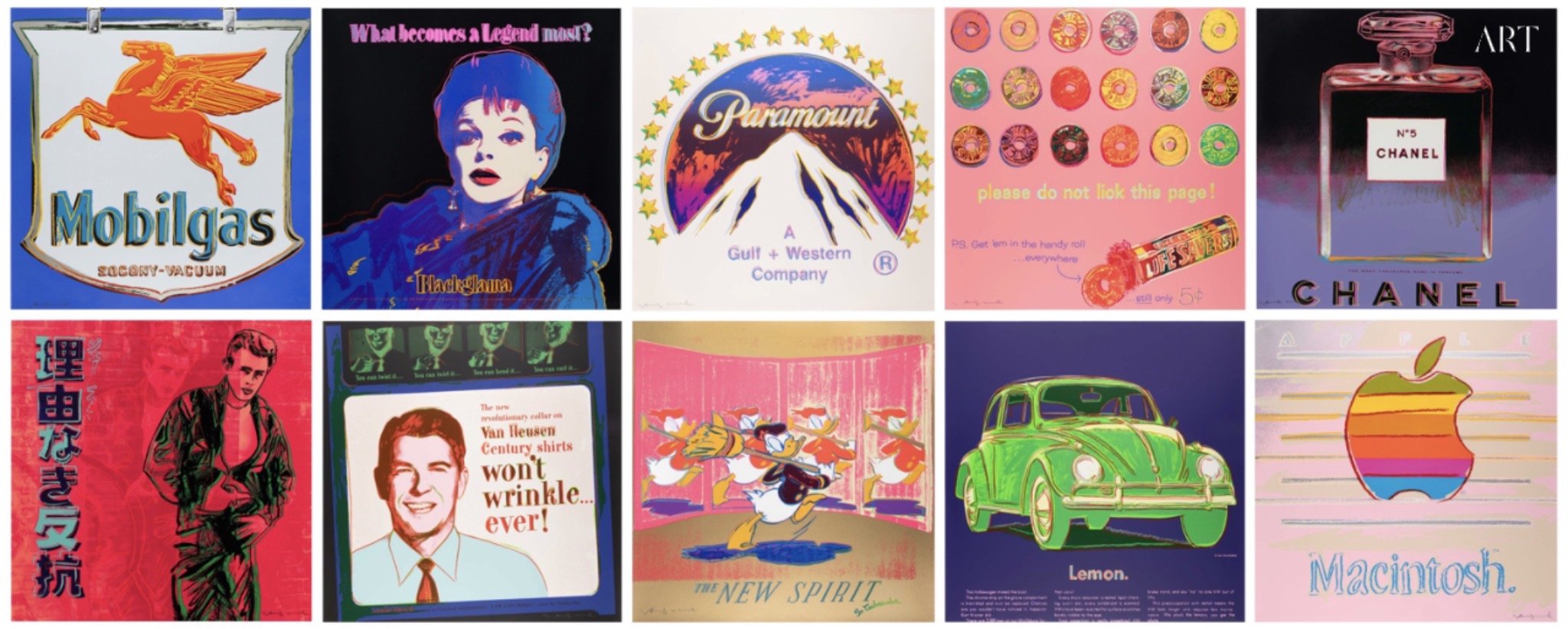
Andy Warhol, Ads, 1985, estimate $2,000,000 - 3,000,000
So what would her work look like arranged as a constellation, rather than a timeline?
"What matters to me is that my works are shown and read for their content and their meanings. I would choose three axes that I feel sum up the experience.
"The first is a visual dialogue, Ritual of Light, a celebration of light and of belonging to the historic landscape of Mleiha and the spirit of the place.
"The second is the series Pulse of the Desert, where a network of dots and traces and a flowing rhythm appear like the paths of time and the footprints of the camel across the desert of the Emirates.
"The third is the series Khor Dubai: abstract paintings in which a human element merges with the surface of the sea."
*
Light at Mleiha, tracks across the sand, a figure dissolving into the creek: laid side by side, Makki's three choices make the same move her reliefs always have. Something rises from the ground, takes on a life of its own, and never quite lets go of where it came from. That is a better way into fifty years of work than any list of firsts.
BY OONA CHANEL
