

The night before the Guggenheim opens, Sotheby's puts fine art under the hammer in Abu Dhabi for the first time, closing its second Collectors' Week in the emirate. Katia Nounou Boueiz, the house's Chairman for the Middle East, talks to Author about unbuilt monuments, public looking, and what an auction can leave behind once the paddles are down.
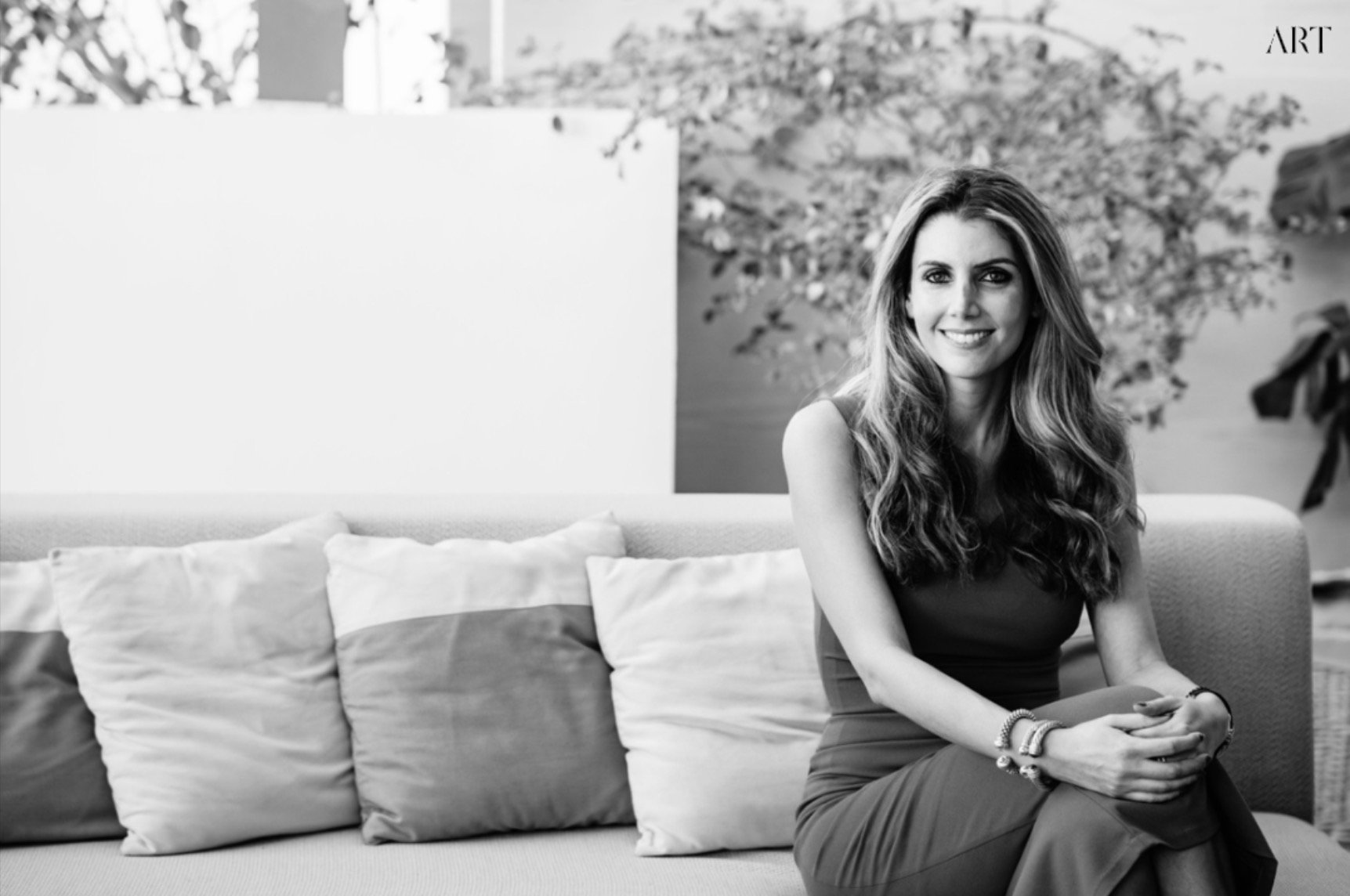
Picture by Katia Nounou Boueiz
On 10 December, the night before the Guggenheim Abu Dhabi opens on Saadiyat Island, an auctioneer will step up to a rostrum a short drive away and start selling paintings. Nobody at Sotheby's pretends the timing is a coincidence. Breaking Ground is the fine art sale at the heart of Sotheby's second Collectors' Week in the emirate. Last year's first edition was given over to luxury sales; this time the house has brought paintings, and the calendar lands them in the thick of a season that has redrawn the cultural map of the Gulf. Frieze has arrived at Manarat Al Saadiyat, taking over from Abu Dhabi Art after its 17-year run. Christie's held its own first sale in the city on 1 November. And the museum district that was a set of architects' renderings ten years ago is now, very nearly, a place you can walk through.
Sotheby's has brought a sale whose catalogue reads like an argument. There is a Monet still life, Prunes et Abricots, painted between 1882 and 1885 for the Paris apartment of the dealer Paul Durand-Ruel and estimated at $2 million to $2.6 million. There is Andy Warhol's Ads portfolio of 1985, made two years before his death and estimated at $2 million to $3 million. And in the same rooms are the Emiratis. Hassan Sharif, who knotted, bundled and piled up cheap, mass-produced things until the idea that art had to be precious began to look absurd. Mohamed Ahmed Ibrahim, whose forms seem to come up out of the earth and rock of Khor Fakkan. Najat Makki, whose canvas A Woman's State of Being (1988) carries an estimate of $30,000 to $50,000. Two artists make their auction debut, with the involvement of the artist and the estate: the Emirati poet, filmmaker and artist Nujoom Alghanem, and Nasser Al-Yousif.
The gap between those estimates is an undeniable fact of the evening, and it should be said plainly. The market prices what it already knows. An estimate measures the market, not an artist's place in history. Whether an auction can widen that knowledge, or only borrow the shine of a cultural moment, is the question that hangs over any sale like this in any new city. Abu Dhabi has spent two decades showing that it is not simply a new market. In that context, it is fair to ask an auction house what it intends to give back.
One lot makes that question unusually concrete. The Mastaba of Abu Dhabi (Project for UAE), a 2007 drawing by Christo, estimated at $180,000 to $250,000, shows a work that does not exist. Christo and Jeanne-Claude first imagined the Mastaba in 1977 and came to the UAE to look for a site two years later. The plan was a trapezoid 150 metres high and 300 metres long, built from 410,000 oil barrels painted in bright colours, standing in the sand near the Liwa oasis, about 160 kilometres south of the city. Jeanne-Claude died in 2009 and Christo in 2020. The engineering is done and the site is chosen, but nearly fifty years on the Mastaba remains a proposal. Selling a drawing of it in the country it was designed for is a strange and quite moving thing: a picture of a promise, offered for sale in the place still waiting for it.
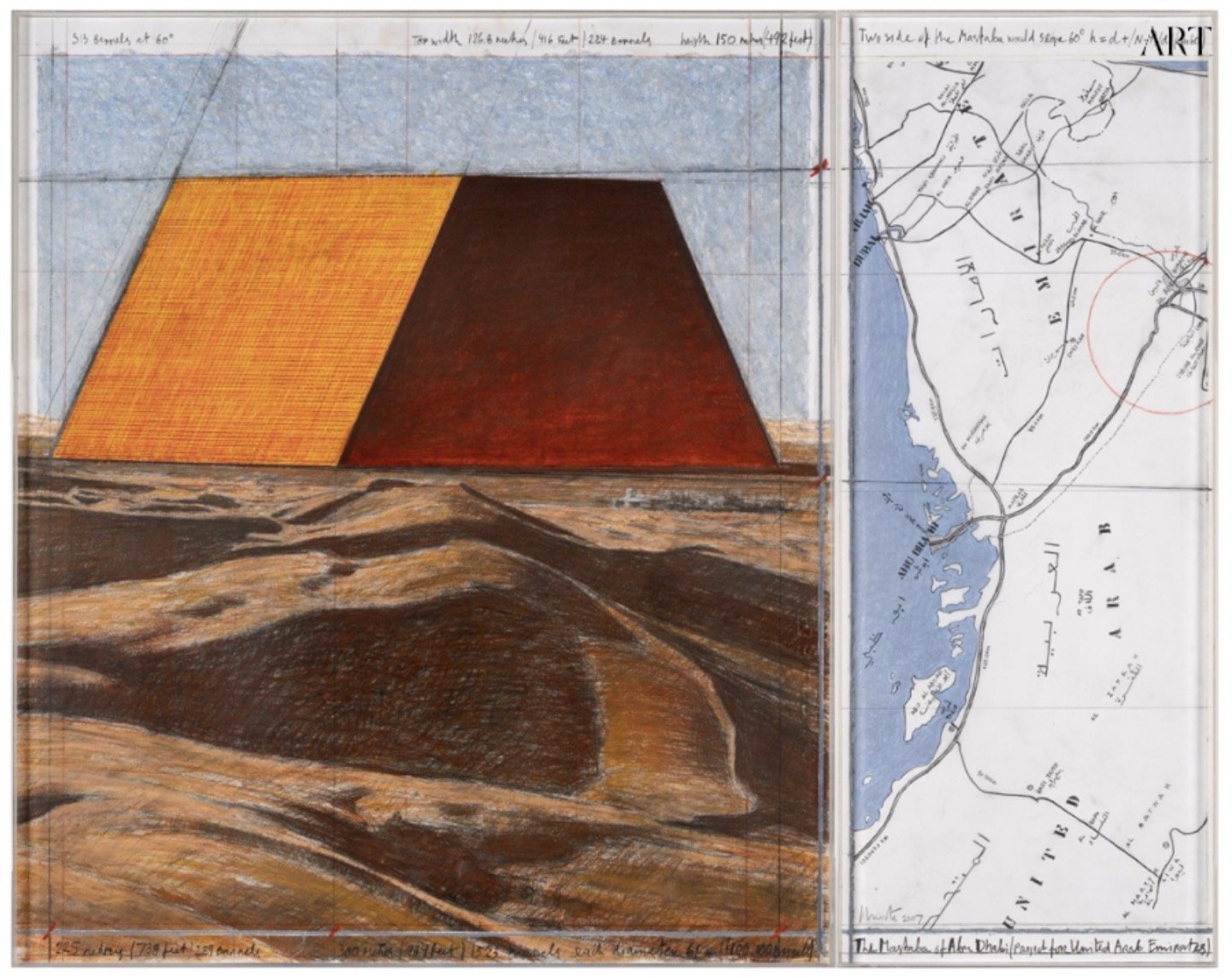
designed by the artist-duo Christo and Jeanne-Claude
If anyone is positioned to talk about what Sotheby's can offer here, it is Katia Nounou Boueiz. She joined the house's Private Client Group in London in 2008, working with a new generation of Middle Eastern collectors, and in 2015 she moved to Dubai to set up Sotheby's first office in the UAE. Over the decade since, she has built a calendar of exhibitions, talks and events across the region, much of it free and open to anyone who walks in. Now Sotheby's Chairman for the Middle East, she spoke to Author ahead of Frieze week. We did not ask her about prices. We asked her what an auction leaves behind.
When this sale is remembered five years from now, what change would tell you it helped build Abu Dhabi's cultural life, beyond the value of the works sold? What can Sotheby's commit to that would help bring that change about?
For me, the success of this inaugural sale will not simply be measured by the results achieved on auction night, but by the relationships and opportunities it helps create over the years that follow.
Abu Dhabi is at an extraordinary juncture in its cultural evolution. The Louvre Abu Dhabi is about to celebrate ten years, and with the forthcoming Guggenheim Abu Dhabi and the wider development of Saadiyat Island, the emirate is establishing itself as a truly international centre for art and culture. We see our presence here as part of that broader journey.
If, five years from now, we have helped introduce a new generation of collectors to art, encouraged greater engagement with art and culture, and contributed to a more dynamic exchange between the Middle East and the international art world, I would consider that a meaningful achievement.
Our responsibility is to build on this inaugural moment through continued exhibitions, educational initiatives, specialist engagement and opportunities for collectors and the wider public to encounter exceptional works of art. Ultimately, we want Sotheby's to be a lasting part of Abu Dhabi's cultural landscape, not simply a participant in its art market.
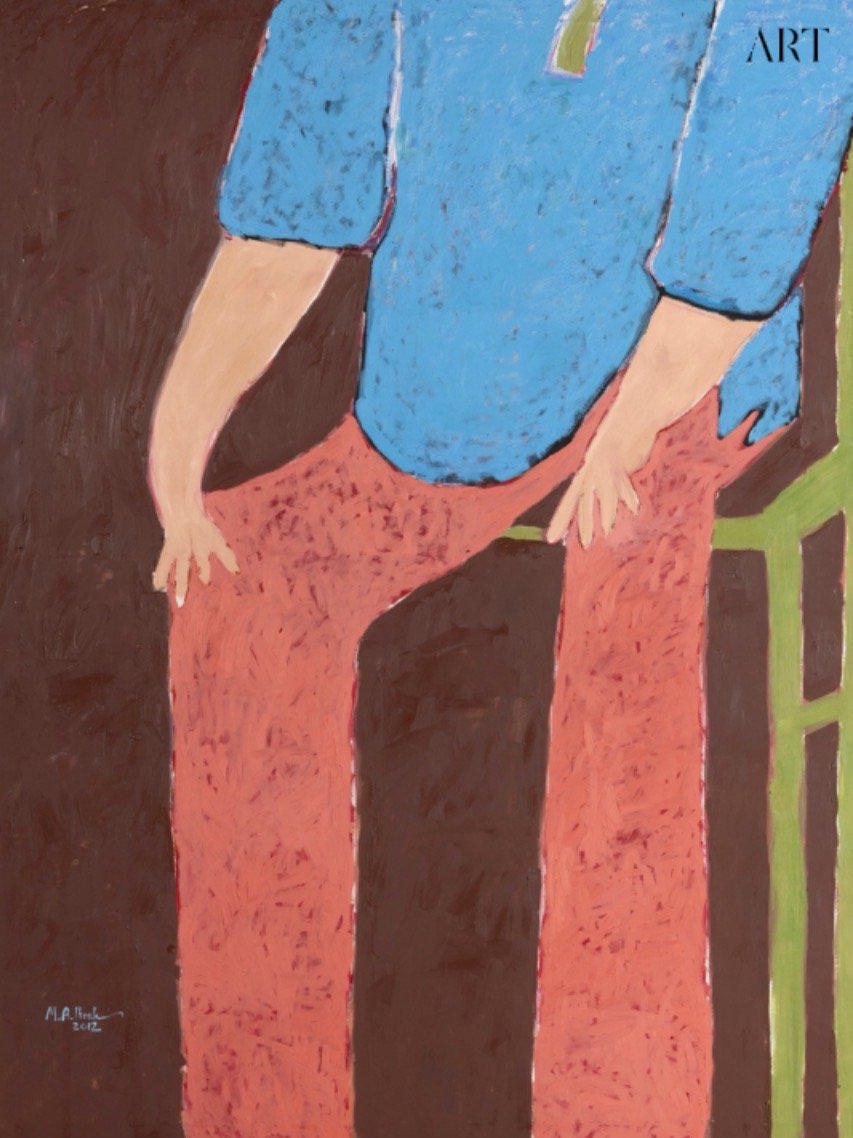
Sitting Man (2012) by Emirati conceptual artist Mohamed Ahmed Ibrahim
A global auction house gives works visibility, and it helps decide how they are described and valued. How will Sotheby's make sure Emirati artists are understood through the depth of their own histories, and not only as company for the internationally familiar names in the room?
This is something I feel particularly strongly about. One of the central ideas behind Breaking Ground is that artistic innovation does not belong exclusively to a single geography or to one period in history.
When we conceived this sale, it was important that Emirati artists such as Hassan Sharif, Mohamed Ahmed Ibrahim and Najat Makki were presented alongside internationally recognised figures such as Monet, Christo, Warhol and Lichtenstein, not simply as representatives of the UAE, but as artists whose practices have made important contributions to the wider history of art.
Our role is to ensure that these distinctive cultural histories and contexts are properly researched, documented and communicated through our catalogues, exhibitions and the work of our specialists. International visibility is important, but it should never come at the expense of an artist's individual story.
What excites me most is the opportunity to create conversations between artists from different backgrounds and generations, allowing audiences to discover both their differences and the shared spirit of experimentation that connects them.
The Christo and Jeanne-Claude drawing points towards the Mastaba proposed for Liwa, an artwork conceived for a specific landscape and still unrealised. What does showing it in Abu Dhabi let us see about the relationship between an idea, a place and an artwork that exists only as a proposal?
I find this work particularly fascinating because it reminds us that art is not always defined by a finished physical object. Sometimes the idea itself, and the ambition behind it, can be just as powerful.
Christo and Jeanne-Claude's proposed Mastaba in the Liwa desert is an extraordinary example of an artistic vision conceived in direct dialogue with its landscape. The desert is not simply a backdrop to the work; it is fundamental to its identity, scale and meaning.
Presenting this drawing in Abu Dhabi gives audiences an opportunity to engage with that vision in the very country for which it was conceived. There is something particularly meaningful about bringing the work into this context, where the relationship between art, architecture and landscape is already such an important part of the cultural conversation.
I also think it speaks beautifully to the title Breaking Ground. Christo and Jeanne-Claude continually challenged conventional ideas of what an artwork could be, pushing beyond the boundaries of traditional artistic practice.
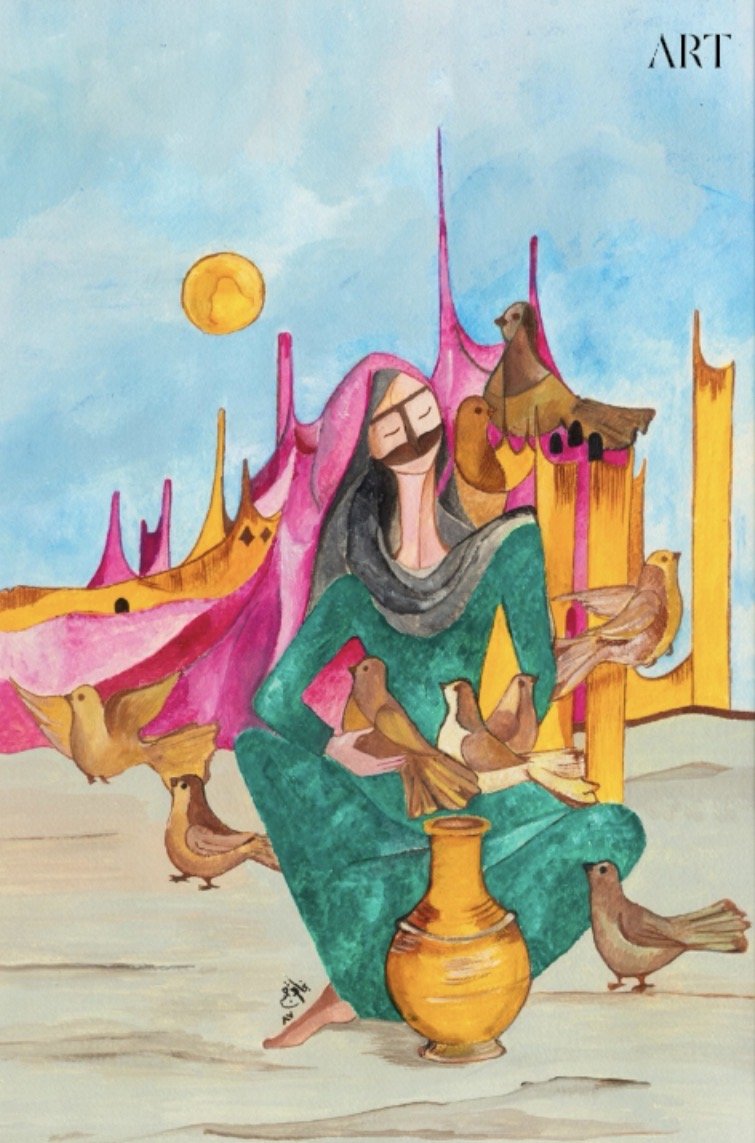
work of Dr. Najat Makki, a pioneering Emirati contemporary artist
Abu Dhabi's museums, galleries, foundations, fairs and auction houses now make up a dense cultural ecology. What is Sotheby's responsibility within it, and what can an auction house contribute that other institutions cannot?
I believe each institution has a distinct but complementary role to play in building a thriving cultural ecosystem.
Museums preserve, research and present art for future generations. Galleries nurture artists and support their careers. Foundations and cultural institutions contribute enormously to education, scholarship and public engagement.
As an auction house with more than 280 years of history, Sotheby's brings something different to that conversation: an international network of collectors, deep specialist expertise and the ability to connect works of art with audiences across geographies and generations.
One of our greatest strengths is our ability to bring extraordinary works, many of which have remained in private collections for decades, into the public eye. Through our exhibitions and auctions, we create opportunities for people to encounter works they might otherwise never have the chance to see.
We also play an important role in introducing regional artists to an international collecting audience, while encouraging collectors from around the world to engage more deeply with the artistic heritage of the Middle East.
For me, the most important thing is collaboration. We are not here to replicate what Abu Dhabi's museums or cultural institutions are doing, but rather to complement and strengthen the extraordinary work already underway. A successful cultural capital needs many different voices and institutions, and I believe Sotheby's can contribute meaningfully by connecting the local and the global, the historical and the contemporary, and the public with the private world of collecting.
The preview is open to visitors who may never intend to bid. What should the exhibition give them, and how can Sotheby's make a saleroom feel like a place for a serious public encounter with art?
This is actually one of the aspects of our work that I enjoy most, because I have always believed that an auction exhibition should be much more than a commercial event. At Sotheby's, our exhibitions are open to the public, and there is absolutely no expectation that someone visiting intends to buy.
I often say that collecting begins with curiosity. You don't need to be a collector to appreciate art, and sometimes a single encounter with an artwork can spark an interest that lasts a lifetime.
Our specialists are an essential part of this experience. Through conversations, guided visits and the stories behind the works, we hope to make the exhibition both intellectually engaging and welcoming.
If someone walks away having discovered an artist, learned something new or simply looked at a work of art differently, then I believe the exhibition has already achieved something important, regardless of whether that person ever raises a paddle.
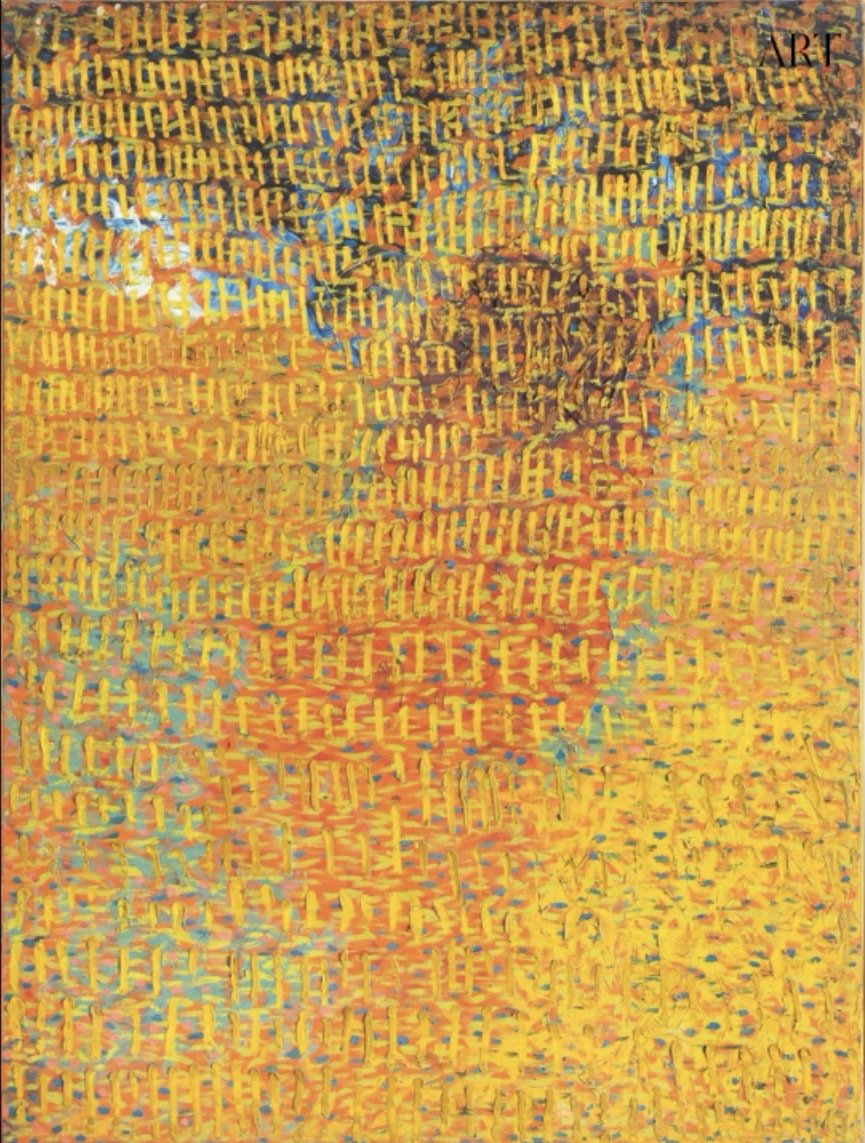
Untitled oil on canvas painting (1991) by pioneering Emirati artist Mohamed Ahmed Ibrahim
If a visitor could carry one question away from the exhibition, what question about art, place or collecting would you most want them to keep asking?
I think the question I would most like people to leave with is: what does it really mean to break new ground in art? It is a question that sits at the heart of this auction, and one that I find endlessly fascinating.
When you look across the exhibition, you encounter artists from vastly different periods, cultures and backgrounds, yet so many are connected by a willingness to challenge conventions and imagine something new.
I would love visitors to leave not only thinking about the artworks they have seen, but also questioning what makes art meaningful to them personally, and perhaps discovering something they never expected to connect with.
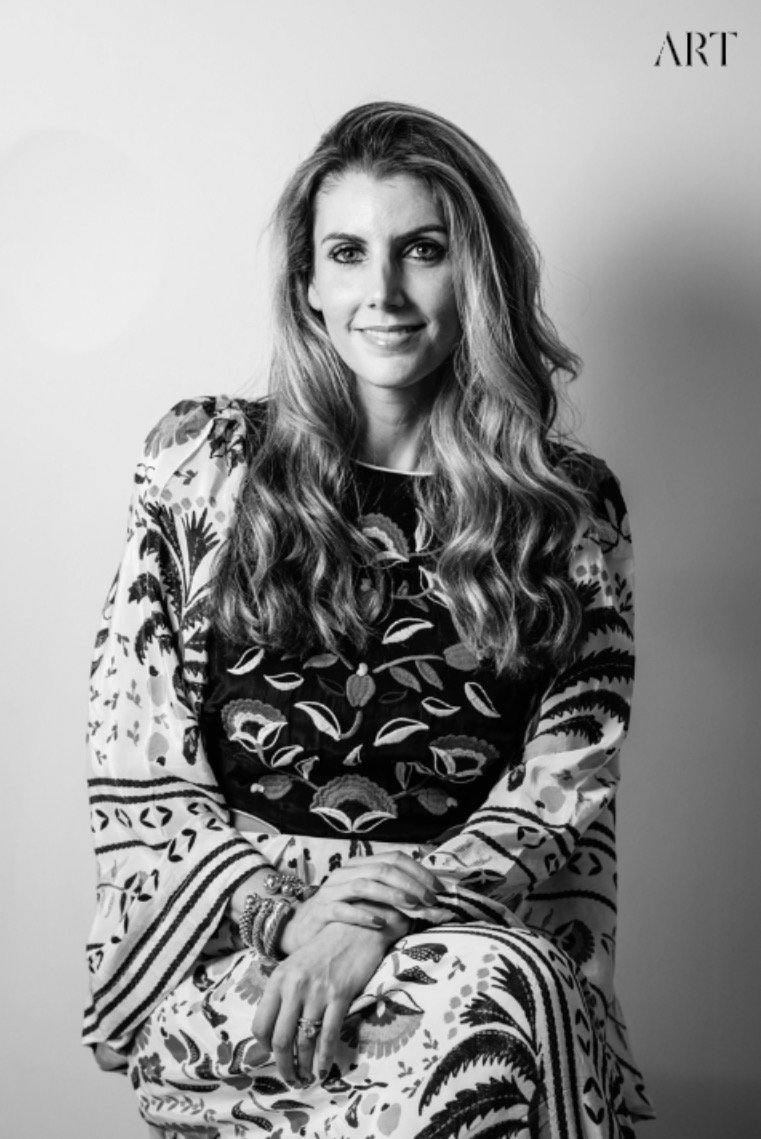
Picture by Katia Nounou Boueiz
*
It is a good question, and in Abu Dhabi it is also a literal one. Breaking ground means putting a spade in the earth, and this city has done a great deal of that: the Louvre, the Zayed National Museum, the Natural History Museum, and now the Guggenheim, all a few minutes from the saleroom. What the next few years will test is whether the buildings are matched by something harder to build, which is a public that looks closely and a market that learns to value its own artists on their own terms. An auction cannot do that alone, and Boueiz does not claim it can. But it can decide what it puts in front of people, how carefully it tells their stories, and whether the doors stay open to those who came only to look.
Out near Liwa, for now, the sand where the Mastaba was meant to stand is still unbroken.
Breaking Ground is at Sotheby's Abu Dhabi Collectors' Week, Saadiyat Grove Experience Centre, Saadiyat Island. The public exhibition opens on 4 December; the auction takes place on 10 December. sothebys.com
Katia Nounou Boueiz is Chairman, Middle East, at Sotheby's, based in Dubai. She joined the house's Private Client Group in London in 2008, focusing on new collectors from the Middle East, and in 2015 moved to Dubai to establish and lead Sotheby's first office in the UAE. Since then she has built a year-round programme of exhibitions, lectures and events across the region and looks after many of its leading collectors. She holds a degree in French Literature from University College London and was named in Apollo magazine's 40 Under 40 Middle East.
BY OONA CHANEL
