

Juma Al Haj paints writing that no one can read. With Revelation newly open in Abu Dhabi and a new life under way in Paris, he talks to Oona Chanel about language, faith, belonging, and what happens when words run out.
By Ron John
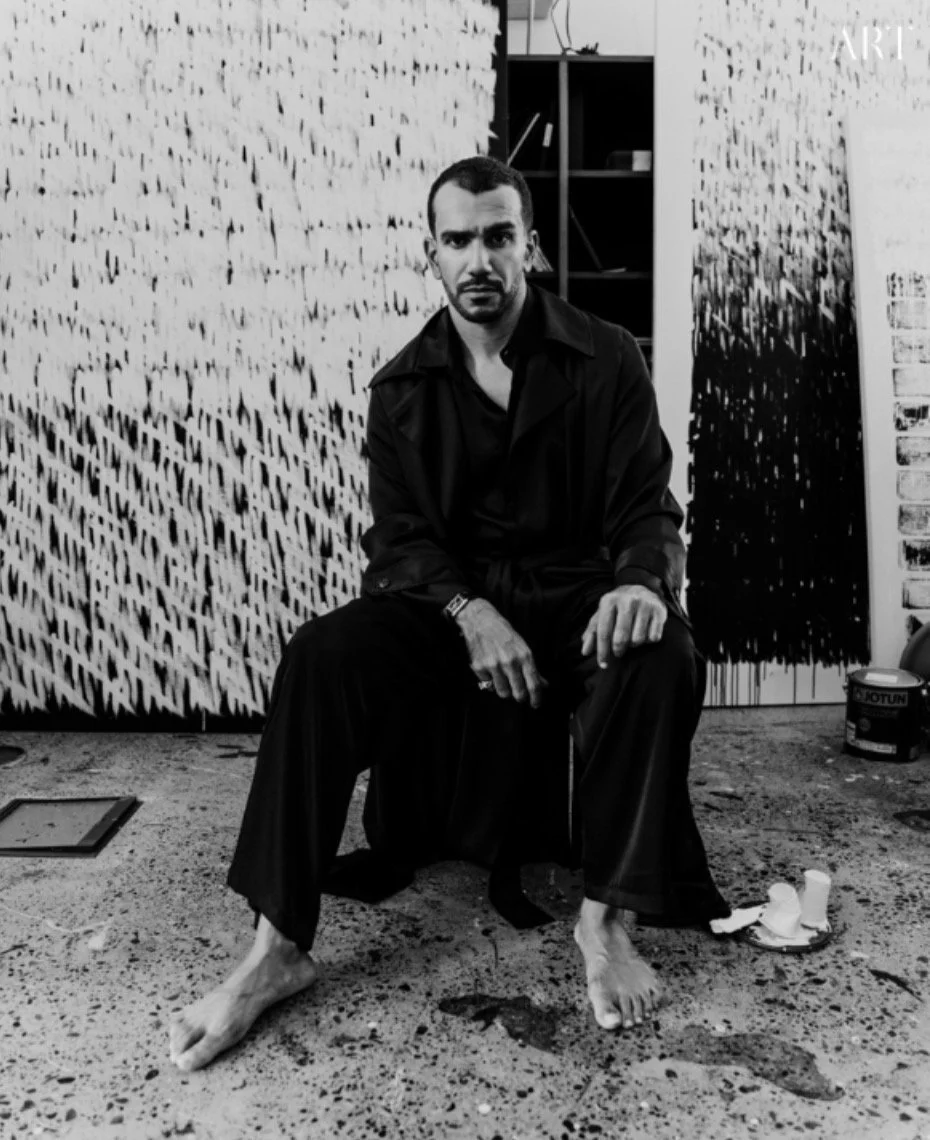
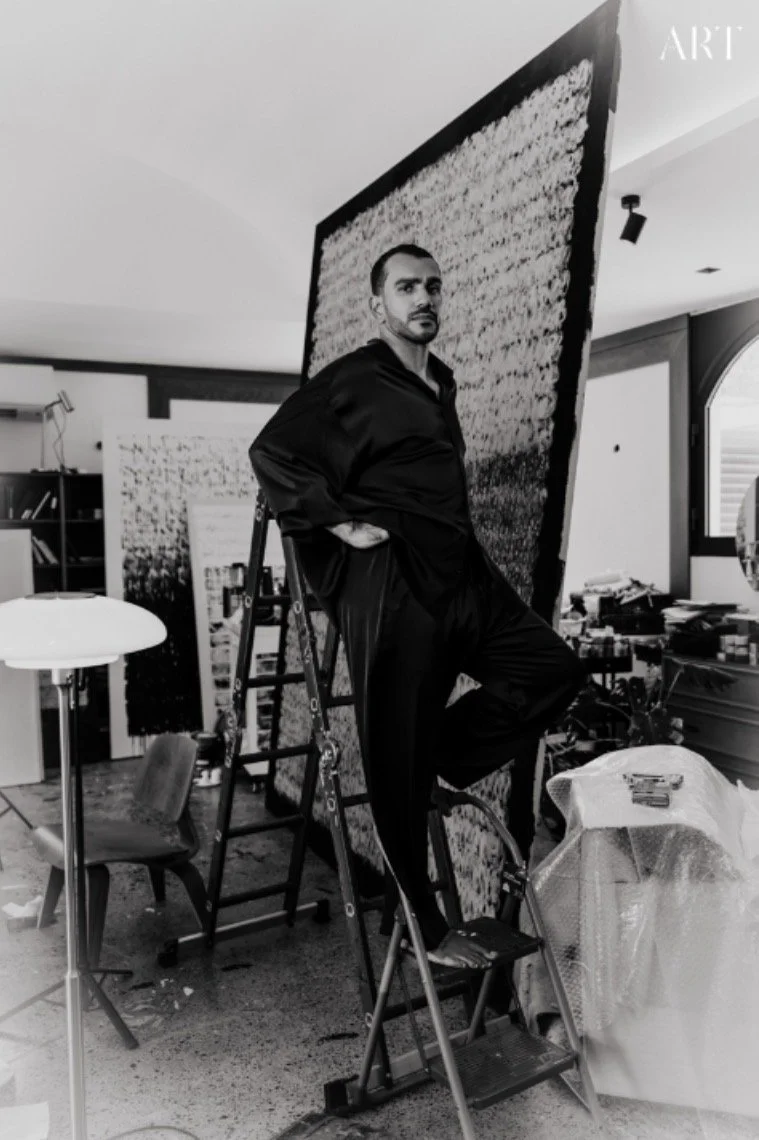
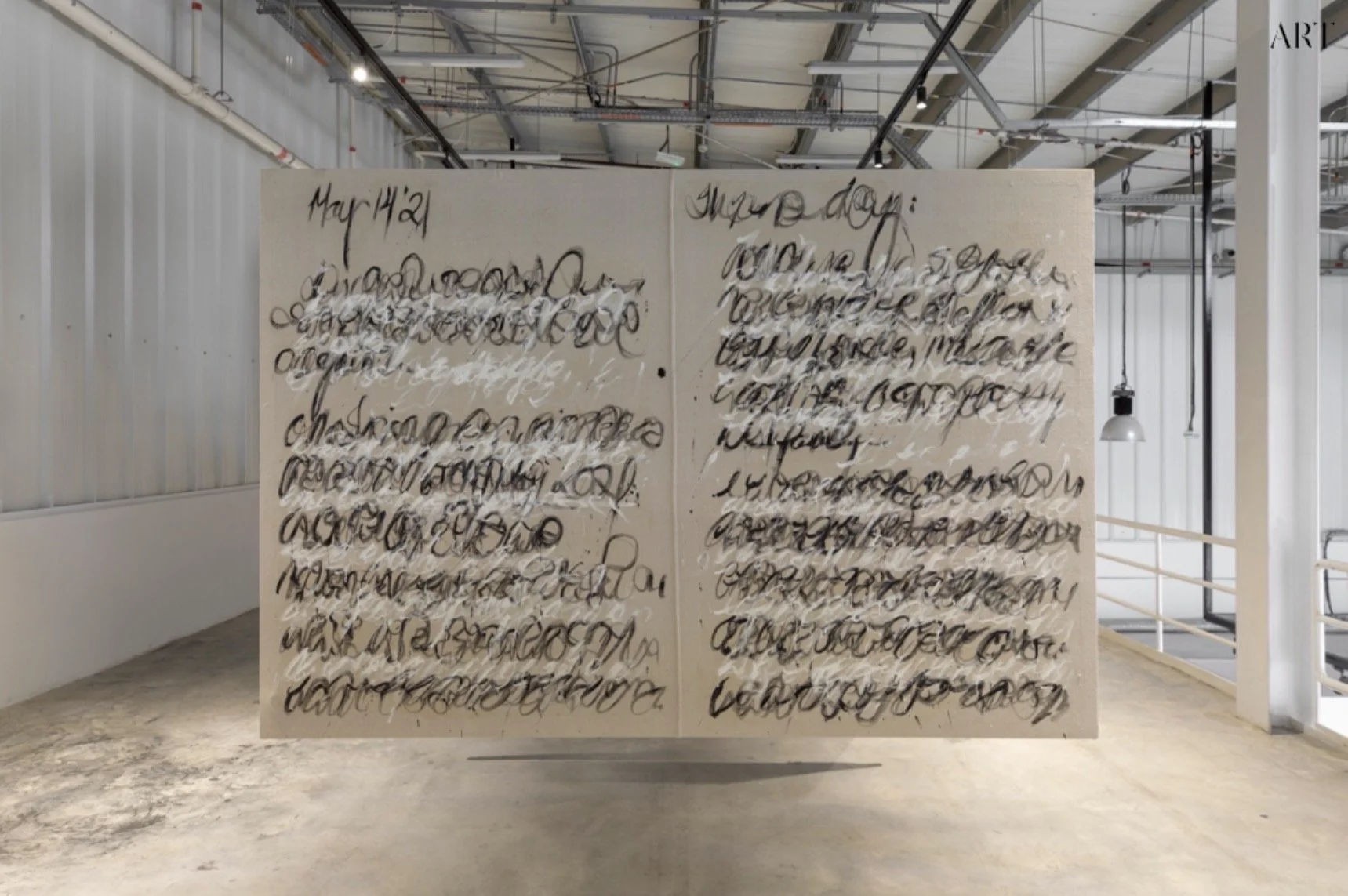
Juma Al Haj's paintings began as homework. He was a boy at a school in the United States, his Arabic slipping, and his tutor had told him his handwriting wasn't good enough. The school's artist-in-residence, a man of Lebanese descent who couldn't write Arabic himself, gave him drills to loosen his wrist: the shapes of Arabic letters, pulled apart and repeated, fast, then slow. Arabic is written from right to left. Al Haj did the drills from left to right.
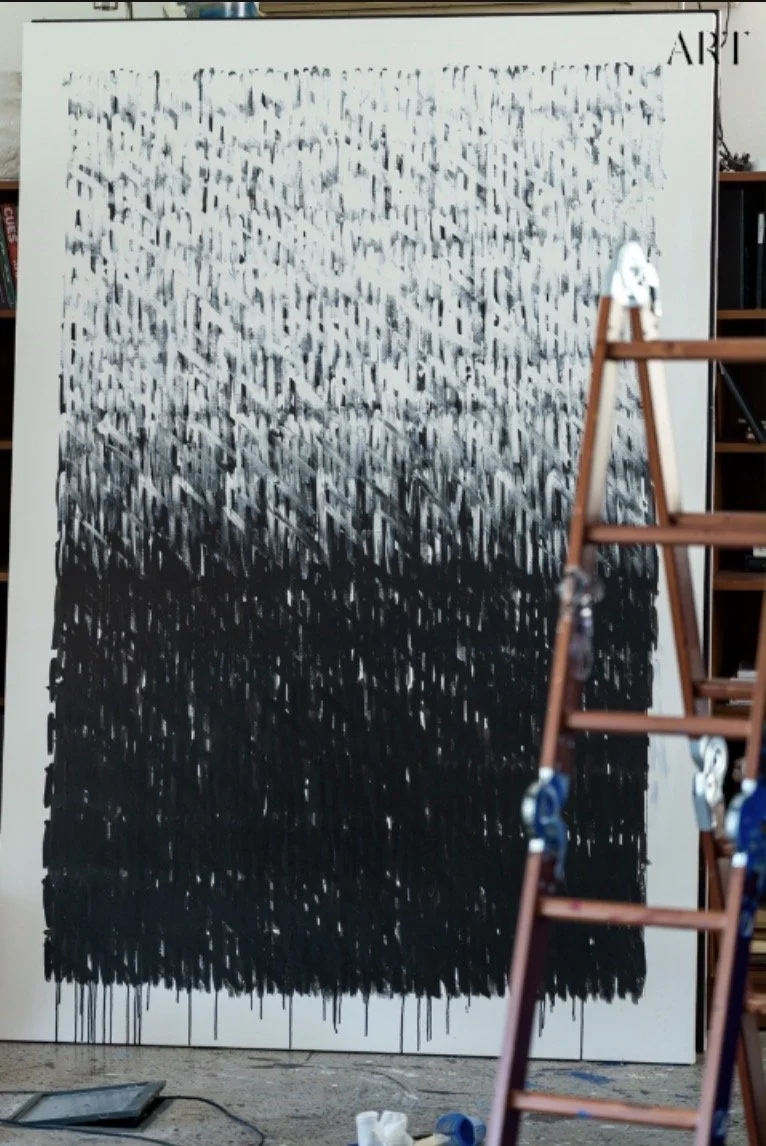
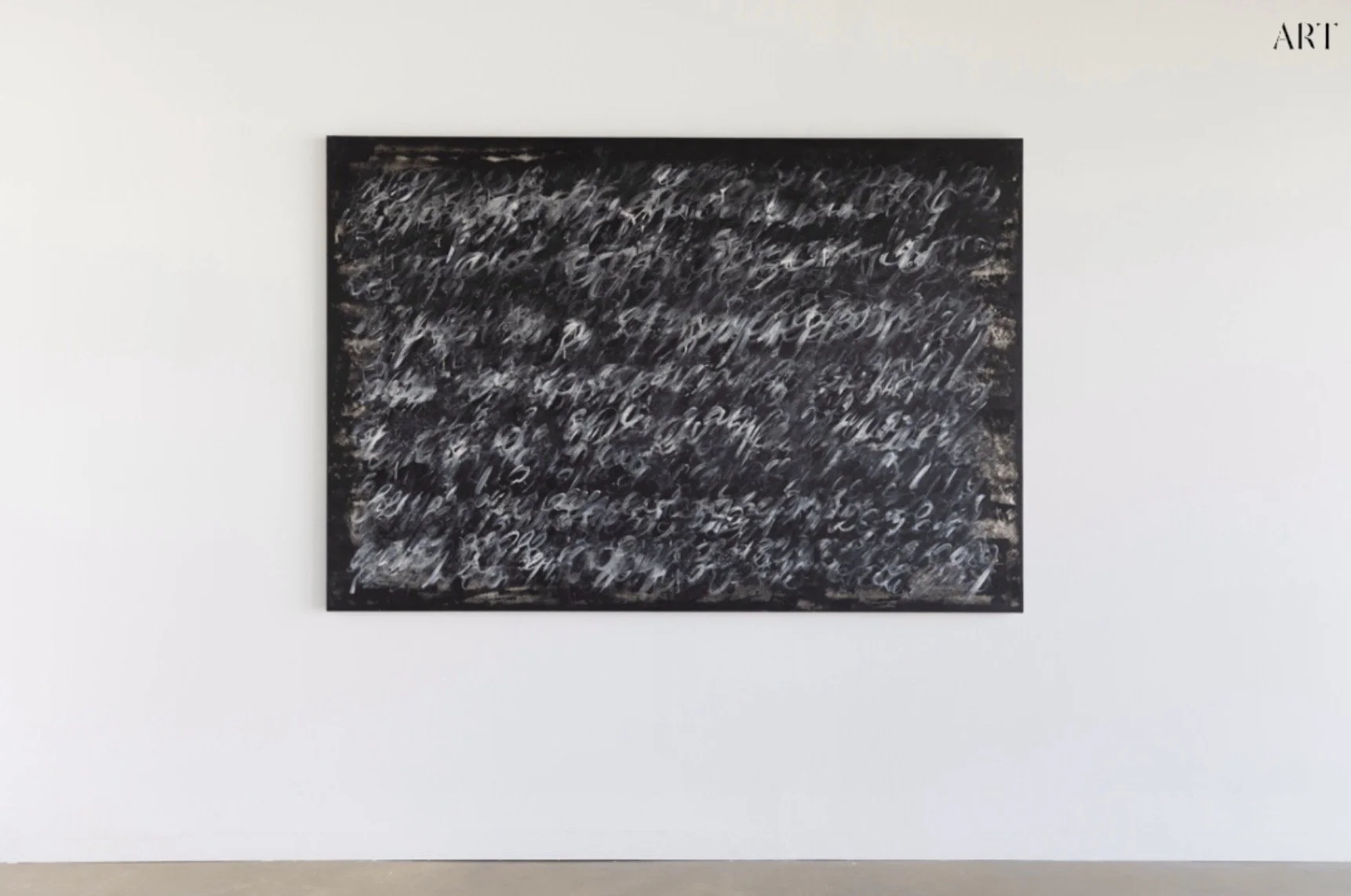
Those drills now cover canvases held by the Barjeel Art Foundation, the UAE Ministry of Culture, the Bvlgari Art Collection, the Zayed National Museum and the private collection of UAE President Sheikh Mohamed. They look like writing. Lines cross the canvas in even rows, spaced like verse or scripture, and the eye starts to read before it understands there is nothing there to read. That moment, when a page turns out to have no words on it, is where Al Haj works. He removes the meaning of a text and keeps everything else: its rhythm, its weight, the feeling it was written in.
Critics often bring up Cy Twombly, and the comparison holds as far as it goes. Both artists treat a handwritten line as the record of a mind at work. But Twombly's line is restless, and Al Haj's keeps to its margins and moves at the pace of recitation. His sources are the Qur'an, devotional poetry and his own diaries, and the paintings keep the reverence of those texts after the words have gone. You can't read them. You can still feel what they are for.
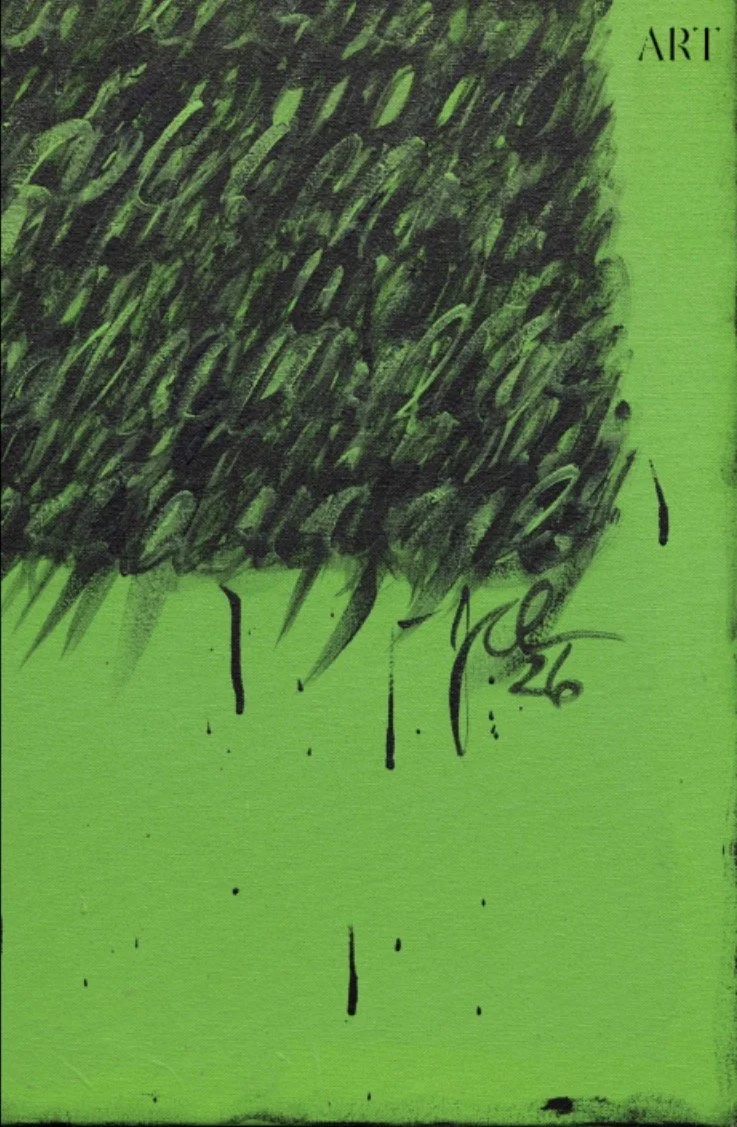
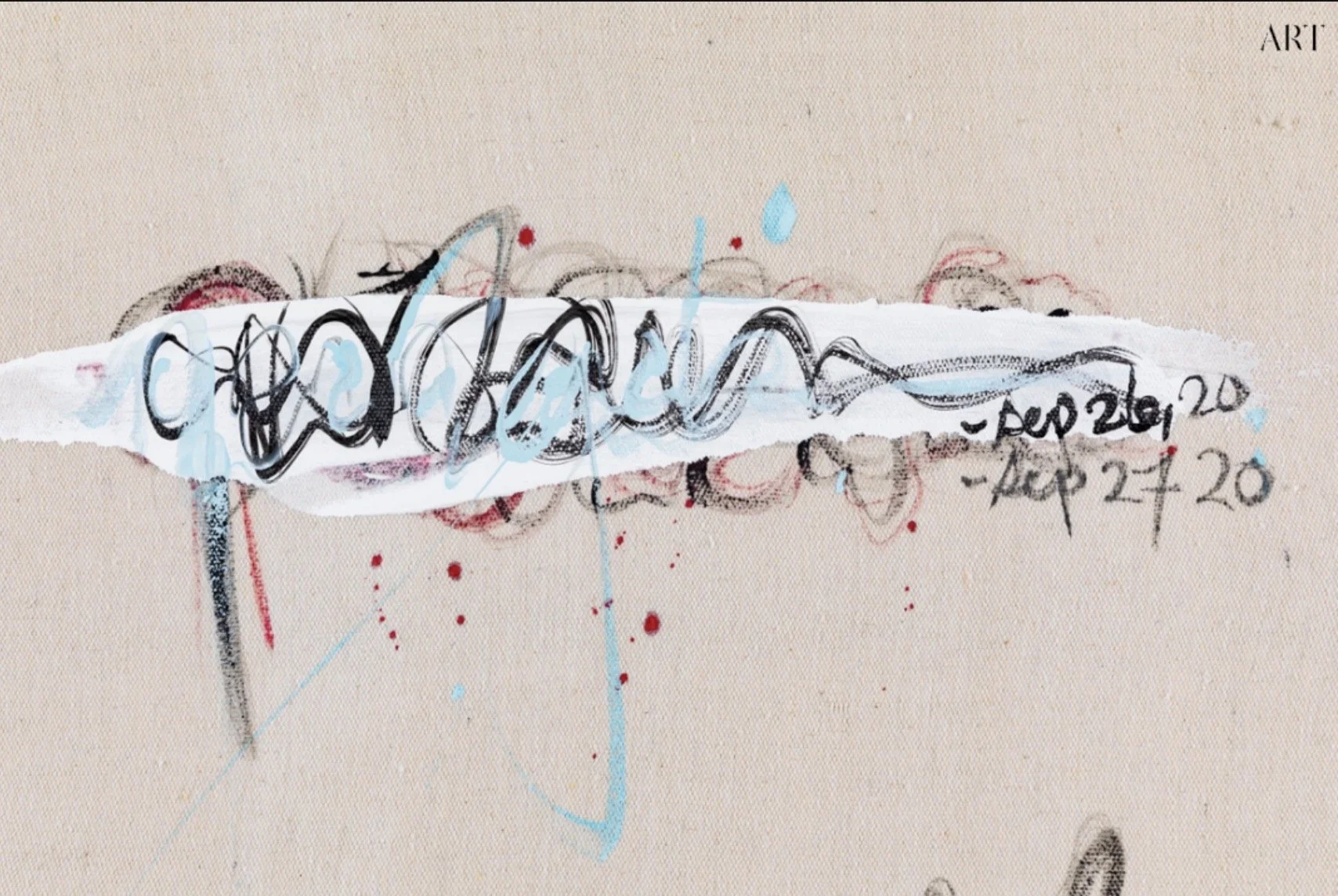
Al Haj was born in 1990 and grew up between the UAE and the US, spending the years around 9/11 in American classrooms with few Arab families nearby. He studied visual communication at the American University of Sharjah, then took a master's in international relations with a focus on visual rhetoric. Painting came later, and it came through grief. On 1 July 2019 his close friend Khalid, whom he thought of as an older brother, died in London. Al Haj couldn't write a word. In about fifteen minutes he made a painting instead, and dated it at the top like a diary entry. It is still in his studio. He has worked the same way ever since, journalling, sometimes for weeks, before he paints, so that each canvas keeps the shape of an entry: a date, a feeling, then text that can no longer be read.
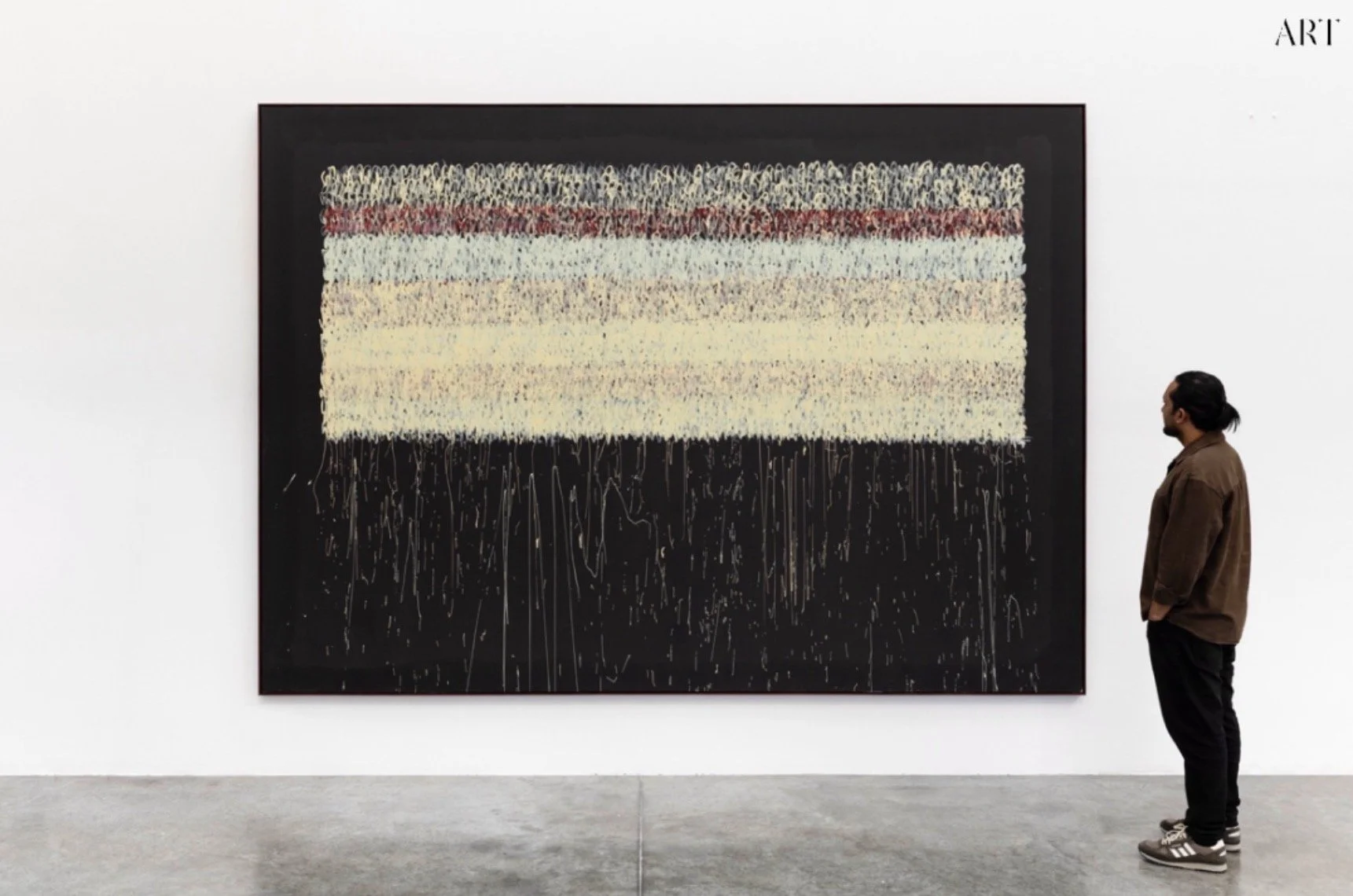
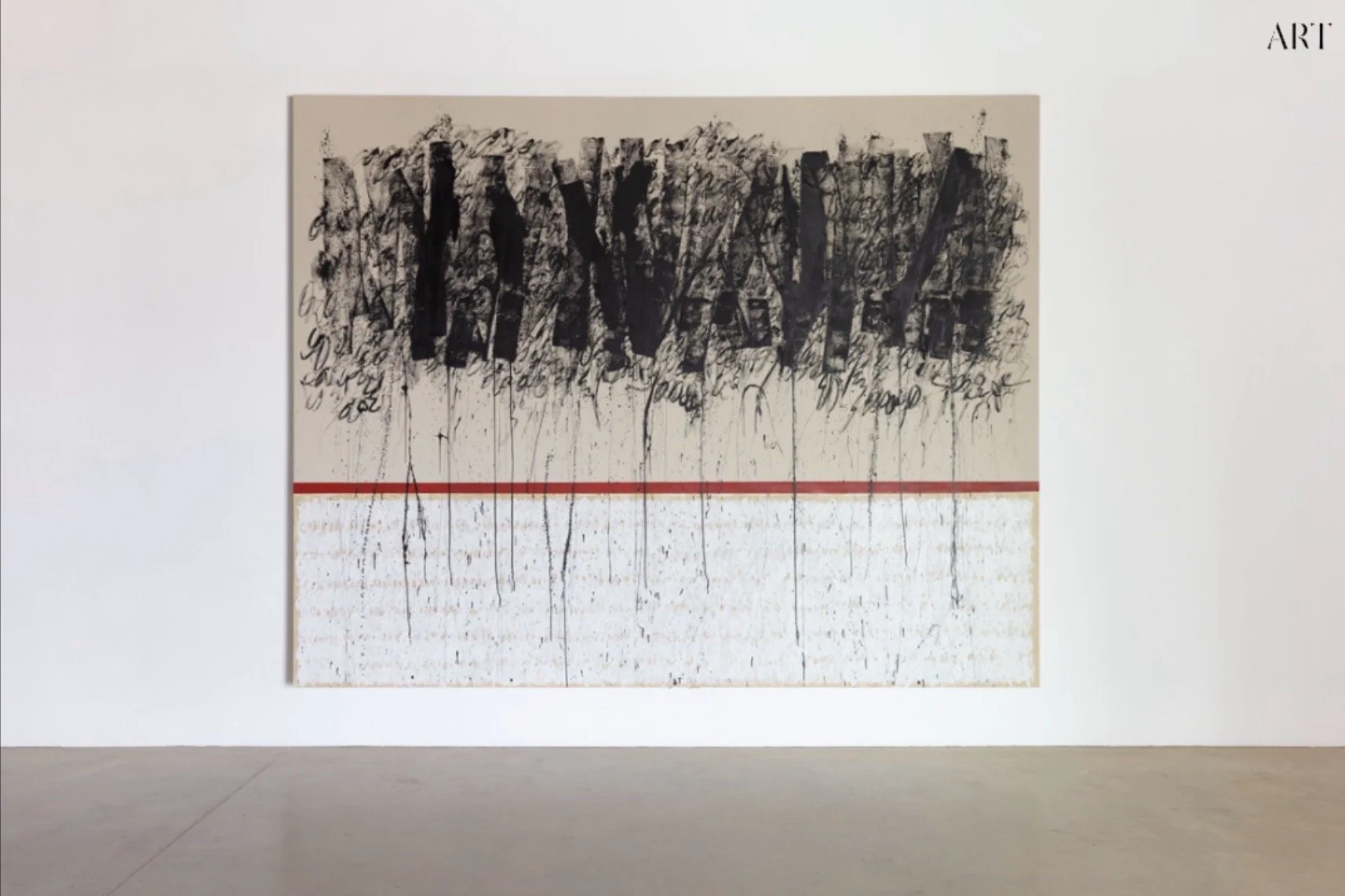
He began to focus seriously on his art in 2020. Frame of Mind, his first solo show, curated by Iris Projects at The Foundry by Emaar, opened in 2021. In 2023 he took part in the inaugural Dubai Calligraphy Biennale, and that November showed The Return (راجعون) at Alserkal Avenue, a body of work about death. Its Arabic title comes from the verse Muslims say when someone dies: to Him we return. This year's Interoception, at Iris Projects in Abu Dhabi, is named for the body's sense of what is happening inside it. He made it in the months after missile attacks hit the UAE, and for the first time the neat rows broke. Paint drips through the script. The yellow of emergency phone alerts sits on top of it. A red line runs across the largest canvas.
Revelation, which opened at 421 Arts Campus in Abu Dhabi on 4 October, takes the text off the canvas altogether. Inscriptions appear on engraved glass and hanging forms, and the show ends in Hijr, a dark room built around a monolithic water feature and set aside for tafakkur, contemplation. Nothing in that room asks to be read. You sit with it. It runs until 10 January 2027.
Al Haj himself now lives in Paris. He left his job as director of marketing at the Sharjah Research, Technology and Innovation Park to begin an MFA at the Paris College of Art, in a city whose language he is still learning. For an artist whose work begins with not being able to read, it is a strange and fitting place to have landed.
He has been interviewed plenty about technique and influence. Over a long lunch at a Portuguese restaurant by the canal in Dubai, shortly before he left, I wanted to ask him something else: what language was before it meant anything, whether the hand remembers what the mind forgets, whether a painting can be conscious, where a person belongs. His paintings raise those questions without words. I wanted to hear what he would say when he had to use them.
Oona Chanel: Before language acquired a meaning, what do you imagine it was?
Juma Al Haj: Oh, wow. Diving straight into it. My answer probably goes against what's normally said: it's always been a barrier. I grew up in a multicultural environment, just as the UAE was starting to open up, and then we left for a completely different one. Somewhere in the middle we moved to another city when I was eight, and the Bedouin dialect there was completely different, so I had to get used to that as well. Every time we went somewhere new, I felt I didn't have the skills to adapt. I had to restart.
Even my accent. My mom has Saudi roots, my father grew up in Kuwait, we live in the UAE, and I have cousins in Qatar. All these dialects are a mishmash, so nobody really knows where I'm from. When I use certain words, people think I'm trying to impersonate a particular group, or that I'm being pretentious. So it's always been a barrier. Hence the painting: when all of that breaks down, the abstraction of the text becomes something everybody can understand and interpret in their own way.
OC: When you were little and kept restarting, did those walls come down?
JA: They thickened. They went up high. Painting broke the barriers down; restarting strengthened them. It's like a wound that heals — there's a scar, and it still stings. It felt like an obligation to speak each language perfectly. And it's ironic that we're talking about language, because my new goal is to learn French. Right now I see it as an obstacle to my life there, and it's the one thing I'm really nervous about.
OC: Really?
JA: Yes. When you speak the language, you gain respect, and to me respect is number one. I don't like it when people automatically withhold it because they think you're disrespecting them, just because of a language barrier.
OC: Did living between languages divide your sense of self, or reveal that the self has no fixed language?
JA: Oh, it definitely divided it. I never felt I belonged to any cultural group, even within the Khaleeji sphere. Our home is very Khaleeji, but mixed. Then the Arabic was different, and so were the kinds of English — I went to a British school, then an American school, each with its own way of using the language. It just divided everything. So I had to create my own internal art piece within myself, in order to function.
Nobody could give me a guide. Even my siblings didn't share my experience; they were older and more settled by the time my father started moving from country to country and we followed. When we went to the States, my brother Ali, the youngest of them, was about 13. He had a foundation. I was barely seven. So I had to figure out how to build my own structure.
That structure he built for himself as a child still runs through the work. Almost every painting starts in a notebook, in words, before he takes the words away. So I asked him where they stop working.
OC: Your medium is the word. When does the word cease to describe reality and begin to create it?
JA: When I feel a burning in my soul, in my chest, in my entire bodily being. A burning I need to get out. Sometimes I hold a pen for a long while and don't know what to write, and I immediately turn back to painting. That's when words fail: when you can't describe that burning with a proper formulation of words. Words are a formula. If you can't find that formula within you, it doesn't exist. And when it doesn't exist, you have to create your own formula in order to keep going.
By Ron John
OC: What remains of the word once you remove its legibility?
JA: The physical form of a word is a vessel. Or think of it as Pandora's box: once you're brave enough to open it, all the true meanings of that word come out. The shape of a word is very limiting to its meanings, and what I do is try to free words from that confinement. In essence, that's how I feel as an artist, as a human, as Juma. I'm trying to free myself from confinements I've found myself falling into. So the act of deconstructing the word is the act of liberation. And then you, the observer, are free to interpret what you see however you want.
That has always been the ultimate goal. I don't like it when people come up to me and ask, "So where is the abstraction of the word?" No, no, no — that's up to you. You make up the narrative. If the feeling you get from the painting is similar to mine, it's successful to me. But if new narratives come out, which has happened many a time, that's successful too, because I was able to relay an emotion. So the form of the word represents limitation, and abstracting it —
OC: Liberation.
JA: Liberation. Limitation and liberation.
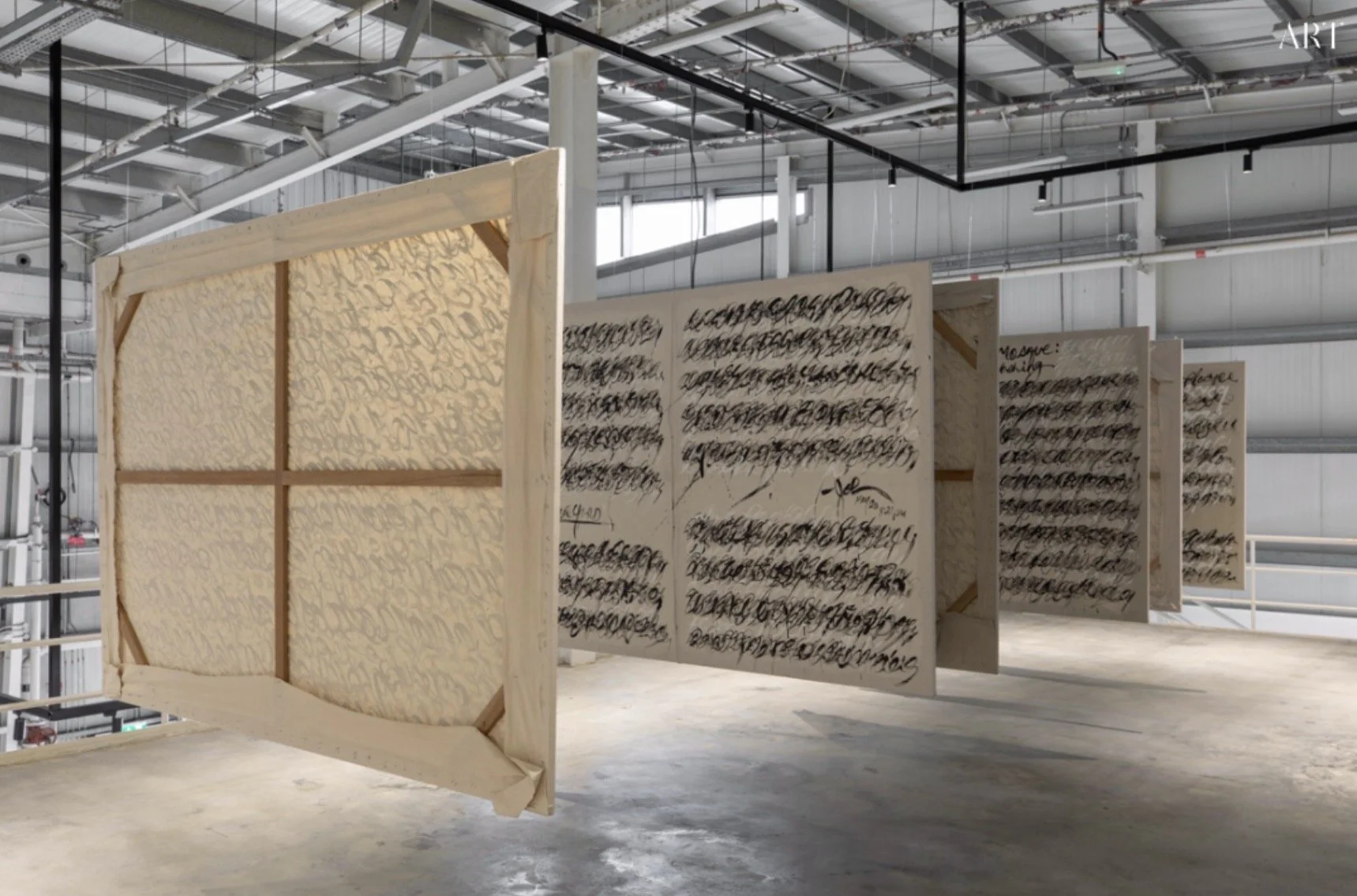
Presented in Zayed national museum .
OC: If language gives form to consciousness, what happens to consciousness when language dissolves?
JA: It expands, definitely, because you become more curious. You're not limited by a certain vocabulary. There's no box, and that's where you start becoming creative. I was telling a friend this very morning — he also left his government job — and he couldn't describe how he felt. I said, "I feel so much more curious about the world now," and he said, "You know what? Yes." Words limit you. And if you're not free, why are you alive?
OC: Your paintings begin in private journals. Which self writes, and which self later returns to paint?
JA: Ooh. The conscious self writes, and the unconscious self paints. When I write, I need to understand and process what's going on in my mind, and that takes self-awareness and analysis. But sometimes in the studio I find myself moving in a pattern, unconsciously, for hours — right to left, left to right, over the painting — and when I look at the time, I don't realise how much has passed. I think that's where my most genuine works emerge: when I let my body do the work, not my brain.
OC: Would you call that state a trance?
JA: It could be. Definitely. It starts with a certain idea, and then it expands. You know when there's so much helium in a balloon that it pops, and the helium drifts off into different realms? The moment I enter that trance is the moment it pops. I'm just floating, letting the words and the painting take over.
OC: When the gesture is repeated, at what point does writing become a ritual?
JA: When you put your trust in it. Then it becomes your safe space. How do you put your trust in the strokes and gestures? You repeat them so much that you become comfortable with them. Then you become comfortable altering them as you go, and eventually they morph together into a beautiful piece. It's a game of trust — like a relationship. If you repeat the things your counterpart appreciates often enough, they put their trust in you. It's the same with the painting. With time, the gestures create an image that both of us, as conscious beings — the painting and myself — reflect.
OC: Does the hand remember what the mind has forgotten?
JA: Oh, yes. Absolutely. If you repeat something long enough, your entire body trusts the process. It knows that if I do this, I'm going to get something beautiful out of it. The body is smarter than people allow; it builds that second nature by itself, without asking permission from my conscious mind. And it isn't only the hand. Sometimes I don't know how I got from point A to point B — I just find myself there. There's a memory bank somewhere in the body that the mind can't control, and it only comes out in the most intimate, most emotional, most vulnerable moments you can go through.
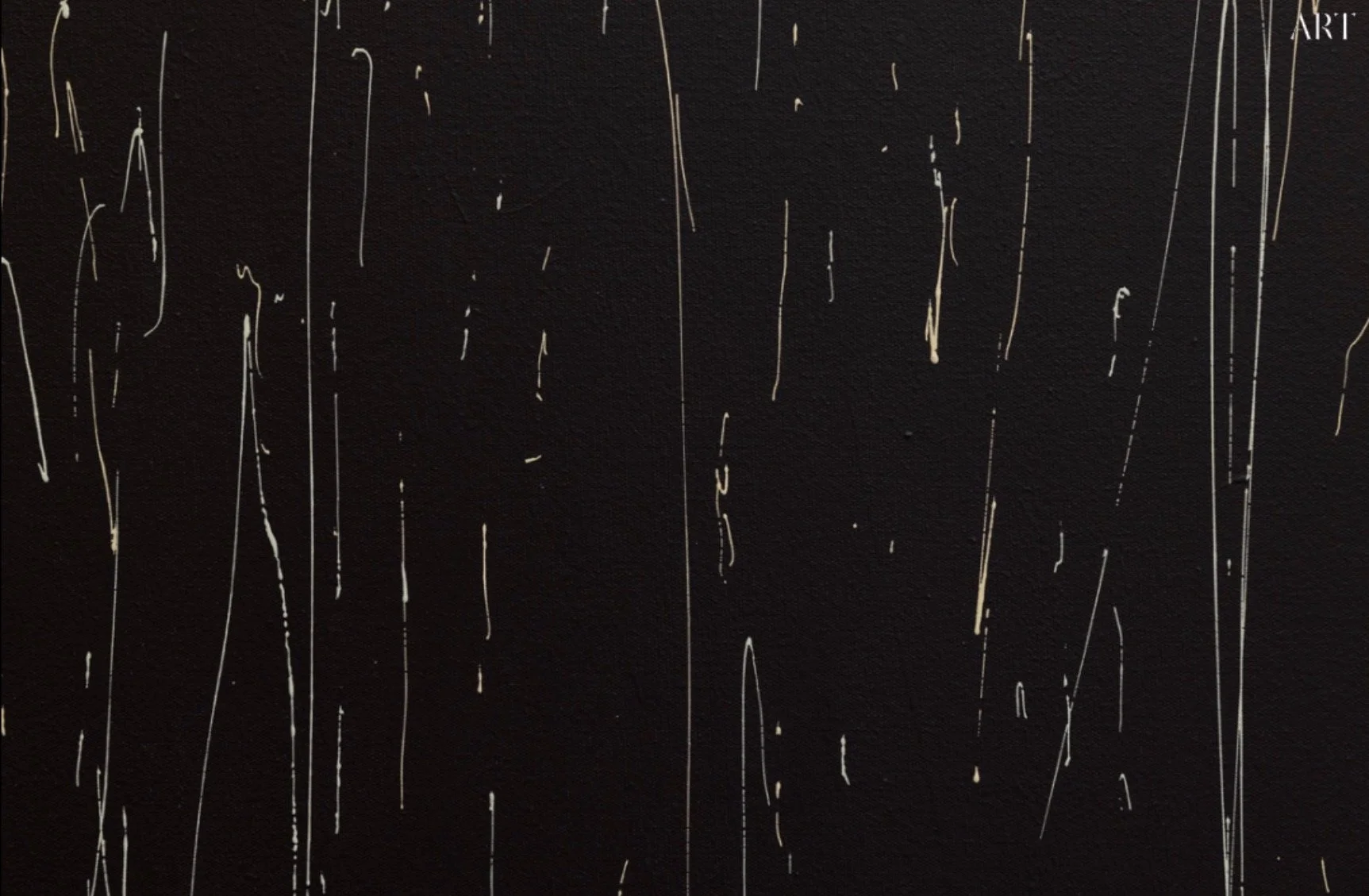
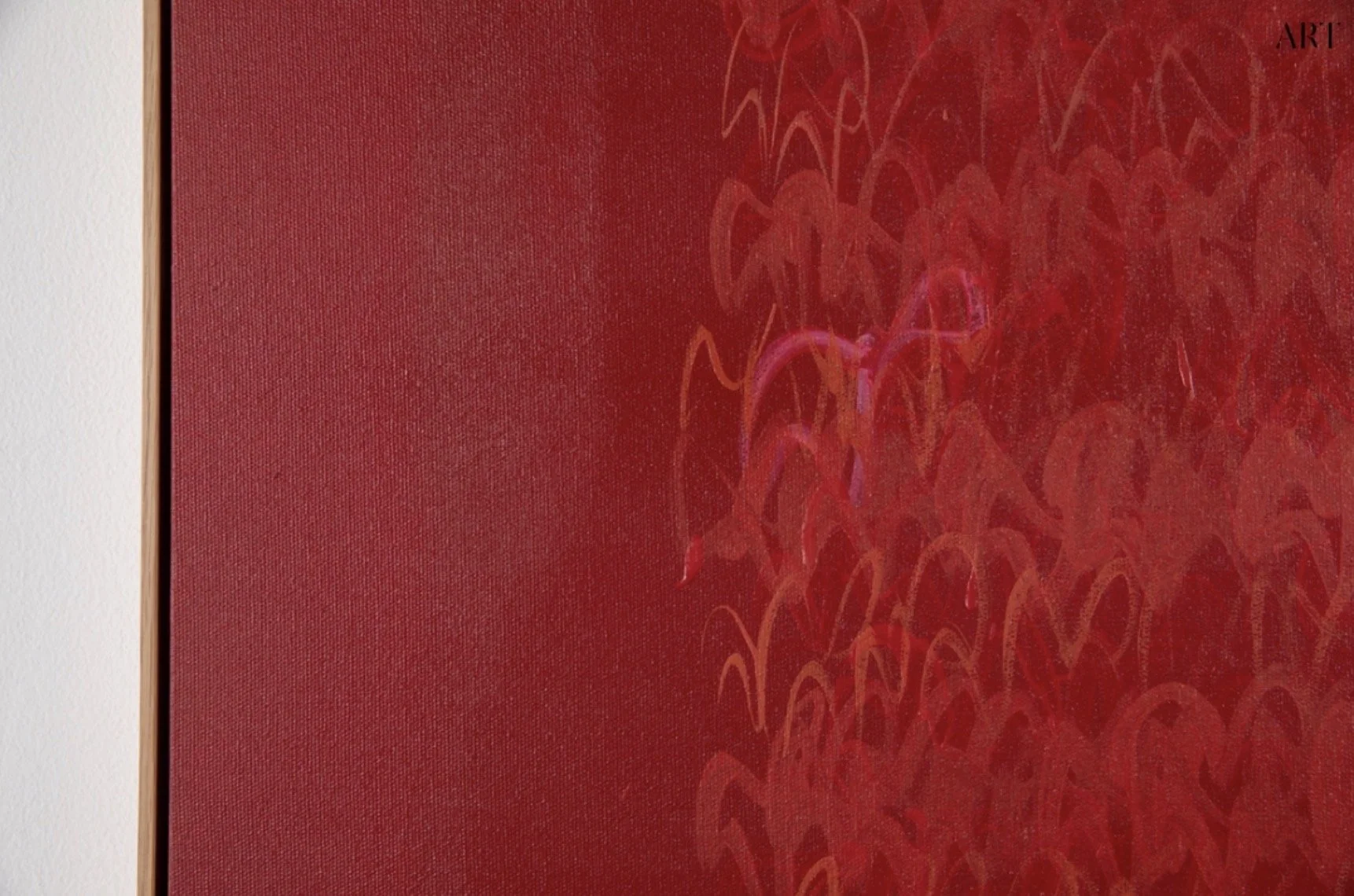
Spend time in front of one of his canvases and it changes as you look. A colour comes up from under the script; a line you missed moves forward. He paints in layers, and the layers hold things back.
OC: Is abstraction a way of concealing meaning, or of returning it to its original infinity?
JA: A bit of both. There are a lot of hidden messages in my paintings — through colour, through gestures, through layers. So it's a way of hiding some meanings. But those hidden meanings build on one another and create a new definition for themselves. You need hidden meanings to create a new, expanded meaning. Any work has to have a core — a subject, an emotion — but then you let it take its own shape. It takes on a life of its own.
OC: Would you say a painting can have its own consciousness?
JA: Yes. Every time you look at a painting, it chooses the part it wants to reveal, because there are so many layers. Wherever your eye falls — the time of day, your emotions — it chooses what it wants to say to you. When it does that, it has a consciousness of its own. Oh my God, you're making me sound so philosophical today.
OC: Your paintings carry feelings that sit beyond words. Where do those feelings come from?
JA: That's the whole point of my paintings: to convey what's indescribable. You're supposed to be in awe, to feel free, to be lost in the painting. I've painted about death. I've painted about breakups, about change, about war. Every time I've had the urge to create a body of work, I was in an extreme emotional state. The relaxed state is beautiful, but it creates mediocre work. An extreme state — even an extreme state of joy — creates wonderful work. You have that hunger, an excess of unresolved emotion that needs an outlet. And that's what happens on the canvas.
OC: Does a painting hold a moment, or is it time passing through you?
JA: When people ask me what I paint, I usually say I try to paint an expression of what remains. So I think painting is an expression of time passing through me. I paint moments, but those moments have to pass through me first. I'm the medium. I think paintings are divine messages that find mediums through which to be released into the world.
I don't think the divine speaks without a vessel, because we are all vessels — even solid things are vessels. When I say divine, I don't mean it in the strict religious sense. I mean the spiritual, the world we cannot see, the emotional, the intangible. Those things need a way to become tangible. That's where painting comes in. The artist is the vessel, the painting is the medium, and the checkpoint is what you feel after you see it. In essence, the intangible has to pass through the tangible to become intangible again, in a new way.
OC: Is that consciousness expressing itself?
JA: No, I don't want to reduce it to consciousness. It's bigger than that. It's an energy. That word is used so much these days, and it limits the feeling of what it is — Arabic has far more vocabulary for these things. There's aura, which is hala. There are so many words. But I'd say it's energy having a voice. Energy doesn't have a voice if not for the mediums it passes through.
OC: Does the sacred enter your work through intention, repetition or surrender?
JA: All of the above. I enter the work with an idea in mind, and I have a way I want the outcome to look. That's the intention. The repetition is the making of the work itself. And surrender is having enough confidence and faith to know the painting will tell me when it wants me to stop. It's like any relationship: you need to know when to let go, and when to push.
OC: A delicate dance.
JA: It is. Oh — one thing I do when no one's watching: I dance with my paintings. I really do. I'll have music on, or a podcast, and when I'm into something new I find myself fencing, dancing, just moving because I'm excited. Those pieces carry a different energy, because I let go and let them tell me what they wanted to be.
Even the darker pieces. One I made recently for my last exhibition is called Palpitations. I was in such an anxious state that I was moving my entire body; the gesture left my arm and moved through all of me. I was dancing with the painting. For me, it's one of the most successful works of my career so far, and it took all of two and a half hours. That was intention, repetition and surrender at the same time.
OC: How do you feel once a work like that is finished? Empty, or fulfilled?
JA: Something in between. When I see my works in the studio, they're just there — just another work. But when I see one hung in a beautiful place and I sit back and look at it, I think, I wish I'd kept that one. That's when the emptiness comes in. Then it turns into fulfilment: that I was able to create something — humbly said — outstanding. And curiosity, because I know I can make something better. I don't have a timeline for that piece, but I know it's coming.
Al Haj has moved between countries his whole life, so belonging isn't a theoretical question for him. It also turns out to be what he has been reading about lately.
OC: Is belonging a memory of unity, carried from before we understood ourselves as separate?
JA: Oh my goodness. You've jumped right into my field of study. I'm studying the unit: why we, as human beings, need to be part of one, and what it's really doing to us. Is it demolishing our personalities? Making us part of a bigger system? Ironically, I saw it through construction materials. When they stack bags of concrete on the back of a truck, to me that represents community. One person drives, and the bags in the back just have to follow — no opinion on where they go or how they're used. The truck is the system, and it could be a faulty one. So I don't think memory takes us back into the unit. Memory is a tool for understanding why we fell into the trap of the unit to begin with.
But what is belonging? I think it's a survival mechanism. You belong wherever your soul feels most calm, most at peace. You don't need to belong to any place or anyone. It has to feel like home — not even effortless, just peaceful. A friend of mine has the words "a stranger everywhere" tattooed on his back. To him, he belongs on the road.
OC: So belonging lives in the heart, rather than in a place?
JA: For me, yes. But that's not the common perception, and I only discovered it very recently. It's what made me take the jump — the move I'm making. If I get that feeling from somewhere, that's where I belong, until the feeling no longer exists. Then I belong somewhere else. Belonging is a feeling.
OC: That's very Bedouin.
JA: It's very Bedouin, right? They don't belong anywhere, yet they belong everywhere.
OC: Is that the ultimate freedom?
JA: We are free, but we're not free. I'll take you back to what we say as Muslims: Inna lillahi wa inna ilayhi raji'un — we are from God, and to Him we return. We come from a place, and we have the freedom on Earth to roam. But where do we belong? Back where we came from. And where is that? We came from energy. So it goes back to the flow of energy.
It really influences my practice — the research into religious texts. It gives me a framework. People say religion confines you. I think it liberates you. It gives you a moral structure for being a person who is free, who can adapt to wherever you want to go, who can be grounded. To me, that's freedom.
Over the last few years I've really returned to my faith. There's a concept, iman, which is basically faith. If you have it, you have an unlimited capacity for positivity. And you can train your thoughts towards that in your daily ritual. Try to find what's beautiful, as cliché as that sounds. There's the canal behind us right now — the sun glistening on the water. That's beautiful. If I see something like that, I say, "Thank God I saw something beautiful today." It just changes your life. I can't really put words to it.
Your questions are very big. I find myself lost.
OC: Why do you think that is?
JA: Because I have to use words. My paintings don't describe; they release the feeling. I'm so used to getting it out with colour and strokes that my verbal muscle hasn't been exercised. Ironically, when I write, everything is there and it flows. It's only when I speak that I can't — which goes back to what language is to me. A barrier.
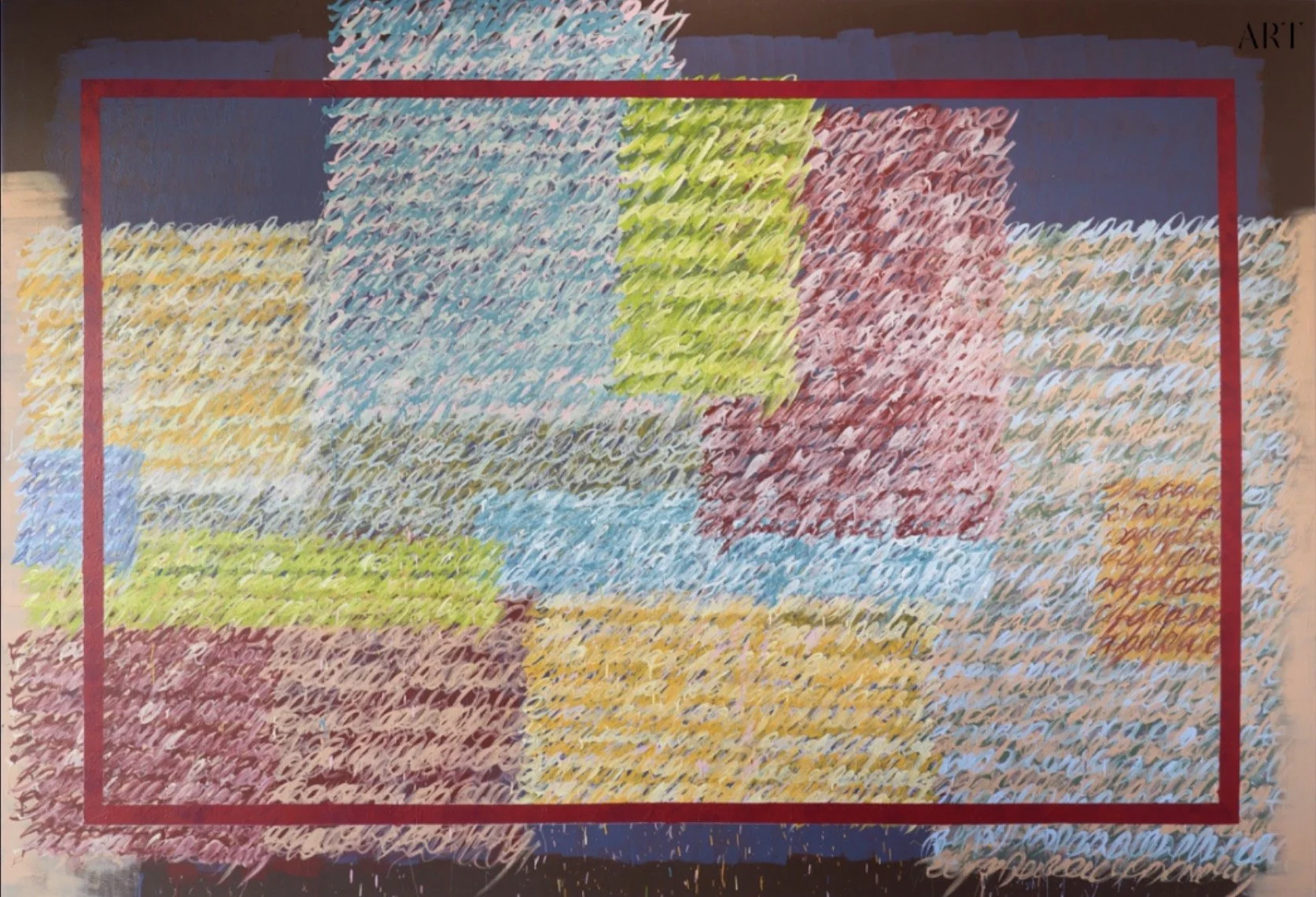
Private collection of sheikh Rashid of Ajman
OC: I'd rather you give me a hard time than an easy interview. When a viewer encounters an illegible language, are they interpreting the work, or encountering themselves?
JA: They try to interpret the work, but unintentionally, through their thoughts, they're encountering themselves. Whatever thoughts you have shape how you see the world, so how you see the painting is already fed by what's in your mind. I can only try to guide viewers. Ultimately, it's on them.
OC: Are you creating a language that has not yet been understood, or returning to one humanity has forgotten?
JA: Definitely the latter. Humanity has forgotten how to express emotion without words. People throw tantrums when they're sad; when they're overrun with joy, they jump and flap and scream. But there's a quiet, elegant way of expressing emotion that most people have forgotten. It doesn't have to be painting. It's the act of choosing to express your emotion through something that resonates with you. Elegantly and quietly — that's what's been forgotten.
I use the word "elegantly" intentionally. It's been my word since visual communication school. My second solo exhibition, at Alserkal Avenue, was about death, and it opened just as the Israeli–Palestinian conflict escalated after October 7th. I was so afraid to exhibit, but it had been planned for months. The Minister of Culture came — an elegant person himself, soft-spoken, quiet. He took his tour, shook my hand and said, "I have never encountered someone who has spoken about death as elegantly as you have." That was my intention, but I had never told anybody.
So elegance has become the driving vessel of my work: expressing what I want to express so that people understand it quietly, and interpret it however they wish, without it being brash. Some might call that weak. But I think getting a message across quietly is a lot stronger than getting it across loudly.
Quiet has served him well. For most of his life, though, it also came with a habit of holding back, and that is what he is now trying to break.
OC: Looking back at your younger self, and at how far you've come, what advice would you give him — and yourself, going forward?
JA: The same advice for both: trust yourself. As a child, I didn't trust my intuition or my decisions, because I was the youngest and most decisions were made for me. That created a kind of fear. Even exhibiting always made me uncomfortable. I always took the back seat. I think I was trained to take it, unintentionally.
Going forward, I tell myself: I got to this point by the grace of God, and because I trusted myself quietly while being trained to take the back seat. So if I take the driver's seat, what's going to happen? That's what I'm trying to do now.
OC: So what's next?
JA: Paris. I left my job. I reapplied to art school. I'm moving from Sharjah to Paris, taking on bigger projects, even if some won't go through. I'm trying new things, and trusting myself to let go, to let things move unconsciously. I don't know where I'll be next year. A year ago, I didn't know I'd be doing this. It all started on my 36th birthday, exactly four months and two days ago.
OC: A big transformation.
JA: I've told you this so many times, but I'm still excited.
That afternoon ended with the plates cleared and the light still on the water. In Abu Dhabi, visitors to Revelation walk past engraved glass towards the dark room at its centre, where nothing asks to be read. The man who made it is in Paris now, starting again in a city whose street signs he is still learning to read. He has done that before, more than once, as a child. This time he chose it.
BY OONA CHANEL
