

In his first magazine interview on All-American Performance (35:1), the Sharjah-based Venezuelan artist Eduardo Enrique talks about 351 black bat-crosses made in a winter factory he will not name, and about the opposites he keeps alive in himself. A reading in layers, from the lacquer down.
Editor's note. Eduardo Enrique's black bat-cross works have appeared in fair coverage and in a 2025 critical response to his SHANKAY presentation at Art Central Hong Kong. This feature makes no claim to first visibility. It is an exclusive long-form study of All-American Performance (35:1), with the artist's first magazine interview about the work.
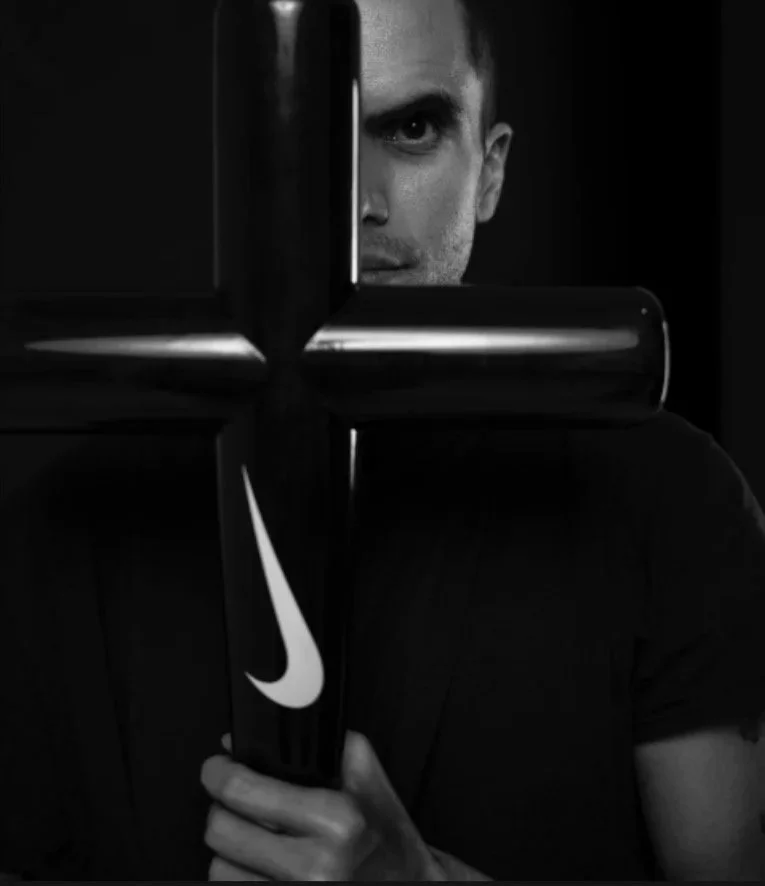
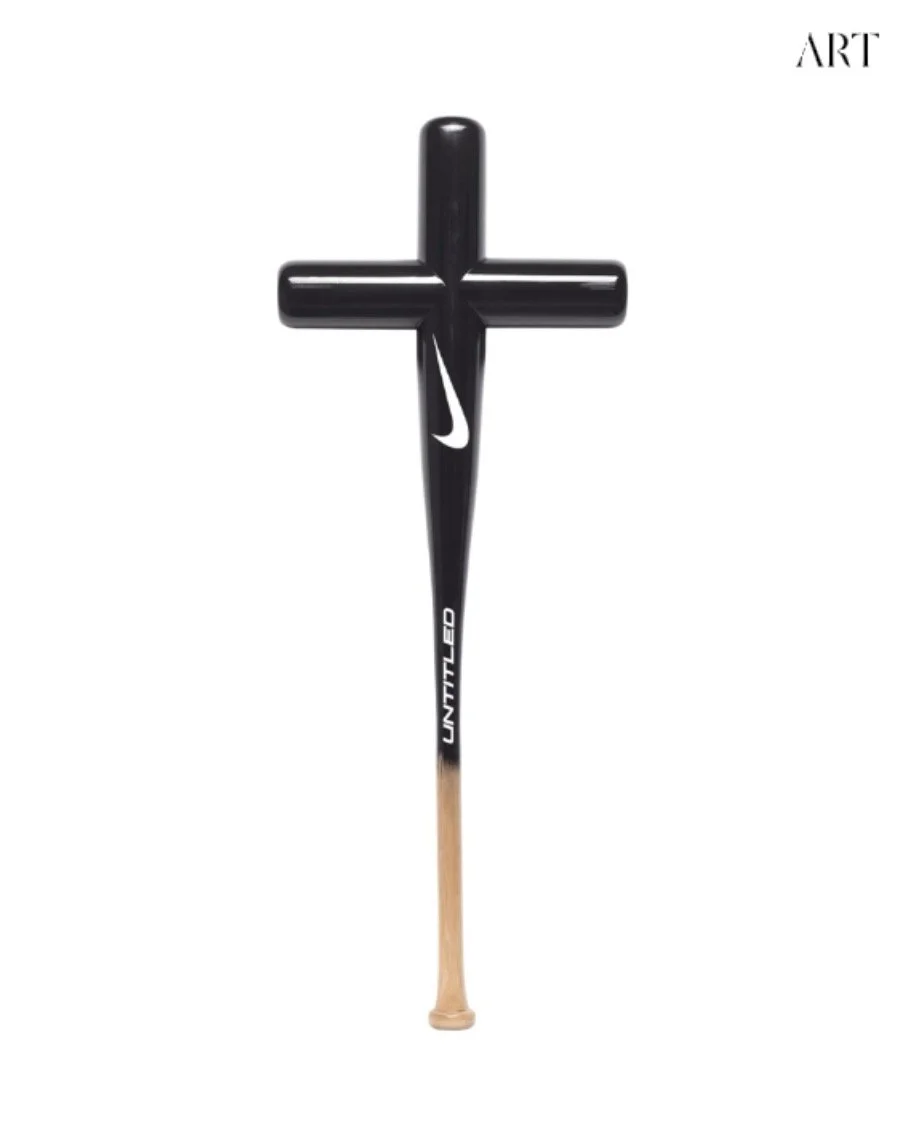
Every bat has a skin. On the 351 bats of Eduardo Enrique's All-American Performance (35:1), it is lacquer: a hard, clear coat over black paint, over a Nike swoosh set by hand against a laser guide, over birch turned on a lathe somewhere overseas, in winter, by people he has never met. You see the shine first. It was the last thing done to them, and it is the first thing they offer you. To understand the work, and the man who made it, you have to go down through it one layer at a time.
He would rather you didn't have to. "I completely reject the idea that you need any kind of context about me," he says. "The work is a lot more important than the artist." Artists say sentences like this to keep a door shut. Enrique says it, and then, across a long exchange, keeps opening the door anyway, a little wider each time, as if testing whether it will still close. That is the first thing worth knowing about him. He tends to want two opposite things at once, and he does not choose.
Start with the shine, because that is where he starts with you. When the installation was shown at SHANKAY's booth at Art Central Hong Kong in March 2025, the only time it has been installed, he arranged the bats so visitors could photograph themselves with them. "I thought it was a good idea," he says, "to turn it into a selfie moment." This from an artist who says the bat could have stayed an image, and who made it physical rather than join what he calls "this wave of image-making artists who use social media as a medium." He refused the feed, then built something for it. Ask what a collector must understand before living with the work, and he says it will "steal the attention from all of their other art." Ask what he hopes it makes impossible: "Not to own it." A limited edition of single bat-crosses sits beside the installation, a souvenir, he says, so people can "take a souvenir from that installation home." It sounds like a joke, and it has a serious version. "I believe we use objects as reminders of who we are and how we think." The surface of the work is desire, polished. He made it shine on purpose.
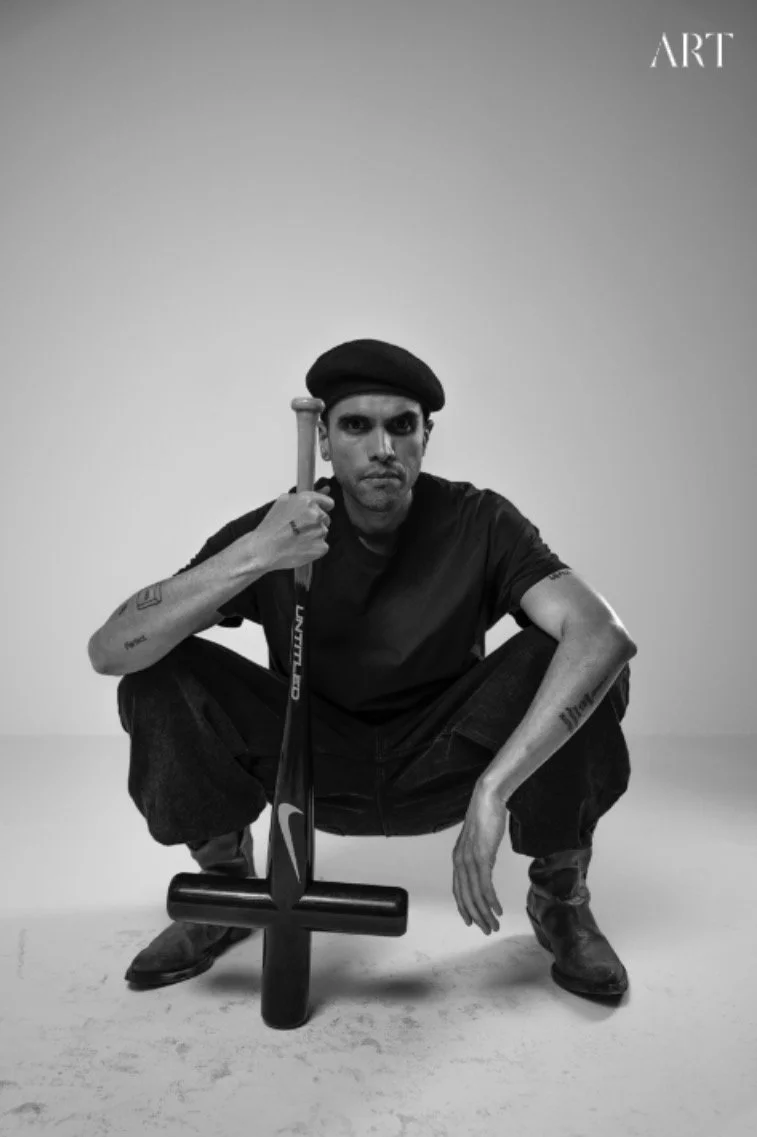
Under the lacquer is the logo. Every bat carries one, made, he says, "with the same exact precision." Enrique spent more than a decade in brand strategy before he made art about brands, and his best-known works take the swoosh apart: on leather, on golf balls, in the bondage boutique he once installed in Singapore. He has called it "a soft weapon." It is also, more or less, all he wears. I don't read that as hypocrisy, and I don't think he does either. Sport works the same way in him. He has never enjoyed competition, "never have," and as a boy he found sport "incredibly morally and psychologically abusive." He watches baseball. These contradictions are not lapses. They are how he gets close enough to a thing to know it: he stands on both sides of the coin, lets the pull and the disgust live in the same body, and lets neither win. The logo on the bats does the same. It is the critique and the thing critiqued, and from a few metres away you cannot tell which.
Under the logo, the black. "I've always rejected the idea of colour," he says, and he means more than the studio. "There is a very evident absence of colour in every aspect of my life." He isn't indifferent to colour. He is "incredibly sensitive" to it, and that is the problem: colour would hold him to one feeling. Black lets him "replace emotion with possibility." Offered three readings of it, a refusal of emotional instruction, a discipline of withholding, a place where meanings stay open, he chooses the second. Withholding. A funerary reading "gives me a smile in the brain." On the bats, the black does what he does. It covers the pale wood and every trace of the hands that turned it, and it makes 351 objects into one body, the way a uniform makes players into a team. Only the swoosh is allowed through. What the surface hides is the labour. What it lets show is the brand.
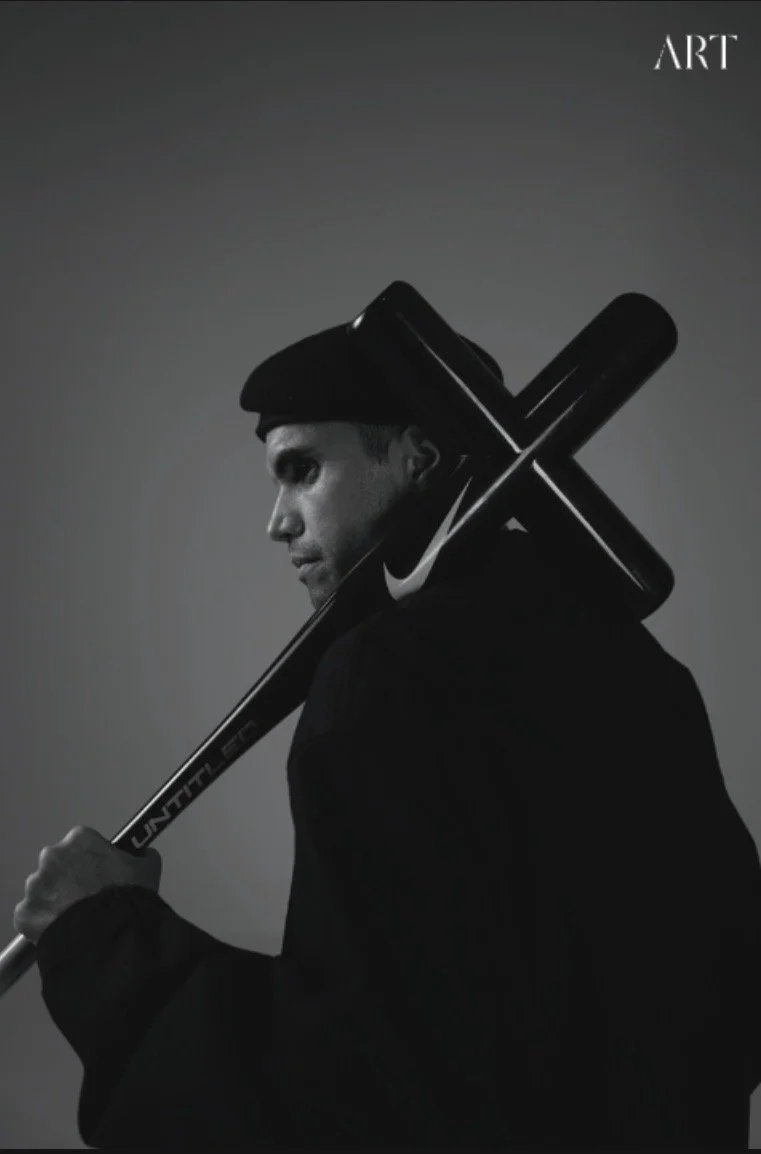
Under the black, the shape. "Some people might see this as a bat in the shape of a cross," he says. "I see a cross in the shape of a baseball bat." He begins from the symbol, never the material. "The cross represents something that is inherently violent. Christ died on the cross and then the cross became the symbol." Both are instruments. One was made for execution and became salvation. The other was made for competition and became escape.
Even the number came from the place where chance turns into faith. Enrique had imagined far more bats; 351 was simply what the factory finished before the deadline. Afterwards he opened a Bible, "just for fun," to make sense of the figure, and found it as a verse. Psalm 35:1, traditionally ascribed to David: "Plead my cause, O Lord, with them that strive with me: fight against them that fight against me." He calls it "quite violent," and "very, very appropriate." A quantity set by labour and cold is given its meaning afterwards by scripture, and the meaning is a prayer for God to take a side in a fight. Production decides; faith explains. He was raised Christian and still borrows from it, alongside "other religions and schools of thought." He says he has "nothing against Christianity," and that "controversy is not a tool of visibility for me." What he is doing is quieter, and harder to argue with. He is showing how belief gets assembled.
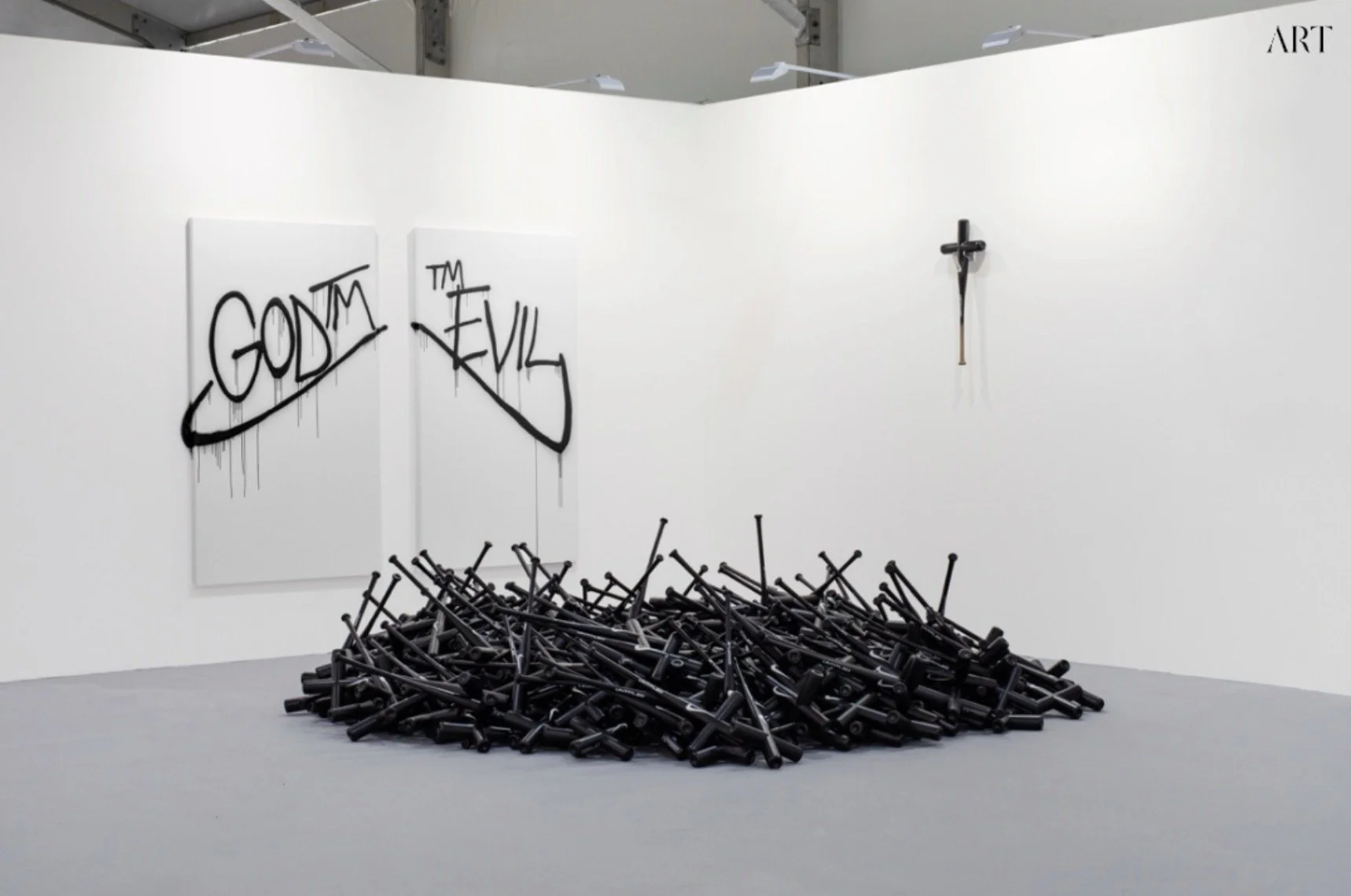
Baseball is where that belief became a body. Enrique left Venezuela for the Dominican Republic in 2007, and found that "even in the poorest slums, you could find a fully functioning, actively used baseball field." A family there can want a son in the major leagues even more than a son who becomes a lawyer. "It is part of the culture to have this aspiration for your male son," he says. "And it truly happens. It is a fact." He holds the word liberation close. "There is a myth that our colonial powers are still ahead of us and that they are superior to us. So any kind of connection to that does promise us a path of relief or salvation. And so does religion." He lists his country like evidence: the largest proven oil reserves in the world, a conquest that brought the church, and a name, Venezuela, "Little Venice," given by explorers sailing for Spain who saw houses built over water. "I see everything that is our culture as this incredible historical accident." Then he says a line that sounds like praise and isn't. Sports are "very important for society because they make us believe that it is civic and socially acceptable to exert dominance over others." He speaks about sport the way people speak about the faith they grew up in: exact about how it works, appalled by it, still fluent. "Culture can be a lot of pressure for a lot of people," he says, "and it's something that, just like religion, can be introduced to your life in a way that it's forced at a very unconscious level." Asked where his comparison between sport and war fails, he doesn't pause. "It doesn't fail. It succeeds in all of them."
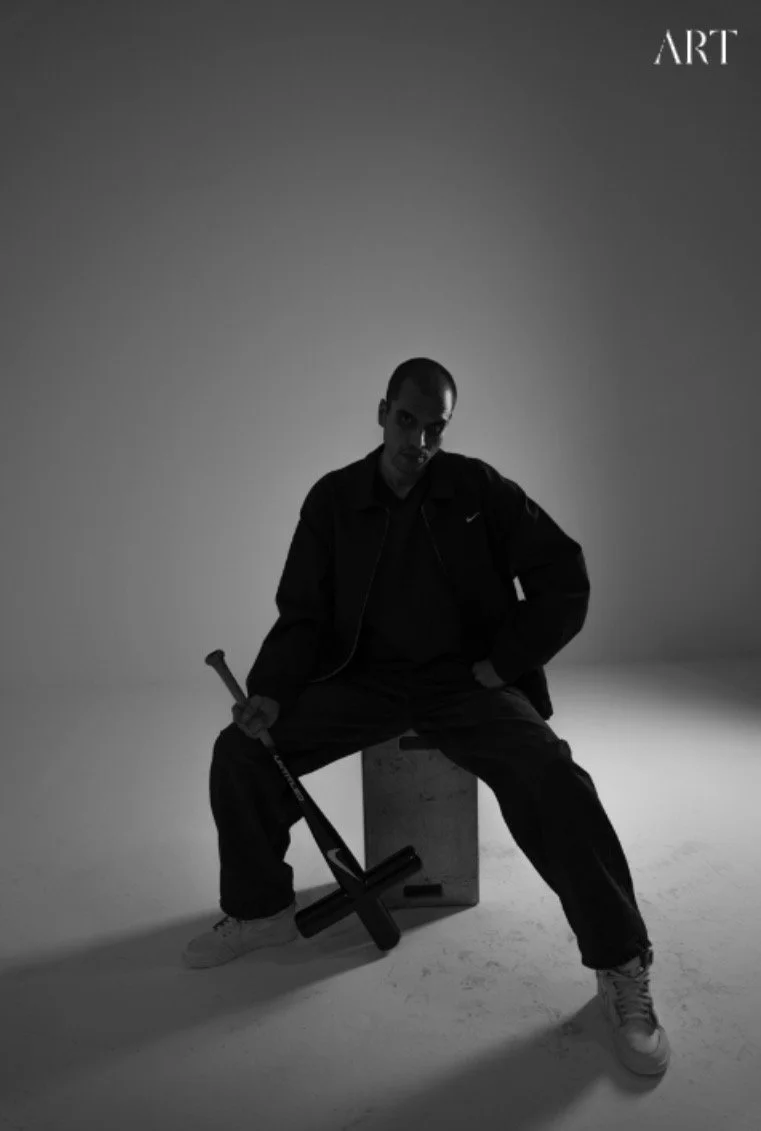
Under the shape, the wood, and the people who shaped it. For most of his career Enrique believed "the best work could not be made; it had to be found." For this piece he broke his own rule. It had to be made "in the same way that the brands I reference would make their products," which, he says, "involves labour that's paid a small fraction of the end cost of the product." He engaged an overseas factory that he will not name, because the workers "could get in trouble." He did not visit. He was not told how many people worked on the order, or for how long. What reached him were videos, sent "to show me that they were doing the best they could to meet the quality expectations of the project and to meet the deadline." "I saw many, many faces in the videos," he says. Of the conditions that winter: "You wouldn't want to be one of them." It is the most exposed thing he says, and he says it plainly. He knows those faces only as they appeared to him, on a screen, reassuring the client. Those videos were not reportage. They were pictures the supply chain made of itself. They do not resolve the contradiction. They make it visible.
Authorship had already loosened before the bats. When he couldn't travel to Hong Kong for the fair, the canvases for his booth were painted on site by another artist. The idea stayed his; the hand belonged to someone else. With the bats, the hands belong to people he cannot even name. "I don't associate craftsmanship with authorship," he says. Elsewhere: "The artist is just a contributor, and he will most likely remain anonymous." He means it as a principle about art. Here it is also a description.
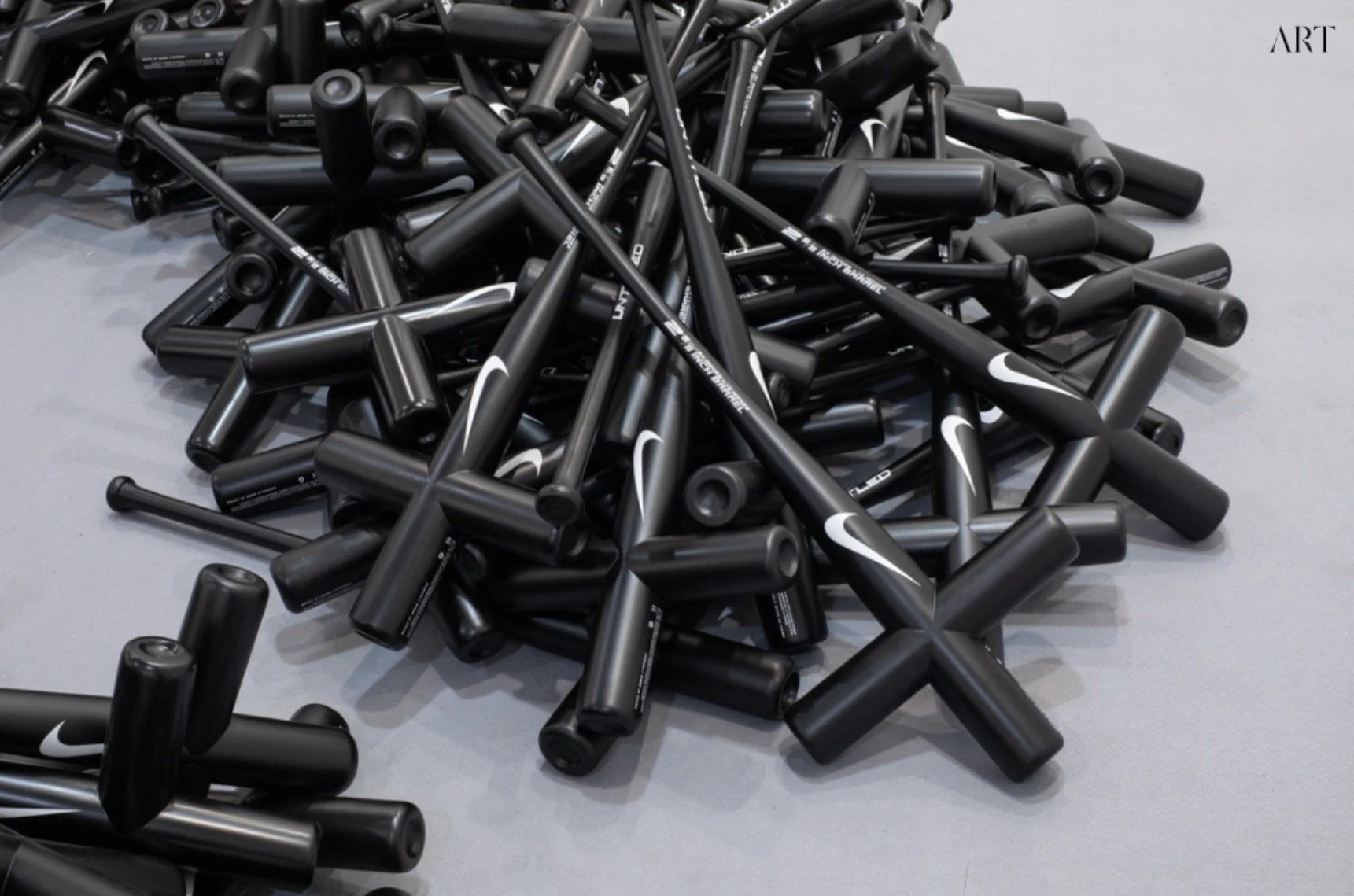
And under the wood, finally, the body. This is where he is most careful, and most raw. He won't let the bat be a weapon. "I think of a baseball bat as a baseball bat," he says. "I'm not doing a machine gun in the shape of a cross." But ask about violence itself and he doesn't keep it at a distance. "We all have the capacity for violence. We all have the capacity to feel threatened to a point where we take action to cause fatal harm to somebody." Then one word, alone: "Anybody." He doesn't put violence in the object, or the sport, or the church. He puts it in us. "Any ideology that you subscribe to will become a violent ideology because you carry violence inside, or you carry corruption inside, or you carry sorrow inside." Sorrow is the word that stays with me. He sets it beside violence as if they weigh the same, as if grief, carried long enough, also learns to swing.
Masculinity is something he has firm views on, and none of them are flattering. The traits a culture calls masculine are, in his words, "absolutely damaging to our society and collective well-being." What he hadn't considered was the bat itself as a masculine object. Violence isn't masculine to him; some of his fiercest references are female figures from ancient religions. Asked about the phallic reading, he reaches for the line about cigars so often credited to Freud: "Sometimes a bat is just a bat." Then he lets the reading in anyway. "It's a reading that I absolutely welcome." He once thought he would become a film director, when it felt easier to speak "through people and situations," and found it wasn't his medium. He speaks through objects now, which may be another way of letting things stand in for him.
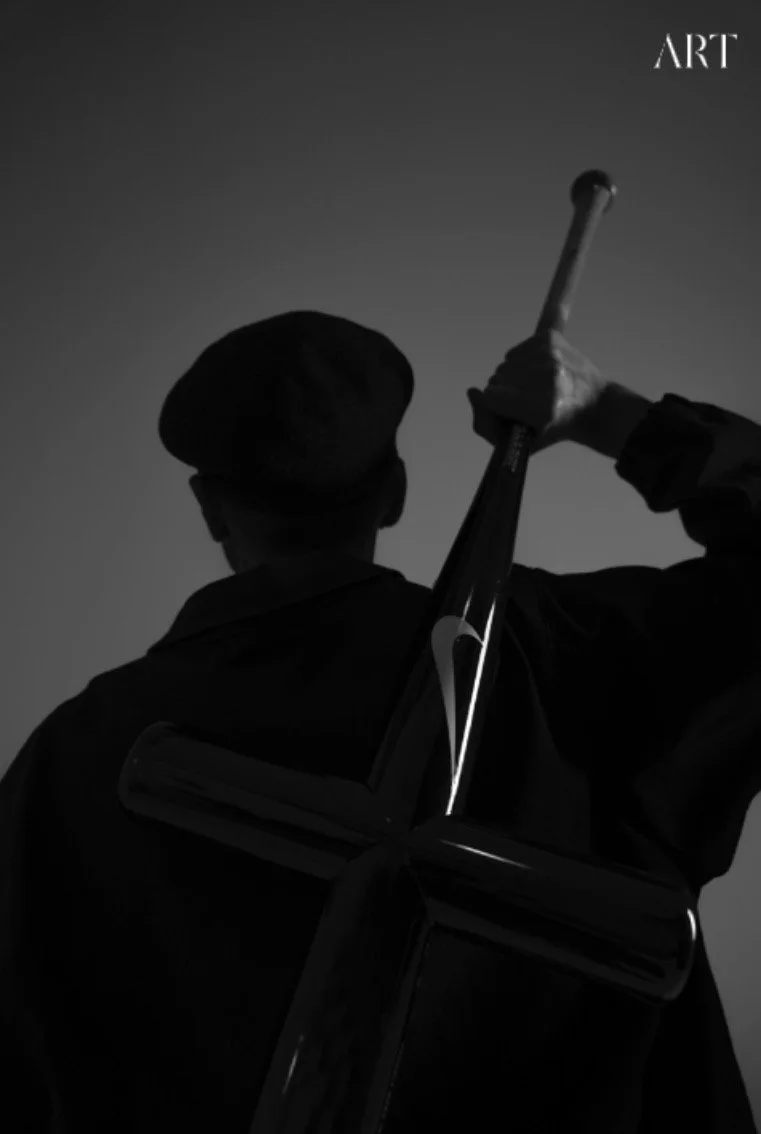
Sexuality enters the conversation the same way, without hesitation. He places it alongside justice and equality, as one of the arenas where he has always tested his ideas about power, "both from a personal and a collective level." In the Singapore installation, where he turned branded objects toward bondage, he was interested "in the idea of dominance and submission," with sexuality, he says, "a byproduct, or a medium, as opposed to a subject." He handles it the way he handles faith and sport: fluently, without apology, as a language for something larger. Dominance and submission are what the bats are about too, only dressed for the church and the ballpark instead of the bedroom. "Every work of art is a self-portrait from the artist in one way or another," he says, and then, with real candour: "The same way that I might not be able to see in me things that others see, I didn't create this work with that concept in mind."
So this is what lies underneath. A man with a few fixed points, which he names himself. "I've always had an issue with injustice. I've always had an issue with abuse of power. I've always had an issue with inequality." And around them, a life spent on both sides of the things he distrusts, sport and spectacle, faith and brand, close enough to feel their pull and name it. His refusals belong here too. What does the project add to contemporary sculpture? "Probably nothing." What remains unresolved? "Nothing." They are not coldness. They are the lacquer again: a former brand strategist declining to write his own brand story. "The only thing a work of art has to do," he says, "is to persist in time."
Walk back up through the layers and the work changes. The body, which carries violence and sorrow. The wood, shaped by hands he saw only on a screen. The cross that is a bat, the bat that is a way out. The black that withholds. The swoosh he wears. The shine he made for your phone. All-American Performance (35:1) does not resolve faith, sport, labour, migration and the market into one message. It lets their promises occupy the same ground, the way they occupy the same man. In that formation of black crosses, aspiration is no longer innocent. It has weight. It has provenance. It has a price.
This is not a work about whether people believe in sport, faith or brands. It is about what happens to a body when liberation is offered only through the systems that first taught it to obey.
Eduardo Enrique's bat-crosses will be on view at the 15th edition of Untitled Art, Miami Beach, Ocean Drive and 12th Street, December 2–6, 2026, with a VIP and Press Preview on December 1.
BY OONA CHANEL
PICTURES BY RON JOHN
