


I Don´t Like You Very Much”-Monica Bonvicini

Monica Bonvicini's exhibition for Kunsthaus Graz is centered on themes at the core of the artist’s research: an examination of architecture, literature, and the construction of sexual and gender identity. Following the show at OGR in Turin, the large-scale architectural sculpture "As Walls Keep Shifting" is presented in Graz in a state of complete but calculated disaster. Further works on view are the new neon work "Love Never Win" (2022), the video work "I See a White and Blue Building" (2020), the carpet installation "Breach of Décor" (2020), and the photo series "Italian Homes" (2019). The question of home, commodity, desire, and sex is continued in the new work "You to Me", treating elements of fetish as sculptural and performative objects that invite the public – within the institutional context of the museum – to live out the voyeurism that is intrinsic to all museum visits.
Photo Credits: GALERIE KRINZINGER


Marina Abramovic: Two Hearts
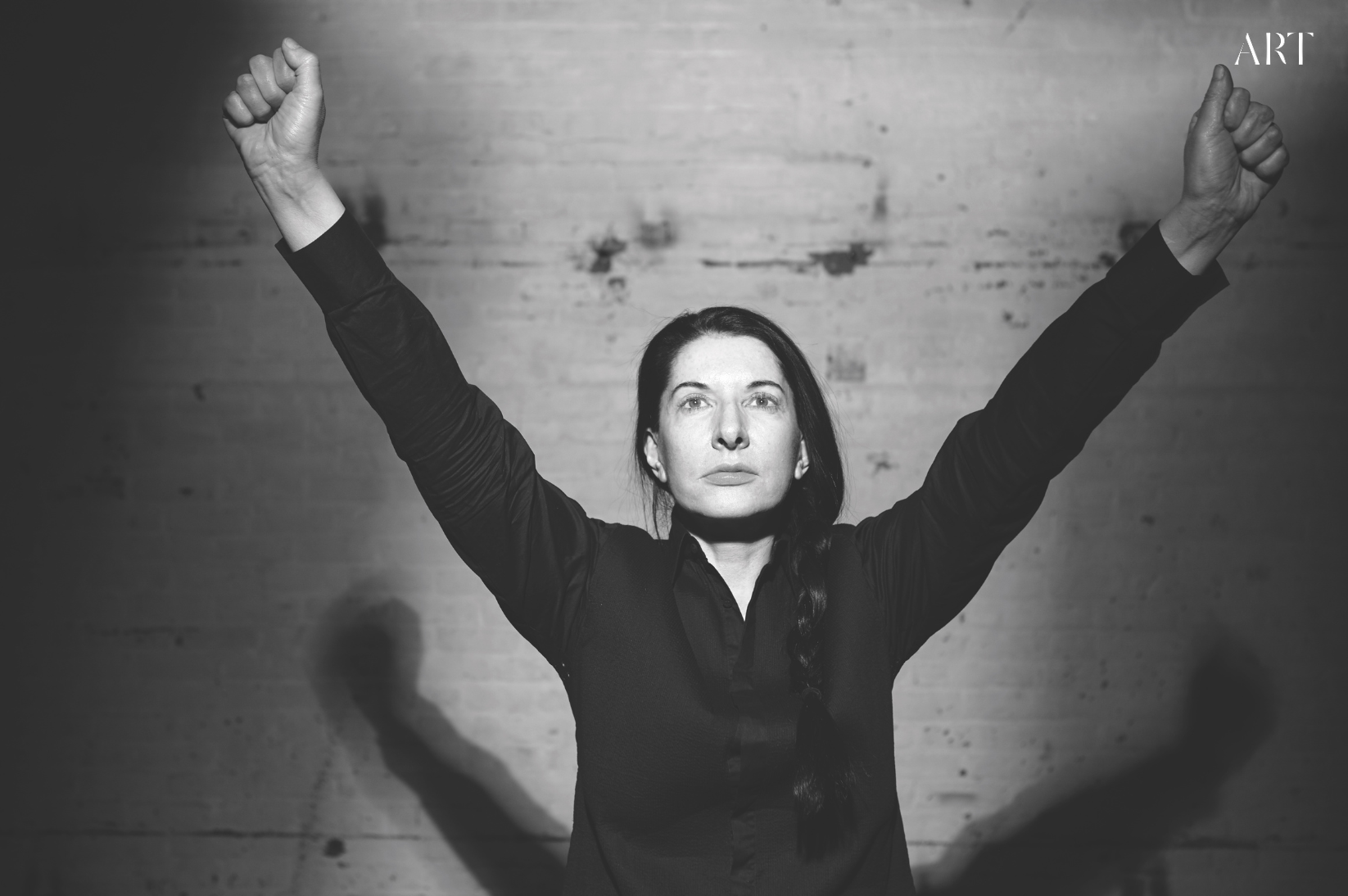
We present a series of images by Art´s most infamous provocateur

She may be the ‘godmother of performance art, but Marina Abramović is anything but a motherly figure, with her confronting works as controversial as they are conflicting. Her name is now synonymous with pushing one’s physical, mental, and psychological limits, the Serbian-born artist has courted her notoriety with ruthless performances that deal with trauma, sacrifice, death, obsession, free will, and fear, primarily sold to her directly through self-induced suffering, her best-known works leaving her own body scarred. In this extract from our extended feature in AUTHOR, we bring images from her retrospective exhibition, Two Hearts, which continues her dismemberment of society’s ideal of life and death, and the kind of morality that envelopes either state.


Text by MICHAELA WILLIAMS
Pictures courtesy of Marina Abramović, Archives, and Galerie Krinzinger

Portraits of an Urban Landscape: Daido Moriyama
It all begins with an idea.

AUTHOR TAKES A WANDER INTO THE GHOSTLY NEON-SOAKED IMAGINATION OF ONE OF THE WORLD’S MOST EVOCATIVE VISUAL ARTISTS
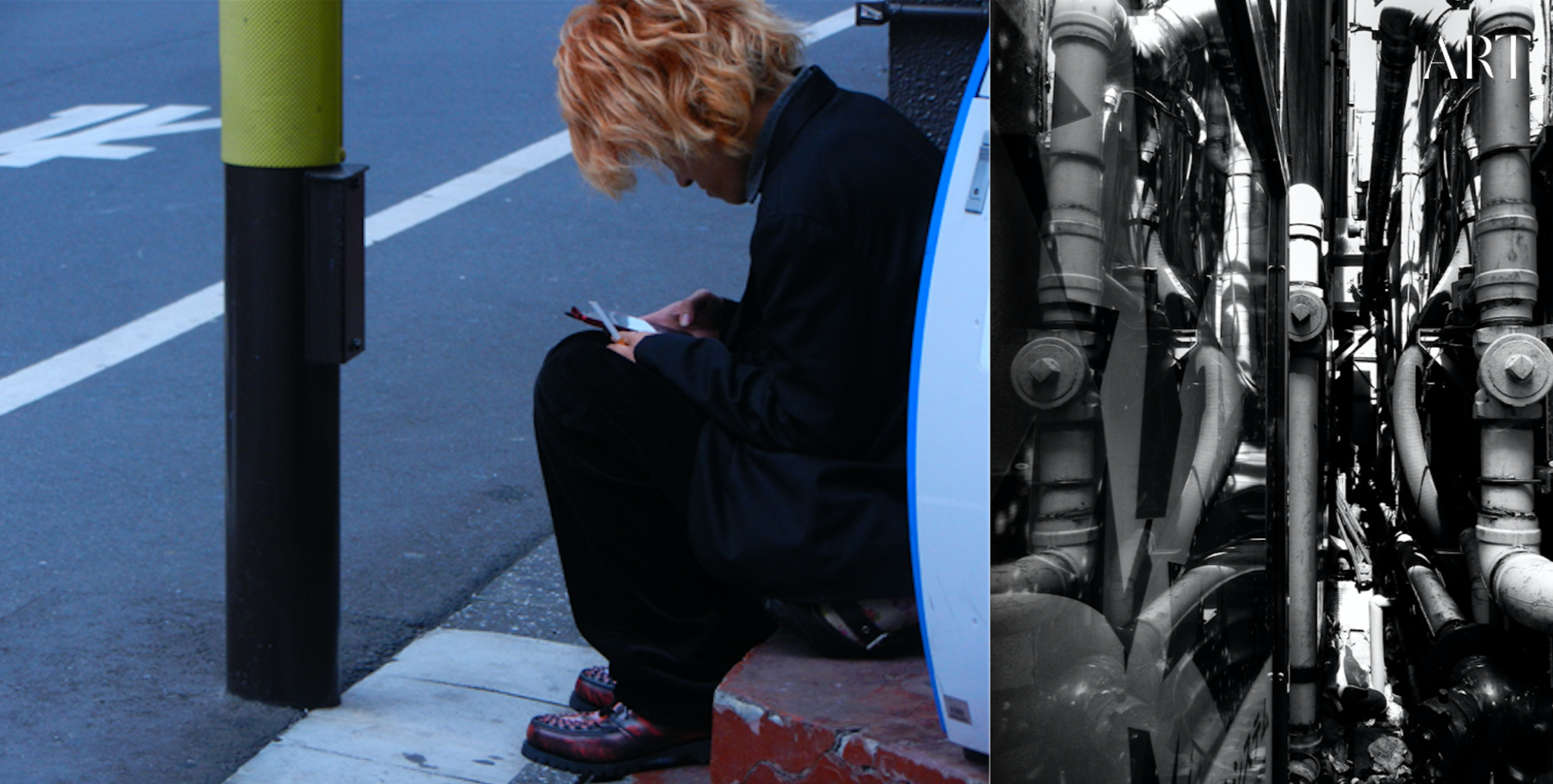
There is a poem entitled “Epilogue” in Les Fleurs Du Malby the decadent 18th-century French poet Baudelairethat ends with the line “courtesans and pimps, you often offer pleasures the vulgar mob will never understand”. It’s an ironic, anti-establishment sentiment that has a no better visual parallel in the 21st century than in the celebrated work of much-lauded Japanese photographer Daido Moriyama. In fact, it could be said of Moriyama that he is the Honoré Daumier of our era, capturing dispossessed outsider souls adrift in the all-enveloping urban sprawl of Tokyo through the open eye of his lens; asking us, by proxy, to stare into the neon-soaked gutter, between the cracks of capitalist artifice, to find something truly eternal; something pertaining to questions of dissolution, decadence and, ultimately, decay.

While some photographers intend to create a fantasy of reality, particularly in the vastly retouched spectrum of fashion photography, Moriyama reminds us that reality is itself simply a temporal fantasy of the individual – a smoke and mirrors dream machine of perceptive apparatus married to external stimuli over which we have little or no control. There is, as a direct result, nothing directional or explicit in a Moriyamaimage – he is not asking us to look at anything from a particular perspective, rather, he is inviting us to view reality in the flux of perpetually fleeting stasis, and he finds no better place to train his eye on humanity than upon the seediest and least celebrated of urban twilights.
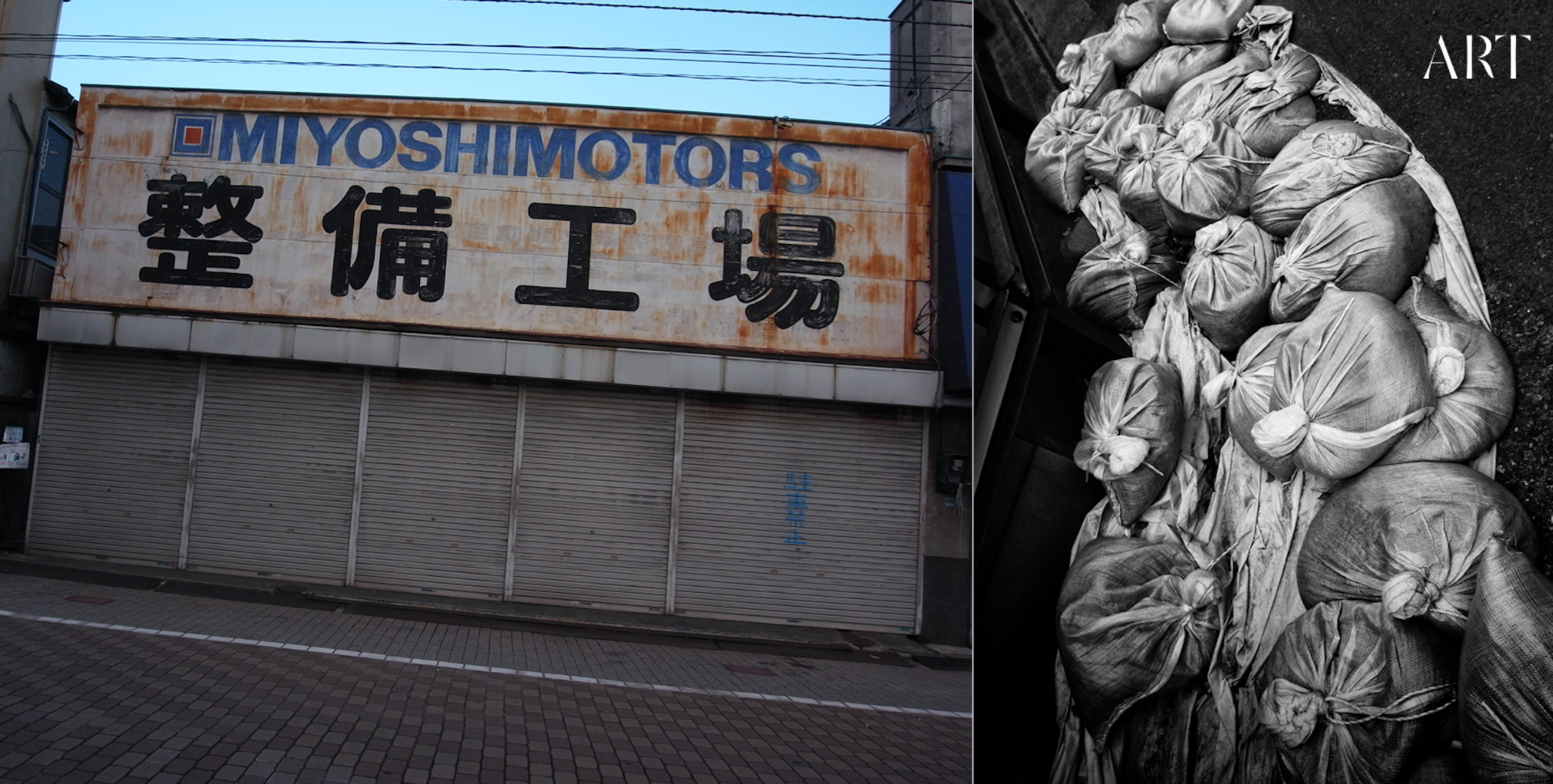
The exclusive images AUTHOR presents here were all shot in the strangely decadent Tokyo district of Shinjuku, and were among the first of his color works to ever be exhibited, debuting at The Fondation Cartier to enormous critical acclaim. While they are a graphic departure from his stark monochromatic style, they contain the same cinematic, haunting quality as his earlier works. Somewhat reminiscent of the classic dystopian science-fiction classic Blade Runner, they serve as a color-soaked reminder that the machinations of capitalist progress are moving exponentially faster than we can possibly fathom and that the resulting decadent squalor is a fascinating product of the machine. In a sense, then, they are photographs, not only of the present, but also of the future – matching urban decay with spiritual malaise, and pertaining to some deep anxiety we all share on a fundamental level, but shall never quite find the time to understand.


Text by: John-Paul Pryor
Pictures Courtesy of the Artist / Daido Moriyama Photo Foundation
Zhang Wei
It all begins with an idea.

The Colors of Emotions and The Emotions of Colors
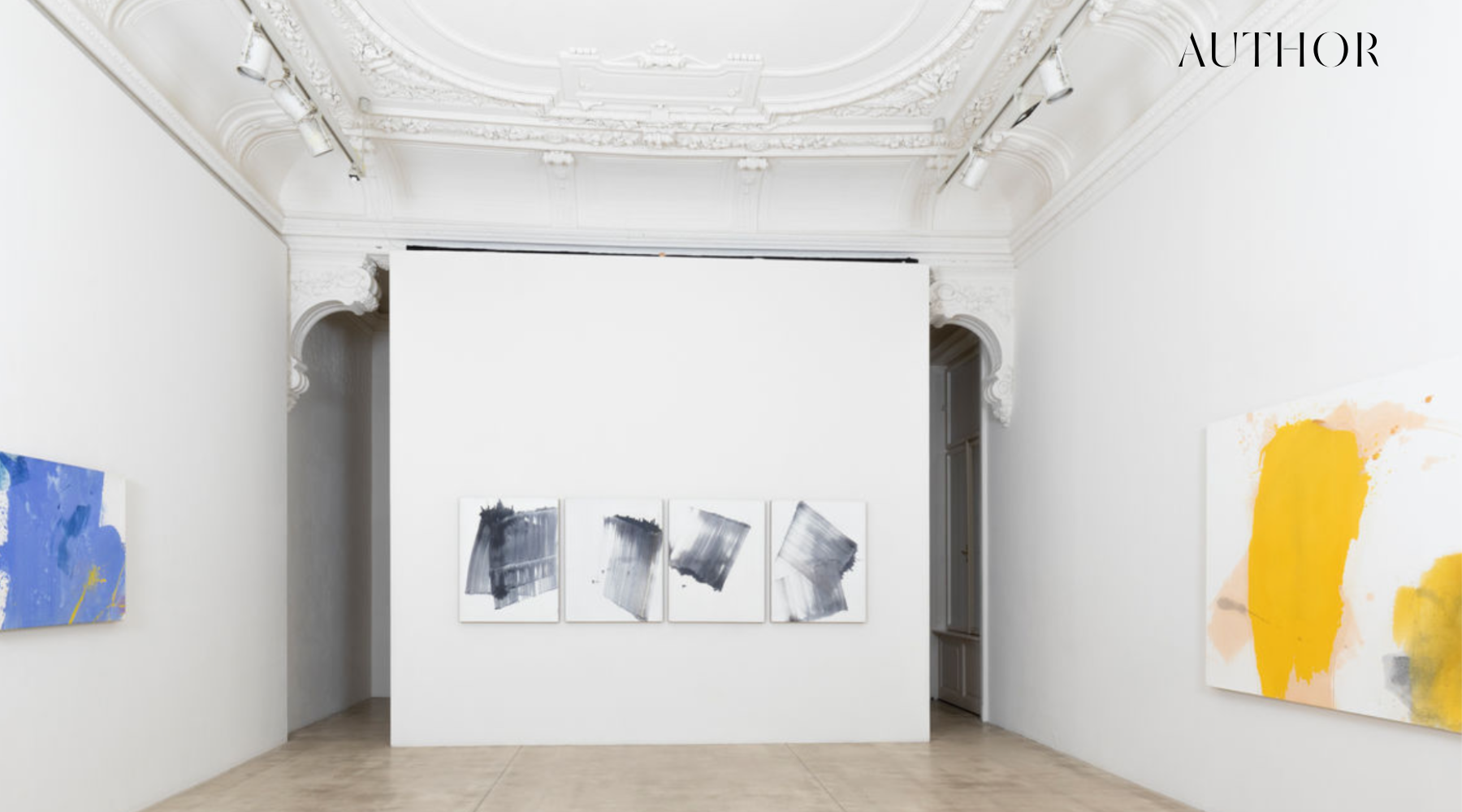
In Zhang Wei’s second solo presentation in Galerie Krinzinger, he is showcasing a selection of 20 works, made between 2016 and 2022. Among them, three were painted in 2022, all unmistakably pointing toward Russia’s invasion of Ukraine. Using the colors from Ukraine's national flag, Zhang Wei covered a large expanse of each canvas in blue. In the Ukrainian flag, blue denotes the skies over the vast land. On both of Zhang Wei’s canvases, the blue colors occupied nearly two-thirds of the canvas on the upper side, meticulously and evenly painted in most parts and hard-edged. In one of them, titled “Z-AC2202”, he painted a smear of yellow from the Ukrainian flag on the lower edge of the blue paint. Much of the blue area is solid while the yellow paint is solid on the upper half and sketchy on its lower part. In the second Ukraine-specific work “Z-AC2203”, the yellow color appears splashed onto the lower edge of the blue sky, much in disarray.
Such an approach brought to mind an experiment he carried out in the early 1980s. As he was exploring ways to steer away from figurative representation of the landscape paintings he was making in the 1970s, Zhang Wei once climbed on a ladder and from the point of about 4 meters high, he dropped a basin of paint onto the canvas so that the paint was splashed all over, not just on his canvas but inside of his room. The uncontrollable effect of this action was actually a desirable outcome and the pursuit of such an effect continues in his subsequent works. He looks for and enacts processes that lead to uncontainable manifestations. For instance, he has in recent years, tried painting with his motorbike. He’s poured a bucket of paint onto his canvas and ridden motorbikes over it, leaving tire marks on it. Sometimes, he runs toy cars across his canvas through a remote control. All efforts aspire for playfulness and dynamism in his works.
The third piece that reconfigures the Ukrainian flag is “Z-AC2204”, a rice paper book album painted in oil, interweaving blue strokes of blue with yellow ones, one intersecting another in a riotous and vigorous way. A familiar format in traditional Chinese paintings, the book album opens into a long stretch of the horizontal scroll that gives generous space for the unfolding of Zhang Wei’s playing with blue and yellow. While compact and quiet in a folded form, the album is an elaborate and dynamic symphony when it is opened up to reveal its many surprises and energy on the pages. Zhang Wei has also painted onto folded paper fans. Like the paper album, the curves of these folded surfaces dissect and intersect Zhang Wei’s strokes and enhance the dramatic sense of change in their flows.

Zhang Wei is forthright about his empathy with Ukraine and its people under war. Since its outbreak, the war in Ukraine has caused enormous rifts among members of both the Chinese public and its artistic and intellectual communities. Some were even hesitant to call it an invasion, aligning with the Chinese government’s pro-Russia position and rhetoric. Being an unwavering liberal, Zhang Wei has felt compelled to articulate his position on the matter through his paintings. This series of new works lends a valuable perspective into understanding Zhang Wei’s practice beyond that of purely formalistic exploration. The critical distance from any form of authority and hegemony underlines Zhang Wei’s artistic career, as well as his philosophy of life. As early as 1976 (or 1977), Zhang Wei took to heart a translated book, Jonathan Livingston Seagull, by American writer Richard Bach. In it, Bach wrote about a seagull flying high and free despite odds and mockery. This story showed Zhang Wei how to live and handle art in a free and personal way. Zhang Wei identified strongly with the courageous seagull in the perpetual quest for freedom and was unperturbed by any obstacle that comes along the way. This book was among the major influences on his way of living and working as an artist before he took the chance of participating in a show in New York to leave Beijing and live in the States in the following two decades from 1986 to 2005. There, he resisted the idea of following his gallerist’s advice to plan his artistic career and rather stood by the human spirit which he deemed far more important than becoming a successful artist.
This liberal and humanistic outlook towards life and art is a consistent and inherent aspect that upholds the tension and relevance of Zhang Wei’s artistic practice towards the varied social and political contexts that he’s lived through. He’s always engaged in some dialogue about the issues at hand. In the early 1970s, the choice of making Plein-en-air paintings and impressionistic landscapes distanced him from the dogma of socialist realist art of the time. At the beginning of the 1980s, his further dive into abstraction afforded him a space for self-expression and artistic freedom. In the wake of the Intellectual Liberation (Xixiang Jiefang) Campaign after the end of the Cultural Revolution, there was less control and more room for free thinking in Chinese society. It was then that older artists took the opportunity to champion stylistic diversity and formal exploration as an outlet for artistic autonomy. Younger artists in and out of art academies at the time pursued faithful figurative depictions of non-heroic characters, events, and aspects of everyday reality such as rural life, in defiance of the idealized rendering of subject matters in socialist realism. Zhang Wei and some of his like-minded artist friends such as Wang Luyan and Zhu Jinshi looked for freedom by painting in abstract forms.
In the 1970s, when Zhang Wei was making landscape paintings with members of the No Name Group, a loose group of Beijing-based artists who continuously and voluntarily painted impressionistic landscapes and still lifes instead of political propaganda throughout the Cultural Revolution, he had recognized that he didn’t care too much about details like what could be seen in realistic paintings. It was Zhao Wenliang, a core member of the group, who taught him to finish a work with some well-placed strokes, and just to leave space unpainted and open in a painting. In one of their many excursions of painting outdoors together, Zhang Wei was struggling with depicting the trees in his painting. Zhao Wenliang walked over and finished it in seconds. Zhao’s ability to summarize a subject matter into succinct and lively artistic expressions captured Zhang Wei’s fascination before he encountered the canon of abstract art as defined in Western art history. Only in 1981, when a show of American paintings opened in the National Museum in Beijing, Zhang Wei laid his eyes on some original paintings of major American abstract painters. When visiting the show, he was most amazed by Helen Frankenthaler’s big strokes in one color, Morris Louis’ paintings that looked washed with drippings, Franz Kline’s calligraphy-like black paintings, as well as Pollock’s stretched paintings. The last left a compelling impression. It looked as if it was done without thinking and full of nonstop actions, which is how Zhang Wei likes to work too, pressing on without interruption until he’s exhausted all his energy.
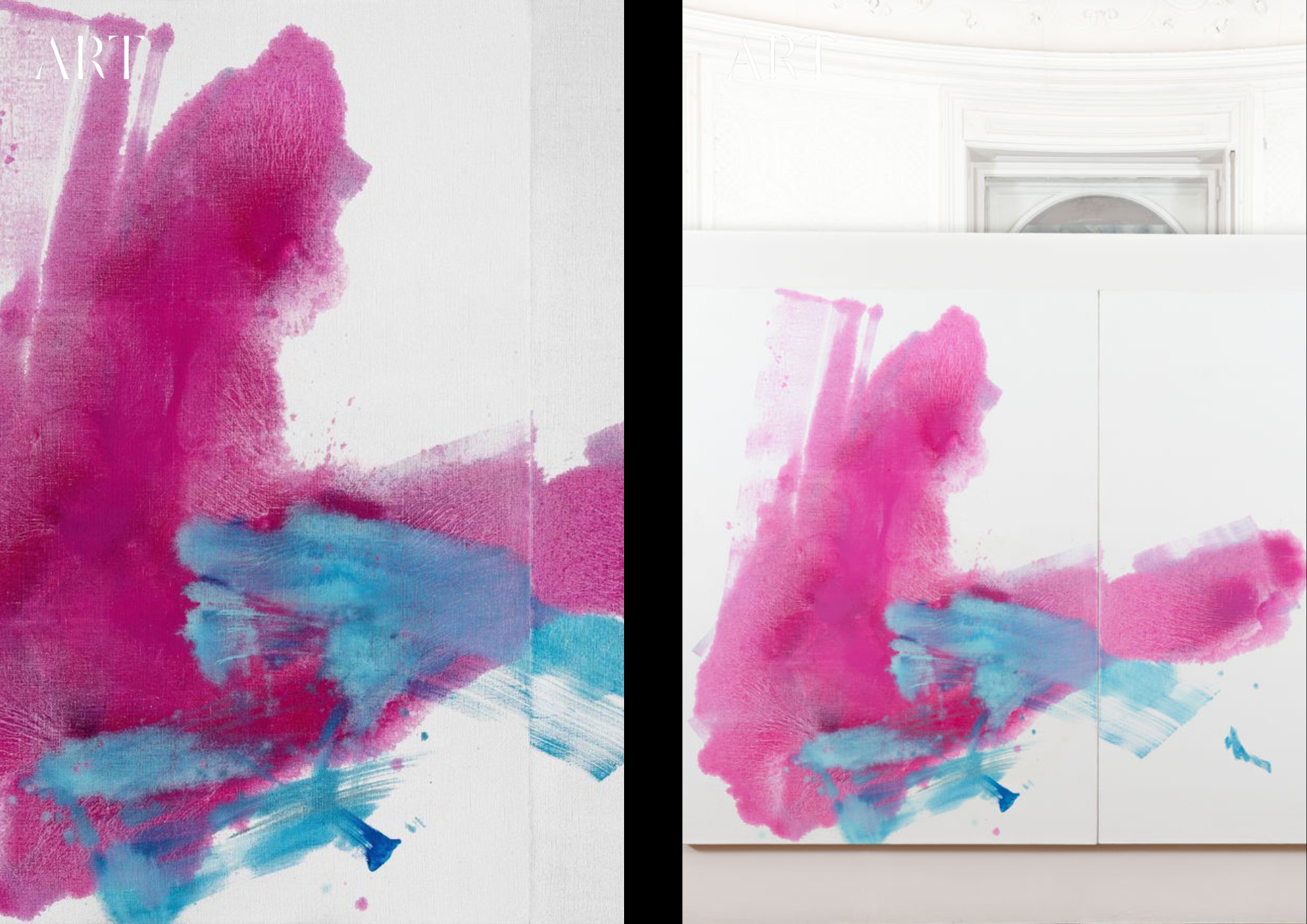
Such exposure aside, Zhang Wei actually attributed his awakening and approaches to abstraction to Chinese ink-wash painters such as Qi Baishi and Xu Wei, both celebrated for their artistic expressiveness. “My idea about freedom of painting was at the beginning based on Qi Baishi, on Xu Wei even. Xu Wei lived in the Ming Dynasty. When he painted running donkeys, it was crazy! He painted the legs and the hooves disconnected! It’s empty in between to show movement!”1 Such a realization that those so-called traditional figurative artists knew to leave something out was a memorable lesson for him. Such ingenious artistic precedents with their mastery of depiction through creating blankness convinced Zhang Wei that a painting doesn’t need to be “finished”.
Just as blankness on a canvas is expressive in emotion and meaning, so is color. Color is not a cover of something or a stylistic device, but the substance in itself. It contains expression as well as significance. Zhang Wei even equates color to people he likes and to himself: “I think color alone already carries a lot of things, especially your personality. In truth, it is about the choice of colors – which ones mean something to you, with which you are related to. It’s like a mirror: when I choose a color, it’s like I am choosing things in daily life. I talk to people, I am dealing with people; it’s like meeting someone, intuitively. I like the person, and if I’d like to see the person again I keep using the same color in another painting. To me, color is just myself.”
When learning to paint landscapes outdoors with senior members of the No Name Group such as Zhao Wenliang and Yang Yushu, Zhang Wei liked to put all kinds of colors on his painting boards. “Even on rainy, grey days, I put a lot of different colors together.”3 Unlike the grey and brown tones that populated the Soviet-influenced school of oil paintings from the 1950s, members of the No Name Group talked about the use of colors, especially the application of subtle and light tones, such as the inclusion of very light blue to lighten up a painting, which would otherwise appear dark and dull. Through these exercises and discussions, Zhang Wei found a way to liberate the beauty of colors from their fixed associations with political connotations. “So red was not just Chairman Mao’s color anymore, a red flag or the Red Book.” With all the colors on his board, he found the expression of a colorful world and life through them. Colors became free, and so did the artist, from dogmatic disciplines of painting as confined by ideological boundaries.
Zhang Wei’s fixation on color is also rooted in one of his early work experiences. From 1978, he worked as a stage designer for Kunqu, a 500-year-old school of Chinese opera that originated from Suzhou in Jiangsu Province in East China. There, he saw how the actors painted their faces in all kinds of colors, an abstract form that personified specific roles in the stories, with their distinctive temperaments, characters, and positions. With the application of color onto each actor’s face, the same face could carry very different personalities and meanings. He thus thought to himself, the way colors are painted carries meaning. “And if you exchange the face with a canvas, then it becomes an abstract painting!”

As such, making a painting for Zhang Wei is primarily about choosing a color first. “The first thing that comes out from my mind is color and I go with that; that color comes with a light touch on the canvas. With that color comes the shape at the same time. And then I naturally think about another color. And so the process goes on automatically without thinking.” Color determines the shapes he makes on a canvas, and leads to the choices of tools, and approaches he would take to realize a work. Color is thus not just a formal tool, but the starting point of everything and the expression of meanings and emotions. The group of 24 works in this exhibition conjures up a rich spectrum of not only the vibrant colors in Zhang Wei’s paintings but of his strokes and brushwork, relevant to the application of different colors. Sometimes, he uses broad strokes, sometimes, it’s slapping colors directly onto canvases. In any case, colors are both the embodiments of his emotions, as well as his positions in life.
In addition, this assembly of works bears witness to a period of time spanning before and after the outbreak of the COVID pandemic across the world. There is no question that the world has become a profoundly different place ever since. Yet the possibility that the works of Zhang Wei can travel beyond the national border and have a place to be seen by an audience far and beyond speaks volumes about the possibility of art transcending differences manufactured by national politics, set free to fly high, just as Jonathan the Seagull.
Zhang Wei was born in 1952 in Beijing, In 1986 he moved to New York and since 2005 he is living and working in Beijing again. Zhang Wei is deemed one of the first avant-garde abstract painters in China. He began his career in the 1970s as part of the underground artist group—Wuming (No Name). Zhang adhered to the group’s ideals in pursuit of an independent and unique artistic style apart from the politically ordained and thus established art forms at the time. In the early ’80s, impacted by the encounters with western Abstract Expressionism, Zhang unearthed a fresh perspective on his own artistic process, delving into the form of abstraction in order to engender a singular abstract language expressing the ineffable power of artistic freedom. Zhang’s paintings echo the instinctive immediacy of action painting and their “style-as-substance” approach alludes to a profound connection to traditional Chinese ink and calligraphy. The texture of his brushwork reveals a thorough modernity that stresses on the emotional significance of colors and the cathartic experience of both the creator and viewer of these works. Zhang’s works are collected globally including Art Institute of Chicago, M+ Museum (Hong Kong) and Stiftung zur Förderung zeitgenössischer Kunst, Germany.
His most important exhibitions include Salon Salon: Fine Art Practices from 1972 to 1982 in Profile – Focus China. Works from Collection Wemhöner, Mönchehaus Museum Goslar, Germany, 2021, Kunst in Weidinger, Germany, 2019, MA Beijing Perspective, Inside-Out Art Museum, Beijing, 2017, Secret Signs: Calligraphy in Chinese Contemporary Art, DeichtorHallen, Hamburg, Germany, 2014, Right is Wrong / Four Decades of Chinese Art from the M+ Sigg Collection, Bildmuseet Umeå University, Umeå, Sweden, 2014, Blooming in the Shadows: Unofficial Chinese Art, 1974-1985, China Institute Gallery, New York, USA, 2011.

Artist: Zhang Wei
Images courtesy of GALERIE KRINZINGER
Text by Carol Yinghua Lu

Double exposure - The Douglas Brothers
It all begins with an idea.

THE ICONIC PHOTOGRAPHY DUO INVITE YOU TO TAKE A LONG JOURNEY INTO THE SPACE BETWEEN DREAMS, TO RECOVER A LOST ARCHIVE OF THE SOUL

DIAGRAM OF DESIRE, Clerkenwell, London, 1993
There are certain images that seem to emanate directly from the shadowlands of the subconscious, those images of an opaque, surreal nature that remind us our daily existence is still nothing more than a kind of waking dream. It could, of course, be argued that this is the ultimate purpose of artistic endeavor of any kind, a process seeking to connect us with the deeper, intangible truth of being in an absurd, temporal universe that’s bookended only by a journey into darkness. In this paradigm, where meaning and purpose are inextricably linked to the creative drive to rage against the dying of the light, the Douglas Brothers stand apart. While their name is known mainly in industry circles, the brothers are considered
peerless as a photography duo, known for creating dreamlike excursions into the surreal landscape of identity that holds a significant candle to the iconic painterly deconstructions of geniuses, such as Salvador Dali, and Francis Bacon. If this sounds somewhat like hyperbole, you only need to look to an early interview in the early 90s Eye magazine, to understand that this journey into the subconscious was precisely their intention, the duo stated in no uncertain terms that their work was to be a reaction to the ‘pin-sharp, pristine and sterile photography’ pervasive in portraiture and fashion at that time: “We were pushing blur to see how far you could go, to see how little information the brain need to make a picture.”

ADRENALIN, Clerkenwell, London, 1992
It is no understatement to say that this undertaking of Andrew and Stuart Douglas made them responsible for some of the most iconic underground portraiture of the early-90s, capturing some of the most celebrated cultural provocateurs of their generation in the dark eye of their lens. Famously, they shot one of the very first, and most haunting, portraits of actor Daniel Day-Lewis. However, it is often remarked that the light that burns the brightest burns the shortest, and in regard to the Douglas Brothers it is an aphorism that rings true. Early into their promising career, the siblings fell out with near Shakespearean fervor, not speaking to each other for some 20 years. During this prolonged period of enmity, the brothers, almost wilfully, mislaid a huge body of work. It was the almost miraculous discovery of these long-lost prints in a discarded refuse container in London’s King’s Cross three years ago that finally brought them back together, subsequently witnessing the work be placed in the permanent collection at London’s National Portrait Gallery. The finding of a long-lost archive is, of course, a narrative with an epic sweep, but while the fourteen portraits that now hang in the National Portrait Gallery are important cultural artifacts, they were not the only works discovered in the chance excavation in King’s Cross. Among the haul recovered from the brink of destruction were also a number of deeply surreal works that exemplified the strange ruminations on being that resolutely underpin the ghostly portraits for which the brothers are now celebrated. On the following pages, AUTHOR is privileged to now present a number of those lesser-known gems, taking you on a journey into being and nothingness where gentle shadows churn through dreams, in the gold-edged veils of night.
CREDITS
by John-Paul Pryor

Alchemy as photography - PHILIP POCOCK
It all begins with an idea.

Infinite Emptiness Will Be All Around You, 1989
THE MASTER OF FLUID LIGHT AND MOLTEN METALS, PHILIP POCOCK HAS MADE THE CIBACHROME TECHNIQUE HIS OWN, WITH HIS PSYCHEDELICALLY SURREAL EXPOSURES AN ILLUSION COME TO LIFE. WRITING AS HIS OWN CRITIC, HERE HE HOLDS A MIRROR UP TO HIS ART

The Currents Will Carry Us Away, 1989
Philip Pocock has “untied photography from its initial mission to produce a mirror of recognisable objects. He produces photography as such, photography pure, opening it to new vistas in a brilliant interplay of forms and colors, each specimen granting hallucinatory journeys into the new. His imaginations prove the inexhaustible richness of mastered craft and conjured fantasy.”
– Prof. Dr. L. Fritz Gruber, Gruber Collection, Ludwig Museum, Cologne, Germany

The Ring to Sing, 1989
“This alchemy as photography works by Berlin-based Canadian artist Philip Pocock poses a timely question: Is hallucination a valid form of perception? Cyberspace author William Gibson thought so. He coined ‘cyberspace’ as a ‘consensual hallucination shared daily by millions. Also working as a digital artist, Pocock is aware of this virtual reality. Still his love of photography as material led him to experiment with the Swiss Cibachrome deluxe photographic material for its real silver shadows and patinas, and the purest, psychedelic clothing color dyes on the planet.
He produces phantasmic portraits of the photograph itself–a polished surface with a true sense of 3D; molecules of silver coagulating, interacting with the color pigments exploding in bursts, streaming, rivulets of chemicals etching out other hues and tones. The Cibachromes appear to possess both an atomic microscopic and dizzying astronomical scale. The photograph becomes a painting of a photograph in the act of becoming itself. No light, no optical image, Philip Pocock paints these works in full daylight.”
CREDITS
by PHILIP POCOCK
All images courtesy of Philip Pocock and INDA Gallery